

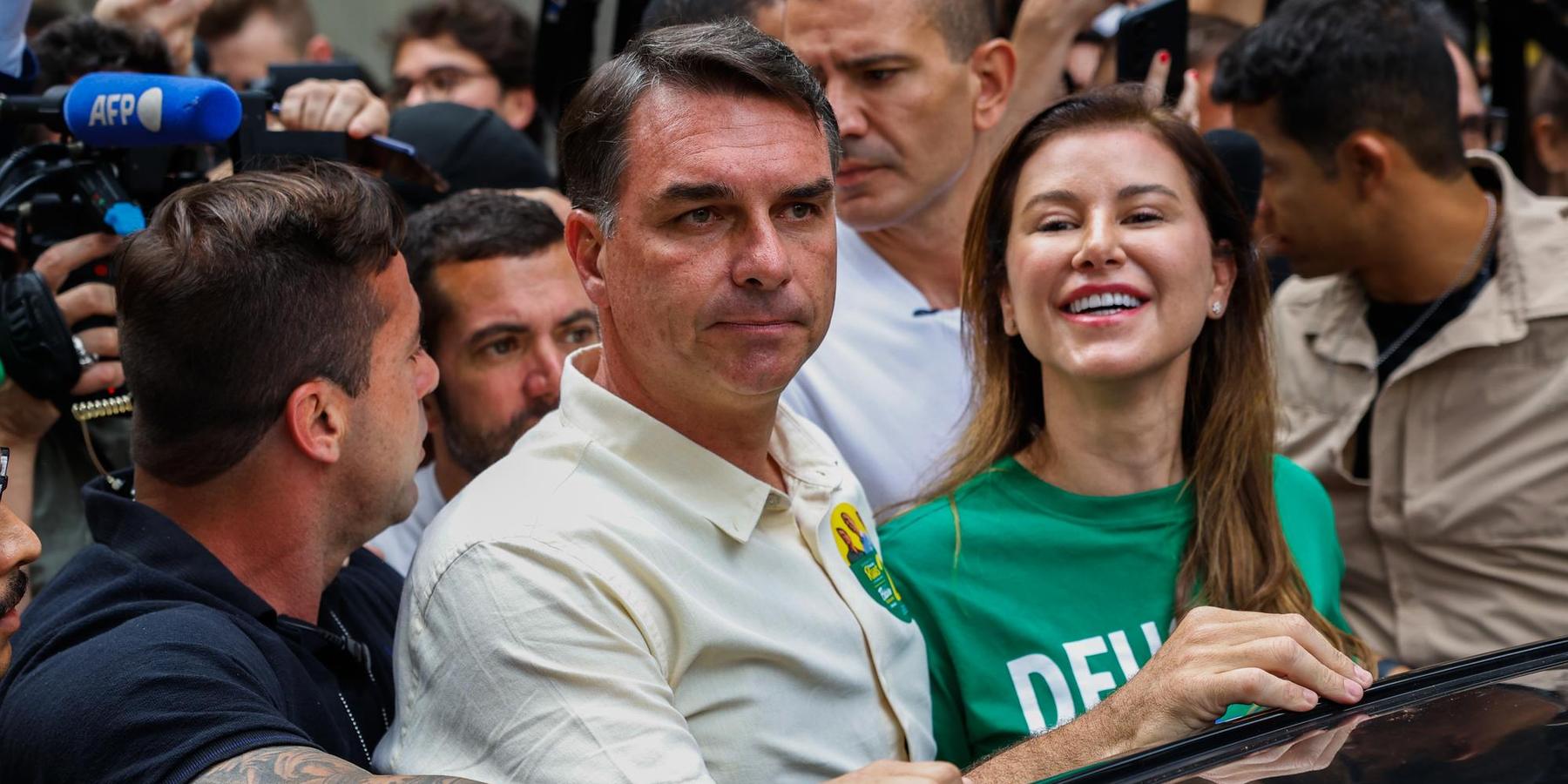
In the wake of Brazilian incumbent Luiz Inacio Lula Da Silva’s historic reelection, right-wing challenger Flávio Bolsonaro executed a daring — and likely CIA-assisted — escape to the bosom of Cuban-exile, neoconservative Miami, where he briefly proclaimed himself “president-elect” of Brazil.
Within hours of his loss, the younger Bolsonaro — son of former President Jair Bolsonaro (2019-2023) — was ordered to turn over his passport by controversial Supreme Court Justice Alexandre De Moraes. Reports suggest that the candidate and his family subsequently entered Argentina by land, whereupon they boarded a jet to Trump-aligned Ecuador before continuing on to Miami. Upon their arrival in Florida, Secretary of State Marco Rubio granted the family asylum, calling them victims of political persecution.
Bolsonaro then published a letter on Tuesday alleging fraud and declaring himself “president-elect of Brazil”; he likewise compared himself to Venezuelan opposition leaders Juan Guaidó and Maria Corina Machado. The statement itself was riddled with reportedly AI-generated errors, including an antiquated coat of arms bearing the pre-1967 inscription: “United States of Brazil.” Within the hour, Bolsonaro republished an amended, State Department-approved text describing himself as “leader of Brazil.”
Yet President Donald Trump, asked whether he recognized Flávio’s self-proclaimed victory, replied, “I won’t get involved.”
In effect, Bolsonarismo — like its equivalent in Venezuela — has placed its future in the hands of the Trump administration. As with Delcy Rodríguez in Venezuela, the question then is why the U.S. president has once again spurned a MAGA-friendly opposition in favor of a nominally left-wing incumbent.
Last August, the Trump administration imposed 50% tariffs on a host of Brazilian products on the grounds that the country violated the elder Bolsonaro’s human rights. (The former president was barred from seeking office and sentenced to prison time by Brazil’s Supreme Court over an attempted coup following his 2022 loss to Lula.)
The surprise trade war could not have come at a more opportune moment for Lula, the incumbent president, who was languishing with record low approval ratings that have since recovered. What’s more, the tariff broadside blindsided the Bolsonaros, who previously sent Jair’s youngest son, Eduardo, to Washington to lobby for sanctions — as opposed to broad tariffs — against the Brazilian government.
Defiant, the Lula government stood its ground and rallied Brazilians against the Bolsonaros and their foreign allies. Trade between Brazil and China skyrocketed, marking a spectacular own goal for Washington. Just three months later, Trump unilaterally dropped most tariffs on Brazil, with Lula citing “good chemistry” between the two leaders following a brief encounter at the U.N.
Why the sudden shift? Perhaps because Brazil has much to offer Washington. In the wake of the Trump administration’s 2025 trade war with China, Beijing successfully cowed its opponent by restricting U.S. imports of Chinese rare earths. Brazil, meanwhile, has the world’s second largest reserves of rare earths, making it a potential partner for lessening U.S. dependence on the Middle Kingdom.
Contrary to rhetoric in defense of Brazilian sovereignty, Lula and the governing Workers’ Party (PT) have more or less capitulated to Washington over rare earths. In April, American mining multinational USA Rare Earth announced the $2.8 billion purchase of Goias-based Serra Verde Group — at present, the owner of the only active rare earths mine in Brazil.
Lula could have conceivably annulled that deal but ultimately chose not to do so. He also backtracked on plans to create a state-owned rare earths company known as Terrabras; both moves are clearly aimed at placating both Washington and Brazil’s business elite. As it stands, the country has handed the entirety of its admittedly minimal rare earth production to an American company, though a recently-passed law governing rare earth extraction stipulates domestic processing and refining of pertinent minerals.
Lula, moreover, will face extraordinary domestic challenges in his fourth term. Bolsonaro’s Liberal Party (PL) won the most seats of any single political party in the Brazilian National Congress since the 1980s, with a record 121 deputies and 28 senators. All told, Bolsonaro allies will control 124 out of 513 and 32 out of 81 seats in both houses of Congress. In the event of a crisis, it’s likely that clientelist ‘centrist’ parties that control around a third of the legislature — known as the “Centrão” — could side with the opposition and remove the octogenarian Lula from office, as occurred with former PT president Dilma Rousseff (2011-2016).
Lula will also have to deal with the growing crisis of legitimacy facing Brazil’s Supreme Court. Justice Alexandre De Moraes has drawn significant backlash for allegedly exceeding his authority to persecute political opponents, mainly those affiliated with Bolsonarismo. Moraes sparked significant frustration in Lula’s camp for demanding that Flávio Bolsonaro surrender his passports within hours of losing the election; while Bolsonaro is credibly accused of serious crimes, the president’s team fears the timing has given the fugitive “a powerful justification for portraying himself as the victim of a witch hunt,” sources told Bloomberg.
Both Lula and Bolsonaro campaigned on reforming the court, with the latter promising to impeach Moraes. Lula would do well to make good on these promises in the form of a grand bargain with the opposition, particularly given that Moraes is due to assume control of the Supreme Court’s presidency in September 2027. A serious reform effort would go a long way toward securing Brazil’s institutional stability in the coming term.
As of this writing, four Bolsonaros are expected to join the next Congress, including Jair’s wife Michelle, brother Renato and sons Carlos and Jair Renan. Flavio’s exile has and will continue to stoke divisions on the Brazilian right over the movement’s future. PL leader Valdemar Costa Neto, evangelical pastor Silas Malafaia and popular São Paulo Governor Tarcísio de Freitas have since recognized Lula’s victory and distanced themselves from the fugitive Bolsonaro. Conservative voters, however, will likely continue to look to the Bolsonaros — Jair and Michelle most notably — for leadership.
Lula’s victory marks a likely end to the current wave of Trump-aligned right-wing governments in the Americas. With some exceptions, virtually all of the leaders of the so-called Shield of the Americas are spectacularly unpopular and are likely to stoke backlash in future elections.
The main challenge for Brazil’s octogenarian president will simply be getting to the end of his historic fourth term without being impeached; the president took one step in this direction already by committing to further market-friendly policies in order to appease irate investors.
The White House has no doubt calculated that their interests in Brazil are reasonably secure under Lula. In the meantime, Flavio Bolsonaro will have ample time to follow in the footsteps of Juan Guaidó in Miami.
- Trump's 'Shield of the Americas' is more fragile than it seems ›
- Despite Trump's 'shield' right-wing govts line up to congratulate Lula ›