
Follow us on social

google cta
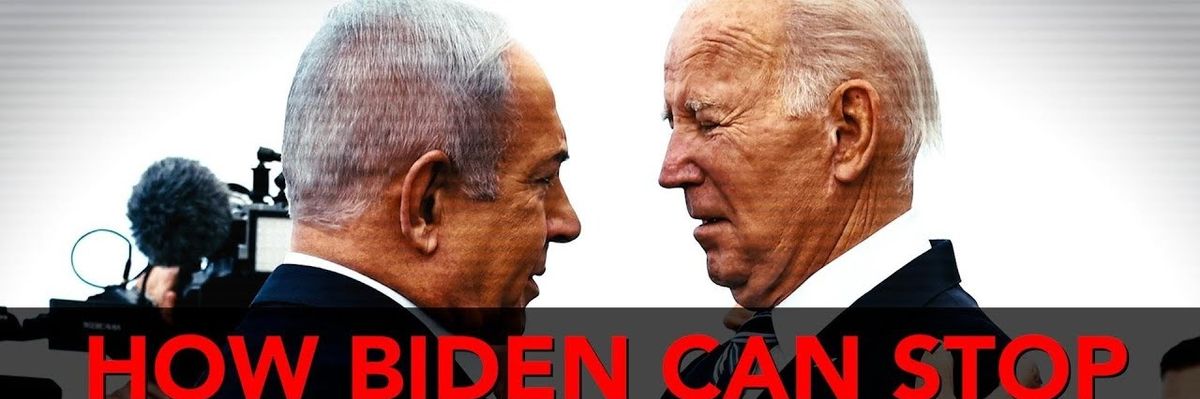
Biden has the leverage to stop the war in Israel

Biden has the leverage to stop the war in Israel

But it only works if he decides to use it. What is he waiting for?

Analysis | Video Section
google cta
google cta

Saying that the U.S. has the right to defend itself doesn't mean the United States must defer to Israel on all things, especially when it is harming American interests abroad. Washington officials say are concerned about protecting civilians amid ongoing Israeli military operations on the ground in Gaza, but these same officials continue to support $3.8 billion a year in military aid, plus more on the way.

Meanwhile, the war in Gaza increases the risk of the United States itself getting into a wider war. Biden's unwavering support is putting U.S. global standing at risk and harming its national security.

The president has the leverage to stop this. But leverage doesn't work unless you specify a cost or apply real pressure, a step the Biden administration has so far, been unwilling to take. Watch more below:


Dear RS readers: It has been an extraordinary year and our editing team has been working overtime to make sure that we are covering the current conflicts with quality, fresh analysis that doesn’t cleave to the mainstream orthodoxy or take official Washington and the commentariat at face value. Our staff reporters, experts, and outside writers offer top-notch, independent work, daily. Please consider making a tax-exempt, year-end contribution to Responsible Statecraftso that we can continue this quality coverage — which you will find nowhere else — into 2026. Happy Holidays!

How Biden Can End the War in Gaza
google cta
Analysis | Video Section
Bart De Wever
Top image credit: Belgian Prime Minister Bart De Wever holds a press conference after a summit of Heads of State and Government of the European Union (18-19 December), in Brussels, on Thursday 18 December 2025. BELGA PHOTO NICOLAS MAETERLINCK via REUTERS CONNECT

EU avoids risky precedent in Ukraine aid deal

Europe

The European Union’s leaders began their crucial summit on Thursday aimed at converging around the Commission’s proposal to use Russian funds frozen in Europe to guarantee a “reparations loan” to Ukraine. In the early hours on Friday, they opted instead to extend a loan of €90 billion backed only by the EU’s own budget. The attempt to leverage the Russian assets opened a breach within the EU that could not be overcome. As the meeting opened, seven members — Belgium, Italy, Hungary, Slovakia, Czechia, Bulgaria and Malta — had opposed the proposal. Germany, Poland, Sweden, Finland, Denmark and the three Baltic countries were its main supporters.

Proponents of the reparations loan — above all Commission president Ursula von der Leyen and German Chancellor Friedrich Merz — argued that approval would make the EU indispensable to any diplomatic settlement of the war in Ukraine. The EU as a whole recognized that Ukraine’s war effort and governmental operations require substantial new financing no later than the first quarter of 2026.

keep readingShow less
090127-f-7383p-001-scaled
MQ-9 Reaper Drone. Photo Credit: U.S. Air Force

Military contractors reap big profits in war-to-homeland pipeline

Military Industrial Complex

By leveraging the dual-use nature of many of their products, where defense technologies can be integrated into the commercial sector and vice versa, Pentagon contractors like Palantir, Skydio, and General Atomics have gained ground at home for surveillance technologies — especially drones — proliferating war-tested military tech within the domestic sphere.

keep readingShow less
Paradoxically, 'Donroe Doctrine' could put US interests at risk

Paradoxically, 'Donroe Doctrine' could put US interests at risk

Latin America

The Trump administration’s new National Security Strategy (NSS) not only spends significantly more space discussing and developing an approach to the Western Hemisphere than any recent administration, but it also elevates the Americas as the primary focus for the administration — a view U.S. Secretary of State and national security adviser Marco Rubio iterated shortly prior to his first international trip to Central America.

The NSS lays out a specific vision of how to approach the Americas described as “Enlist and Expand” — by “enlisting regional champions that can help create tolerable stability … [and] expand our network in the region… [while] (through various means) discourag[ing] their collaboration with others.”

keep readingShow less
google cta
Want more of our stories on Google?
Click here to make us a Preferred Source.

LATEST

QIOSK

Newsletter

Subscribe now to our weekly round-up and don't miss a beat with your favorite RS contributors and reporters, as well as staff analysis, opinion, and news promoting a positive, non-partisan vision of U.S. foreign policy.