
Follow us on social

google cta
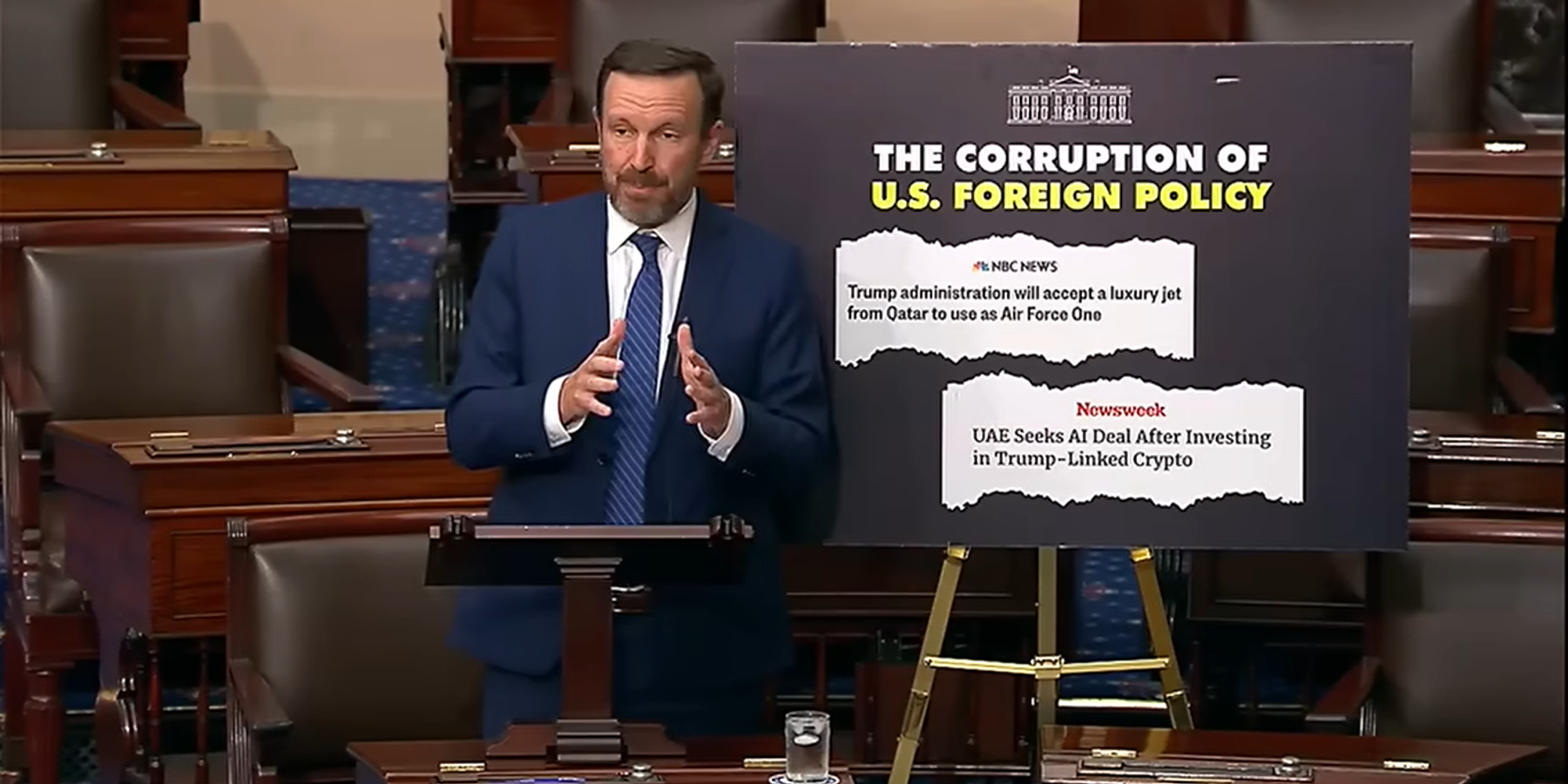
Senator Chris Murphy on Senate floor

UAE support to Sudan's RSF on Senate chopping block

The Democratic senators' resolutions would cut off the sale of weapons often provided to the paramilitary group

Reporting | QiOSK
google cta
google cta

UPDATE: S.J. Resolution 54 did not pass a vote in the Senate Wednesday, with 39 voting Yea and 56 voting Nay.

Democratic senators are targeting the United Arab Emirates’ (UAE) controversial support of the Rapid Support Forces (RSF) in Sudan’s civil war, through myriad resolutions also aiming to undermine what they call Trump’s use of “foreign policy [as] a machine to enrich himself.”

Senators Chris Murphy (D-Conn.), Tim Kaine, (D-Va.), Chris Van Hollen (D-Md.), Bernie Sanders (D.-Vt.) and Brian Schatz (D-Hawaii) aim to block weapons sales to the UAE with Joint Resolutions of Disapproval (JRD) S.J.Res.51, S.J.Res.52, and S.J.Res.54. The senators have forced a vote on Resolution 54, expected to take place as soon as later today.

Sen. Murphy has said the resolutions are an effort to block arms deals to countries he alleges “take part in Trump's corruption,” citing the UAE’s $2 billion investment in a Trump family crypto project. Another resolution introduced in tandem would block arms sales to Qatar, he said, over its recent move to give the U.S. a luxury jet, intended for use as Trump’s Air Force One.

But JRDs 51, 52, and 54 would also seek to undermine the UAE’s support of the RSF, a paramilitary group at the heart of Sudan’s raging civil war that began in 2023, which the Biden administration State Department asserted was committing genocide in January. Specifically, the resolutions would cut off sales of weapons to the UAE that could subsequently be provided to the group. To date, the war has killed over 150,000 people and left over 30 million in need of humanitarian aid.

“The UAE is the main supplier of weapons to the worst of the two parties that are involved in the brutal, catastrophic, deadly civil war in Sudan,” Murphy explained on the Senate floor on Monday. "They want the United States to keep giving them weapons, most recently asking for a resupply of Chinook helicopters, even as they use their military prowess to destroy Sudan."

The UAE insists on its neutrality in the war. But many investigations, including a U.N. panel linking the UAE to weapons found in Darfur, suggest the UAE’s supported RSF with weapons and other material support. Citing such support, 30+ humanitarian organizations voiced support for the JRD in a joint letter published Monday.

“Independent investigations by human rights organizations, journalists, and a UN panel have concluded that the United Arab Emirates has provided weapons and other support to the RSF…Much of that support violates the United Nations Security Council’s Darfur arms embargo in place since 2005,” the letter read. “Investigations by leading human rights organizations have additionally concluded that the RSF has engaged in widespread war crimes and other atrocities, including extensive sexual violence.”.

The letter continued, “Civilians in Sudan have endured unimaginable suffering in a war marked by extensive abuses, which have been fueled by flows of weapons into the country.”

“Congress has paid too little attention to the role of outside actors in fueling atrocities committed by the Rapid Support Forces,” John Ramming Chappell, advocacy and legal adviser at Center for Civilians in Conflict (CIVIC), told Responsible Statecraft. “Senators should take the chance to vote for this resolution and send a clear message to the Emirati government: stop arming the RSF, or face consequences for the US-UAE relationship.”

The resolutions are unlikely to pass.

Editor's note: The reporting has been clarified to reflect that JRDs 51 and 52 have yet to be brought to be voted upon.


Top Image credit: Murphy: Trump's Corruption Has No Precedent in American History -- Senator Chris Murphy [YouTube/Screenshot]
google cta
Reporting | QiOSK
Arlington cemetery
Top photo credit: Autumn time in Arlington National cemetery in Arlington County, Virginia, across the Potomac River from Washington DC. (Shutterstock/Orhan Cam)

America First? For DC swamp, it's always 'War First'

Military Industrial Complex

The Washington establishment’s long war against reality has led our country into one disastrous foreign intervention after another.

From Afghanistan to Iraq, Libya to Syria, and now potentially Venezuela, the formula is always the same. They tell us that a country is a threat to America, or more broadly, a threat to American democratic principles. Thus, they say the mission to topple a foreign government is a noble quest to protect security at home while spreading freedom and prosperity to foreign lands. The warmongers will even insist it’s not a choice, but that it’s imperative to wage war.

keep readingShow less
Trump Maduro Cheney
Top image credit: Brian Jason, StringerAL, Joseph Sohm via shutterstock.com

Dick Cheney's ghost has a playbook for war in Venezuela

Latin America

Former Vice President Richard Cheney, who died a few days ago at the age of 84, gave a speech to a convention of the Veterans of Foreign Wars in August 2002 in which the most noteworthy line was, “There is no doubt that Saddam Hussein now has weapons of mass destruction.”

The speech was essentially the kickoff of the intense campaign by the George W. Bush administration to sell a war in Iraq, which it would launch the following March. The campaign had to be intense, because it was selling a war of aggression — the first major offensive war that the United States would initiate in over a century. That war will forever be a major part of Cheney’s legacy.

keep readingShow less
Panama invasion 1989
Top photo credit: One of approximately 100 Panamanian demonstrators in favor of the Vatican handing over General Noriega to the US, waves a Panamanian and US flag. December 28, 1989 REUTERS/Zoraida Diaz

Invading Panama and deposing Noriega in 1989 was easy, right?

Latin America

On Dec. 20, 1989, the U.S. military launched “Operation Just Cause” in Panama. The target: dictator, drug trafficker, and former CIA informant Manuel Noriega.

Citing the protection of U.S. citizens living in Panama, the lack of democracy, and illegal drug flows, the George H.W. Bush administration said Noriega must go. Within days of the invasion, he was captured, bound up and sent back to the United States to face racketeering and drug trafficking charges. U.S. forces fought on in Panama for several weeks before mopping up the operation and handing the keys back to a new president, Noriega opposition leader Guillermo Endar, who international observers said had won the 1989 election that Noriega later annulled. He was sworn in with the help of U.S. forces hours after the invasion.

keep readingShow less
google cta
Want more of our stories on Google?
Click here to make us a Preferred Source.

LATEST

QIOSK

Newsletter

Subscribe now to our weekly round-up and don't miss a beat with your favorite RS contributors and reporters, as well as staff analysis, opinion, and news promoting a positive, non-partisan vision of U.S. foreign policy.