

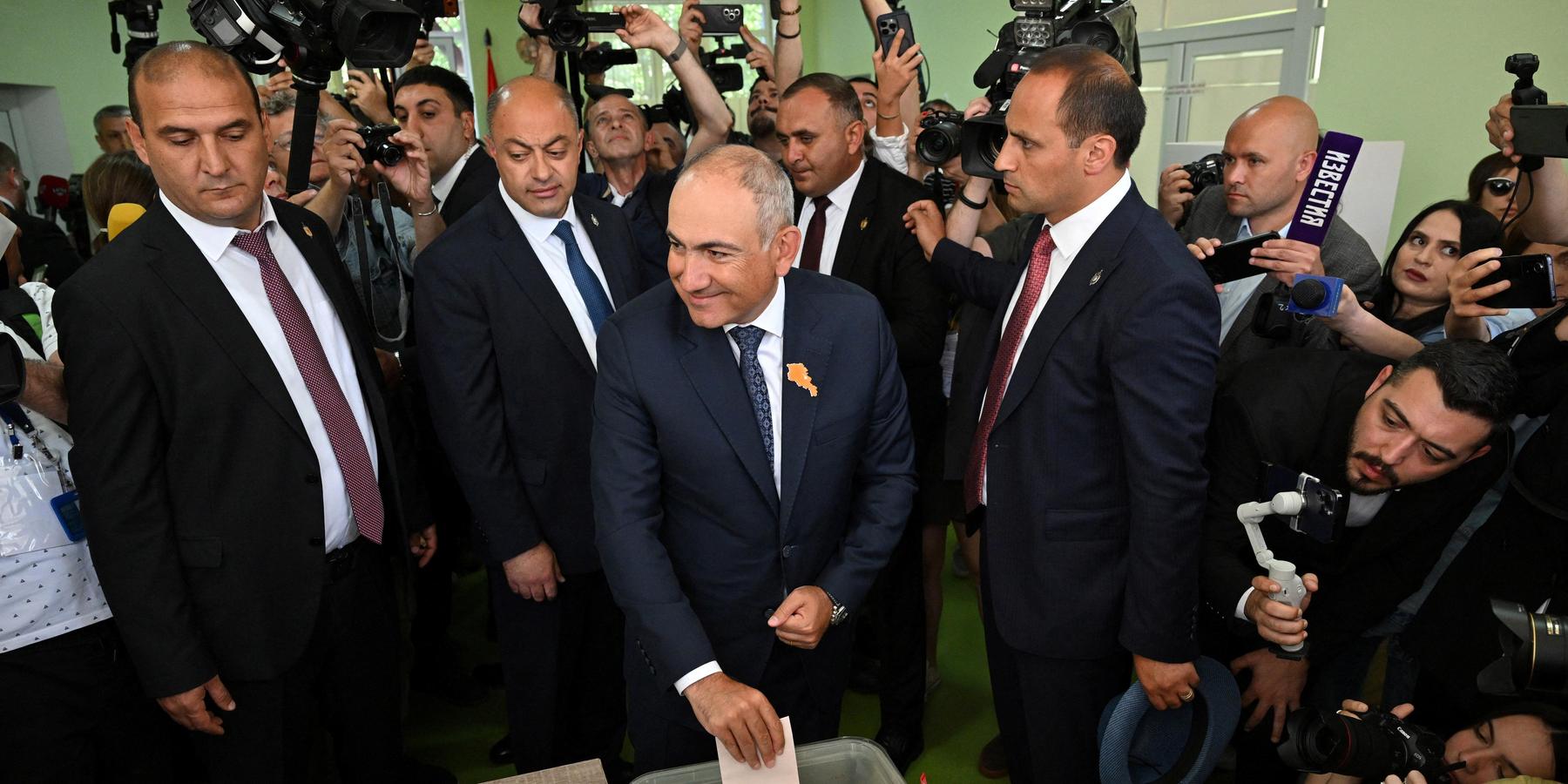
For a small, land-locked nation between the Black and Caspian Seas and surrounded by Iran, Russia, and Turkey, Armenia has had a bright spotlight shone on it the last couple of months. The reason? The country’s most consequential election since regaining independence 35 years ago.
Prime Minister Nikol Pashinyan’s Civil Contract party held onto its parliamentary majority, but remained shy of the two-thirds control needed to push through controversial constitutional reforms. The Strong Armenia and Armenia Alliance blocs will enter the National Assembly as the opposition after failing to unseat the ruling party.
Similarly to recent elections in Georgia in 2024 and Moldova in 2025, Armenia’s parliamentary vote attracted significant international attention from both the West and Russia. Much of this outside attention has simplistically characterized the election as a binary choice between pro-Russian opposition parties and the pro-Western Civil Contract. This binary approach, however, risks threatening Armenia’s future security and prosperity.
The reality is that Armenia’s interests would be far better served with the country acting as a bridge rather than a battleground.
From international reporters preparing dispatches on the ground and explicit endorsements by world leaders to Russian economic pressure and European efforts to counter foreign information manipulation and interference, Armenia’s parliamentary vote bore all the hallmarks of an election in the former Soviet Union amid the war in Ukraine. As that war rages on and tensions between Europe and Russia intensify, both sides are seeking to notch wins for themselves and deliver setbacks to the other.
For the countries in between, however, this demands a delicate balancing act, especially when sensitivities are heightened. One parade attendance here or one remark from a summit-goer there can shift the spotlight and add increased scrutiny and even tangible repercussions.
Following successive military defeats between 2020-23, principally over the formerly disputed Nagorno-Karabakh region of Azerbaijan, Armenia, under Pashinyan, began to pursue an overtly pro-Western pivot.
Armenians have a long history as part of the Russian Empire and then the Soviet Union, and more recently as a close ally of Moscow. While this arrangement undoubtedly came with its share of drawbacks, Armenia and Armenians did gain some benefits too, most notably in the economic realm.
Nevertheless, that historical connection began to fray following what Pashinyan and many Armenians perceived as Moscow’s abandonment during the 2020 Nagorno-Karabakh war, Azerbaijani incursions into Armenia proper, and Azerbaijan’s subsequent takeover of the entire region a few years later. Recent polling shows less Armenian affinity toward Russia and even growing fears of its northern neighbor.
Armenia’s geography, however, is inescapable. Russia remains its largest import and export market, offers important seasonal labor opportunities, and plays a key role as the country’s largest energy supplier, while providing other important stimulants for Armenia’s economy.
Another part of Pashinyan’s pivot has been pursuing peace negotiations with Azerbaijan and the normalization of relations with Turkey. While many in Armenia are concerned that success here requires concessions that are destructive to the soul of the Armenian nation, Pashinyan has sought to challenge this through his narrative of “Real Armenia.”
At once a political maneuver to explain away poor political and military decision-making by Yerevan and an attempt to reconfigure the Armenian national psyche, the project remains a polarizing topic for many Armenians in the country, and especially in the diaspora. If successful, however, it would allow Armenia to open two of its shut borders and officially close a war-torn chapter in the young republic’s history, thus increasing trade and investment opportunities that may lead to greater future prosperity.
Over the last few years, Azerbaijan and Turkey have successfully increased their positions in the South Caucasus at the expense of Russia and, to a lesser extent, Iran. The U.S. and European Union now seek to capitalize on these successful inroads and push developments further.
In Washington, D.C., last August, U.S. President Donald Trump convened Pashinyan and Azerbaijani President Ilham Aliyev for an historic summit. Yerevan and Baku made symbolic progress on their peace agreement while, most significantly, agreeing to the Trump Route for International Peace and Prosperity (TRIPP).
The American-sponsored project will build transit infrastructure for goods, natural resources, and people through a strip of southern Armenia connecting Azerbaijan with its Nakhchevan exclave. The route — which first made headlines in the Russian-brokered ceasefire statement that ended the 2020 war — is expected to become a key transit route connecting the energy and mineral riches of Central Asia and the Caspian basin to Turkey, Europe, and other international markets.
TRIPP has had a significant effect on future perceptions of the South Caucasus and the region’s geopolitical orientation. The Trump administration, to its credit, has largely avoided framing the project along the Iranian border and in Russia’s so-called near-abroad as a strategic move targeted against either Tehran or Moscow.
An important component of TRIPP, and the future prosperity and security of Armenia and the other former Soviet states between Russia and NATO, will be shrewd diplomacy by Washington. It will require the U.S. to advance its interests without stoking negative reactions from regional actors, chief among them Russia. As leading Russia hand Thomas Graham has described, the U.S. ought to challenge Russia’s position without appearing to do so.
There are numerous ways the U.S. (and even its European allies) can pursue such a policy. When it comes to TRIPP, Washington would be wise to engage the Russians diplomatically and keep them informed of their objectives while assuaging Moscow’s greatest insecurities. A more challenging approach, but one worth pursuing, would involve exploring opportunities for limited Russian involvement in elements of TRIPP where Russia could be helpful without becoming domineering.
While negotiations over Ukraine inch forward, the last thing the U.S. should want is to provoke Moscow’s fervor elsewhere, lest Washington’s regional policy triangulate the interests of Russia, Iran, and China in undermining or sabotaging TRIPP.
While Pashinyan and his ruling party speak of an EU future, the truth is that membership is a far way off. In the here and now, pursuing practical economic relations in all directions is in Armenia’s best interest.
Russia’s reactions to Armenia’s steps — both symbolic and practical — toward the EU have been extreme and counterproductive. Managing this tightrope act is no easy task for Yerevan. It’s especially challenging as the country faces domestic and international pressure and the ever-looming threat of renewed regional instability.
The next five years will prove far-reaching in terms of Armenia’s future trajectory. The continuing influence of exogenous factors, alongside domestic dynamics, makes this trajectory all but impossible to predict.
Nevertheless, the broad outlines of a successful international policy can be surmised: peace and normalization with Azerbaijan and Turkey; the opening of regional borders and greater interconnectivity; continuing diversification of diplomatic, defense, economic, and cultural ties; strengthening democratic institutions; deepening links with the EU without subscribing to self-sabotaging foreign and security policies; maintaining political and economic engagement with Russia while standing firmly for a multi-directional international strategy; and continuing to advance mutually beneficial projects with the U.S.
In an era of increasing competition across Eurasia, there are no guarantees of freedom or fortune. Pursuing a policy that makes Armenia a bridge rather than a battleground, however, would be a pretty wise bet — and not only for Yerevan. With elections over and Pashinyan’s mandate secured, the time is now ripe for all international stakeholders to pursue a more balanced approach to ensuring stability and prosperity across the South Caucasus.