

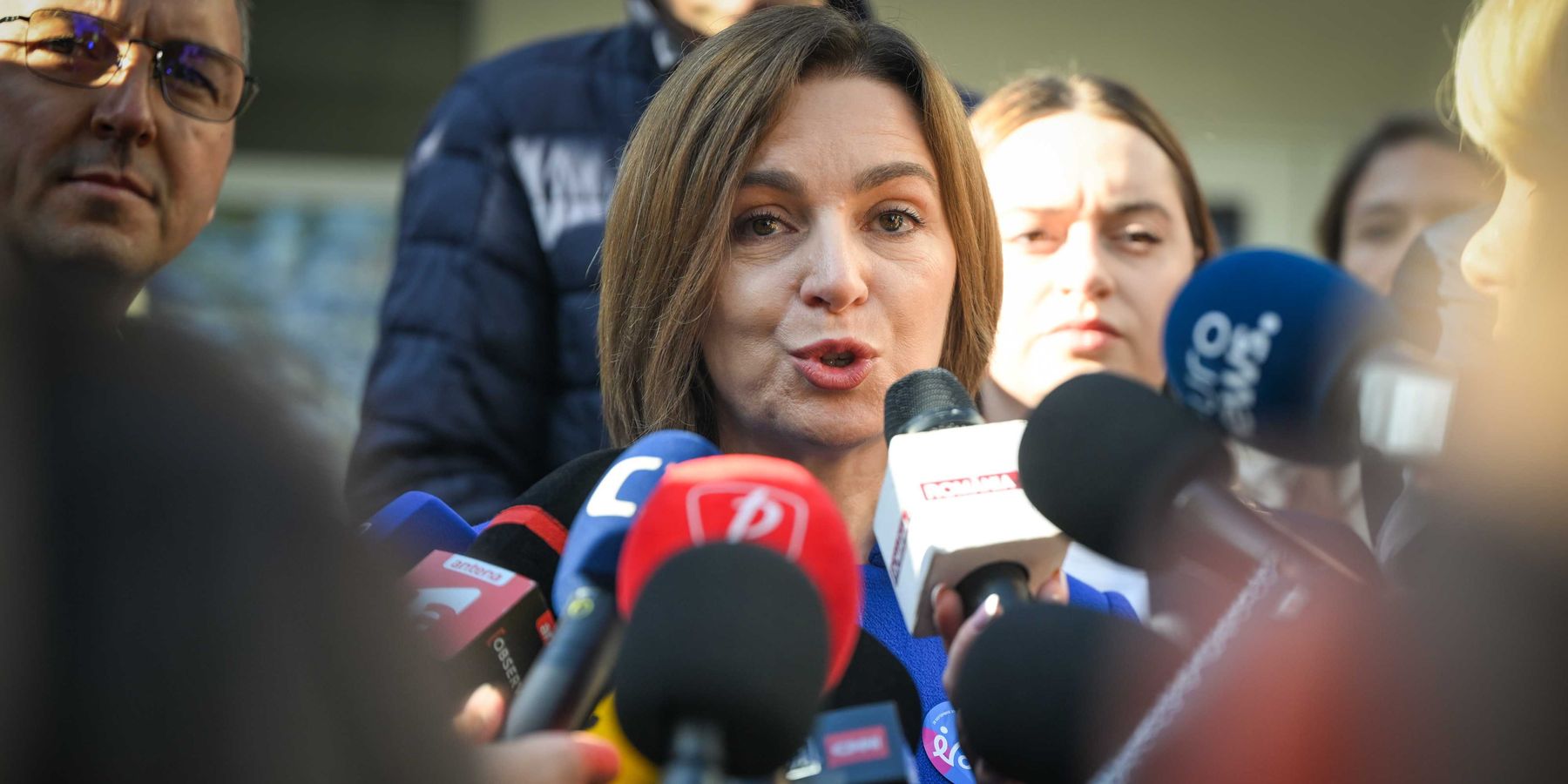
CHISINAU, Moldova – President Maia Sandu’s ruling Party of Action and Solidary (PAS) was able to just narrowly hang on to its majority in Moldova’s parliamentary election on Sunday, widely considered the most consequential vote since the former Soviet republic gained independence over 30 years ago.
PAS secured just over 50% of the vote, while its closest competitor, the Patriotic Bloc, gathered around 25%. Three other political groupings entered parliament for the first time.
Since a snap parliamentary vote in 2021, PAS has governed the country with a clear majority in the 101 seat legislature. While PAS will continue to hold a majority in parliament, its margin will be narrower and the number of groupings in the unicameral chamber will be greater. The new makeup of the Moldovan parliament is likely to have serious implications for the future of the Moldovan state and its people, the Transnistrian conflict, the Ukraine War, and European security more broadly.
Over the last several months these elections have taken on a significant international dimension. President Sandu has stressed — especially to Western audiences, but also to her own population — the importance of the vote for the future of Moldova and European security writ large. With Russia reportedly influencing the election through disinformation campaigns and illicit financing, the concern by many in Brussels and Washington was that absent a clear victory for pro-European parties Moldova may follow the path of intransigent Georgia.
For its part, the Moldovan opposition has criticized the government for banning, on the eve of elections, several ostensibly “pro-Russian” parties from competing, citing alleged illegal financing and voter bribery. In addition, the government reduced the number of polling stations available for Moldovan citizens living in the breakaway Transnistria region while somewhat complicating their access to those stations that were opened.
Amidst widespread disinformation by all sides, these moves and others have the unfortunate result of calling into question the government’s commitment to democratic standards, both in the eyes of international observers and the Moldovan population.
What is far too often lacking from Western press and expert reports, however, are the economic realities and challenges confronting Moldovans. For Moldovan voters, corruption and socio-economic issues have remained front and center, even while international security concerns continue to be significant in the context of the ongoing Ukraine War.
Indeed, the country and its population are acutely aware of the regional security situation, having taken in the largest number of Ukrainian refugees per capita. Nevertheless, as one of the poorest countries in Europe, energy insecurity and economic challenges continue to roam large in the minds of most Moldovans. Addressing these challenges, therefore, must be a central focus of any Moldovan government that hopes to maintain the public’s trust and support, not just the attention of Western capitals and the press.
Moldova is seen as strategically important due to its location, wedged between co-ethnic Romania (a NATO and EU member-state) and embattled Ukraine, its oscillating domestic political disposition, and the “frozen” Transnistrian conflict — the result of which the country remains divided and with a small Russian military presence on the left bank of the Dniester River.
As a so-called in-between state, Moldova has tragically become a geopolitical prize to be won as tensions have heightened between Russia and the West, especially following Russia’s 2022 invasion of Ukraine. This dynamic has influenced both Chisinau’s domestic politics and international relations, in part exacerbating the internal dynamics of an already polarized society.
Domestic polarization was clearly on display during last year’s presidential election which included a referendum on adding the country’s EU aspiration into the constitution. The pro-EU incumbent, Sandu, was forced into a second-round run-off—which she ultimately won by a 10-point margin—after failing to secure a majority in the initial vote as her challenger, former prosecutor general Alexandr Stoianoglo, surprised many with his electoral success. The EU referendum passed by the skin of its teeth, with less than 51% support.
Before last year’s vote, almost all polls had shown a comfortable margin of victory for Sandu and the referendum. In the end, it was the Moldovan diaspora in Europe that played a critical role in pushing the constitutional referendum through and securing Sandu’s reelection.
While the Moldovan government and its European supporters pointed to extensive Russian-backed interference, Moscow highlighted that only 10,000 ballots were made available at just two polling stations for the tens of thousands of Moldovans in Russia, in stark contrast to those available for the diaspora living in Europe. This time around 301 polling stations were opened abroad (70 more than last year’s presidential vote), most of which were in Europe and North America. Once again, only two were opened in Russia, compared with 17 just a few years ago.
Under PAS and President Sandu, Moldova has succeeded in advancing its EU aspirations. Notably, Chisinau obtained candidate status in June 2022 and began formal accession negotiations in 2024. Marta Kos, the EU’s Commissioner for Enlargement, only recently noted that Moldova may complete accession negotiations by 2028 — granted the country continues on its pro-European course.
For PAS, EU membership and European backing have become a cause célèbre, in part utilized to gloss over challenges on the domestic front. In several other in-between states, similar political rhetoric presenting a binary geopolitical choice between either unity with the West or domination by Russia is commonplace, and likewise contributes to increased domestic division.
Georgia’s local elections next week and Armenia’s parliamentary vote next June are also expected to be closely monitored in Washington, Brussels, and Moscow as the West-Russia rivalry continues to sour international relations and destabilize domestic politics throughout Eurasia. This continuing zero-sum contest over in-between states ultimately produces greater instability, limits development opportunities, and contributes to a further deterioration of West-Russia relations — outcomes any sensible American strategy ought to avoid.
Breaking out of this paradigm will not be easy, but it will be essential to Washington’s longer-term goals of deeper engagement in East Asia and greater European leadership across the continent.
Indeed, any genuine resolution to the Ukraine war will require a broader discussion on European security, economic interconnectedness, and the role of the in-between states themselves. As long as that war continues unabated, polarization, destabilization, and lingering uncertainty will grow across the entire region. Therefore, a sensible resolution to the Ukraine war can only be hoped for sooner rather than later, not least for Moldova.