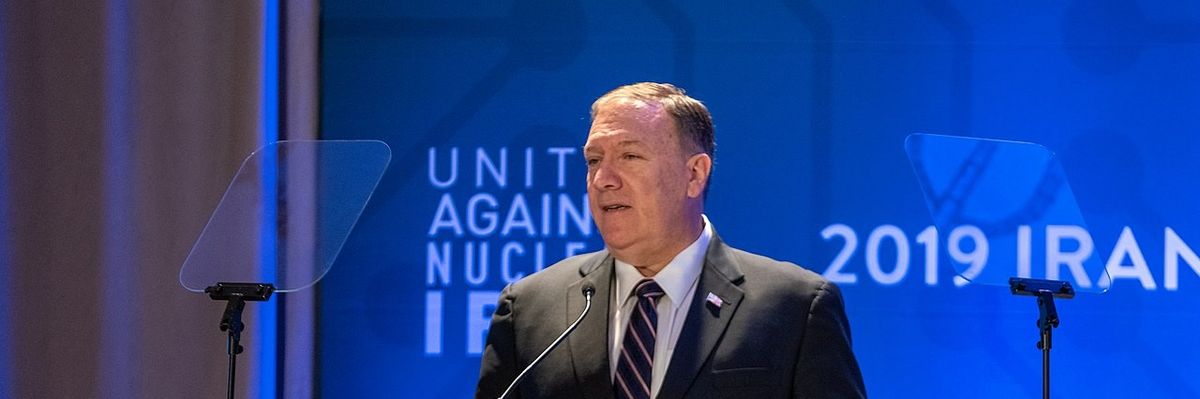
In a major speech on Iran on December 19, in reaction to the protests sweeping the country, U.S. Secretary of State Mike Pompeo proclaimed support for the protestors and announced new sanctions against Iranian officials and their family members. He also designated Iran a “country of particular concern” under the International Religious Freedom Act (IRFA), a status reserved for the worst violators of religious freedom in the world. All of these measures were cloaked, as usual, in the language of support for the Iranian people against despotic theocracy.
Pompeo’s claims of being on the side of the Iranian people are disingenuous. Targeting officials involved in the brutal crackdown on the protests may be morally satisfying. Yet it alone does nothing to mitigate the disastrous effects of the Trump administration’s “maximum pressure” campaign, such as hampering Iranians’ access to medicines and healthcare. These effects are amply documented in the latest report by Human Rights Watch (HRW).
As to the designation of Iran under the IRFA, this has far more to do with Pompeo’s courting of Christian evangelical voters than with a real concern about religious liberty. It’s not a coincidence that to boost his case he singled out the alleged persecution of a Protestant pastor. However, Iranian Christianity is not defined by such incidents, as the experience of traditional Armenian and Assyrian communities in the country demonstrates. If any group does have legitimate grounds to protest widespread discrimination, it is Bahais—yet Pompeo did not even mention them. In any case, Iran’s record on religious freedoms is far better than that of some close allies of the United States, such as Saudi Arabia, where no form of worship other than Wahhabi Islam is tolerated.
Rather than concern for the Iranian people, Pompeo’s speech reflects a barely disguised drive for regime change in Iran. Intentionally or not, the speech followed a memo by the Foundation for Defense of Democracies (FDD), a hawkish Washington-based think-tank, that advocated for the “coercive democratization” of Iran. One of the pillars of this strategy, drawing on Ronald Reagan’s policies vis-à-vis the now-defunct Soviet Union (the way the FDD chooses to interpret them), is the de-legitimization of the regime through denunciation of its human rights record.
Yet this strategy is fundamentally misguided. Whatever the successes of Reagan’s Soviet policies, three decades after the fall of the Berlin Wall Russia is not a liberal democracy, but an aggressive revisionist power that many accuse of meddling in U.S. elections. Former Soviet satellites, such as Hungary and Poland, are backsliding toward authoritarian nationalism. And the ghosts of xenophobic populism haunt many other “liberated” eastern European nations. So, even in coercive democratizers’ own terms, the success of Eastern Europe is very qualified at best.
That is not to say that creating external conditions conducive to setting a country on a more liberal trajectory is, in itself, an absurd proposition. But for it to work in the Iranian context, internal agents of democratization need to be empowered—urban, educated, largely secular middle classes and their political representatives in reformist and centrist camps. Yet Trump’s maximum pressure campaign achieves the exact opposite of this. It weakens the moderates, by impoverishing them through sanctions and forcibly disconnecting them from the world through travel bans and denial of access to education and technologies. It undermines their political representatives, such as President Hassan Rouhani, by validating Iranian hardliners’ narrative about America’s implacable hostility toward Iran. Gravest of all, the Trump administration’s policies put in direct danger any activist or dissident who genuinely seeks positive change in Iran, by enabling the Iranian security apparatus to frame them as foreign agents.
Weakening the moderates is not an unfortunate byproduct of a regime change policy. It stands at its very center, as the existence of political moderates still holds out a prospect of a peaceful, evolutionary path of reform in the Islamic Republic. Hence, the Trump administration deliberately intends to radicalize the Iranian protests, as U.S. special envoy on Iran Brian Hook has openly admitted. Unlike the “Green” civil liberties movement in 2009, the protests in 2019 are driven not by the middle classes, but young, impoverished, unemployed, and often under-educated men from the lower strata of the society. Statements by American officials, like Pompeo and Hook, seek to maximize the violent, destructive potential of the protests.
But if the Trump administration succeeds in provoking chaos and the collapse of Iranian state institutions, the beneficiaries are going to be the best-organized, best networked, most ruthless, and best armed factions. These are not pro-Western secular liberals, but men from the Islamic Revolutionary Guard Corps (IRGC), mosque networks, Ansar-e Hezbollah and Basiji paramilitary organizations—i.e., the very people coercive democratizers seek to overthrow. Violent chaos in Iran will easily spread to other countries in the region, as the IRGC has demonstrated a capacity to strike at the interests of the U.S. and its allies, either directly or through proxies.
So the strategy of coerced democratization either belies a monumental hubris in believing that the United States is capable of socially engineering fundamental change in Middle Eastern countries—especially with the fiascos in Iraq and Afghanistan in the background—or is just a cynical ploy to cover-up the Trump administration’s true geopolitical goal: the removal, through Syria-like chaos, of an actor that challenges the U.S.-led regional order pivoting around Israel and Saudi Arabia. Whatever the real motivations, this is a maximally reckless strategy that, far from bringing democracy and human rights to Iran, will only further inflame the conflicts in the region.
This article reflects the personal views of the author and not necessarily the opinions of the S&D Group and the European Parliament.