

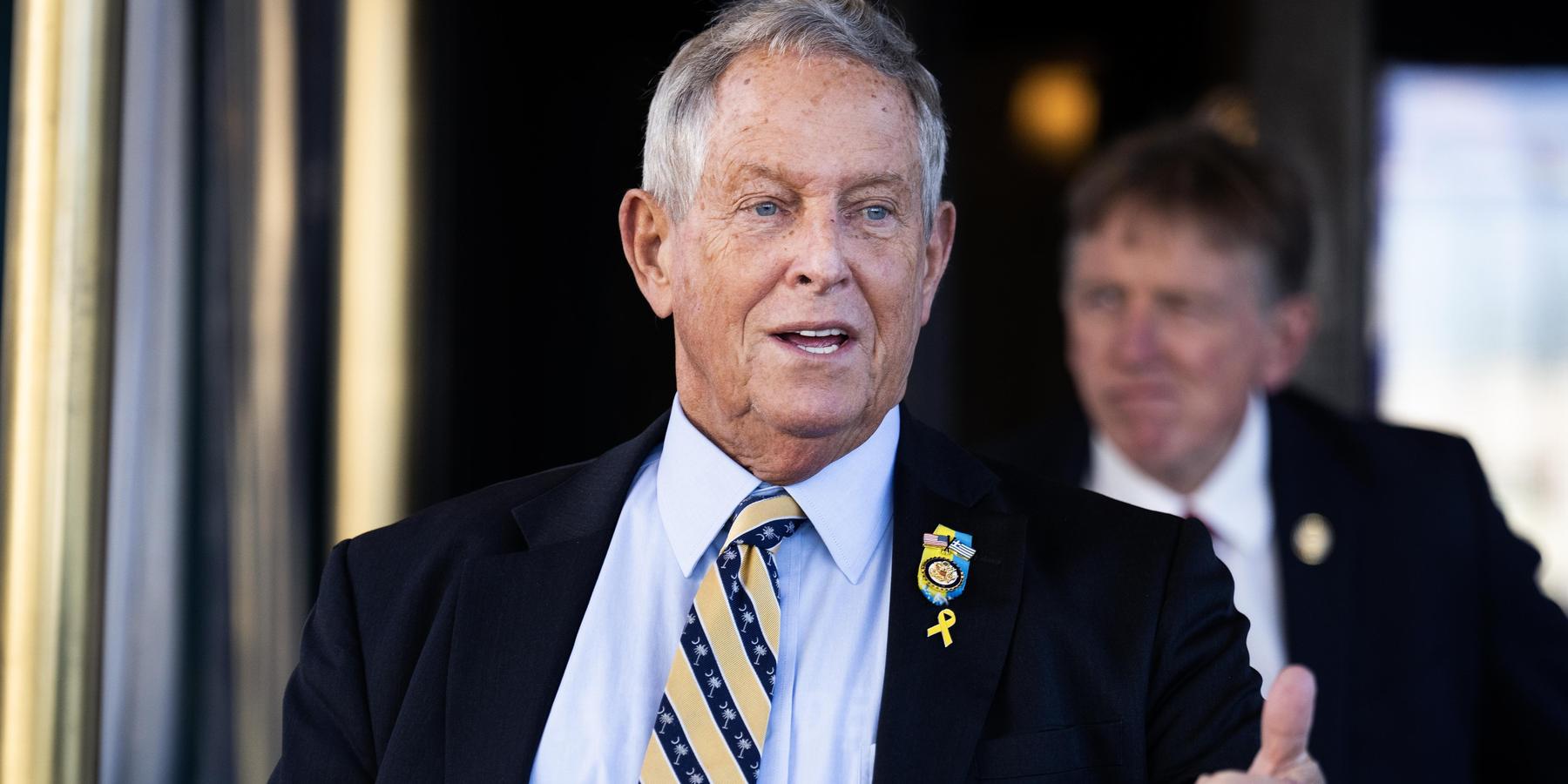
On August 27, Reps. Joe Wilson (R-S.C.) and Bill Keating (D-Mass.) introduced the SRBIJA Act, which would impose sanctions and visa restrictions on “malign actors” accused of undermining democracy, the rule of law, human rights, and stability in the Western Balkans. The proposed legislation also threatens sanctions on Serbia if Belgrade maintains its relationships with Russia, China, and Iran.
The initiative comes as Serbia prepares for snap parliamentary elections next month, following nearly two years of anti-government protests and shortly after Washington and Belgrade launched a new Strategic Dialogue. In Serbia’s polarized political environment, supporters of President Aleksandar Vučić portray Wilson and Keating as hostile foreign actors seeking to dictate Belgrade’s foreign policy, while opponents of the government largely see the SRBIJA Act positively and hope it will “ultimately lead to [Vučić’s] downfall,” said Nikola Mikovic, a Serbian geopolitical analyst.
The SRBIJA Act’s sponsors hope their legislative push will pressure Belgrade to abandon its delicate balancing act between the West, Moscow, and Beijing. But the bill could instead give Vučić an opportunity to strengthen the geopolitical narrative that he has shrewdly navigated a multipolar world, which resonates with many Serbian voters and has helped keep him at the helm.
Engaging Belgrade pragmatically
The SRBIJA Act does not represent the Trump administration’s approach to Serbia, underscored by the newly established Strategic Dialogue. Launched in July, it provides an institutional framework for continued bilateral engagement and cooperation across areas including energy and economics. The Trump administration will not abandon that framework because of a single bill in Congress.
Vladimir Trapara, a Belgrade-based political analyst, said the congressional initiative “stands poor chances of success” and argued that its failure could, if anything, help boost the Serbian government’s popularity at home.
The handling of NIS — Serbia’s oil giant, in which a pair of Russian state-owned companies control a majority stake — illustrates the more complicated reality of Washington’s approach. The Trump administration has granted sanctions waivers to NIS while Belgrade works to resolve the company’s Russian ownership structure. On August 28, Serbia secured another U.S. waiver, giving the company additional time as negotiations continue over the potential sale of the Russian stake. In sum, the Trump administration continues engaging with Belgrade even while pressing Serbia’s government on issues where interests clash.
The Trump-Vučić relationship, meanwhile, has so far fallen short of the close personal partnership that some observers anticipated after Trump’s 2024 electoral victory. For all the talk of an autocratic affinity between the two leaders based on shared resentment of “globalists,” there is limited evidence that such a relationship has emerged.
“Vučić has quite desperately attempted to meet with Trump, even traveling to Mar-a-Lago to do so, and has always been thwarted in his efforts,” noted Lily Lynch, editor-in-chief of the Balkanist Magazine. Lynch explained that Serbia’s government has “settled into a pragmatic, if somewhat distrustful, relationship with the [second] Trump administration.”
Whatever expectations existed in Belgrade in late 2024 and early 2025 that the second Trump administration would dramatically shift U.S. policy toward the Western Balkans to align much more closely with Serbia, Washington’s approach has so far appeared more transactional. The region remains relevant to the United States because of energy, regional stability, Russia, China, Kosovo, and European integration, but those interests compete with a much wider set of priorities.
Ultimately, the Trump administration is simultaneously pressuring Belgrade and seeking to continue cooperation. Nothing suggests that Washington is preparing to abandon its relationship with Serbia. Consecutive administrations, going back at least as far as the 2000s, have seen U.S. engagement with Serbia as necessary for stability in the Western Balkans. Belgrade’s arms transfers to Ukraine and Israel have also helped insulate Serbia’s government from criticism from officials in Washington over its refusal to implement European sanctions on Russia.
Balancing the Great Powers
Congressional pressure is also unlikely to produce a dramatic pivot in Serbian foreign policy. Belgrade has already been incrementally moving closer to the West while maintaining its broader strategy of balancing among competing powers.
This is particularly visible in Serbia-Russia relations. Belgrade has maintained ties with Moscow while cooperating with Western governments and supporting Ukraine in ways that complicate its traditional relationship with Russia. Yet these developments have not amounted to Serbia abandoning its broader balancing strategy.
“Vučić is basically allowed by the West to retain this already low level of relations with Russia, in return for support to Ukraine and cooperation with the West on some other issues. On the other hand, Russia is happy to see [itself wield] at least this much…influence [as it does] in Serbia,” Trapara said. “This way, Vučić attracts support by both [the West and Moscow] for stability of his regime.”
China, which has emerged as Belgrade’s most important non-Western economic and strategic partner, presents a different challenge. Beijing’s presence in Serbia is primarily economic, making the relationship structurally different from Serbia’s ties with Moscow. Miković warned that a worsening U.S.-China confrontation could eventually put Belgrade under greater pressure to distance itself from Beijing — a potentially much more difficult decision for Vučić, who traveled to China in May 2026 and hosted Chinese President Xi Jinping in May 2024.
Ultimately, Serbia has strong incentives to maintain relationships with the West, Russia, and China. Vučić has built considerable political capital around presenting himself as the leader capable of navigating between them.
Western pressure could strengthen Vučić at home
Besides Wilson and Keating, other Western policymakers seek to pressure Vučić’s government. Within the European Union, for which Serbia has been a formal candidate since March 2012, criticism has intensified over Serbia’s handling of the legacy of the 1990s Balkan wars. That issue has become particularly prominent following last month’s death of Ratko Mladić, the former Bosnian Serb military commander and convicted war criminal.
On September 3, a Serbian government plane flew Mladić’s body home to Serbia with his coffin wrapped in a Serbian flag. Days before Mladić’s funeral, held on September 7, EU Enlargement Commissioner Marta Kos canceled a planned visit to Serbia, citing concerns about the glorification of Mladić, which Brussels warned “has no place in the EU or in EU candidate countries.” Just before the funeral, Sens. Jeanne Shaheen (D-N.H.), Chuck Grassley (R-Iowa), and Rep. Keith Self (R-Texas) called on authorities in Belgrade to “refrain from any association with the planned ceremonies and to ensure that no public statement or official act memorializes Mladic as anything other than what he was: a convicted architect of genocide.”
For some of Vučić’s domestic supporters, criticism from Washington or Brussels reinforces perceptions that Serbia faces unfair pressure from the West. Since Slobodan Milošević’s ouster in 2000, “the issue of Serbian support for war crimes indictees and convicted war criminals has been a constant irritant to U.S.-Serbia relations,” said Lynch. That dynamic could become particularly relevant as Serbia approaches its parliamentary elections.
Western pressure could ultimately help Vučić with his core electorate. “Most of his voters have a strong focus on national issues, and they are likely to interpret this pressure as proof that Vucic is doing ‘a good job of defending Serbia’s interests,’ which is why those ‘evil Westerners’ want to overthrow him,” observed Miković.
Trapara stressed how much is at stake for Serbia’s elections in terms of democratic health, the rule of law, independent institutions, a free press, and constitutionalism. At the same time, he argued that outside actors should be cautious about intervening in Serbia’s domestic affairs.
“A message to the foreigners, whether they launch strategic dialogues in support of the regime, or fruitlessly threaten sanctions to help the regime anyway, is that they should refrain from big Serbia-related political moves until we finish our job in the elections.”
- Norway's seizure of a Russian vessel is a dangerous escalation ›
- The Kushner-Israel nexus behind the Albania 'flamingo revolution' ›
- What NATO leaves behind as it pulls back from Kosovo | Responsible Statecraft ›