

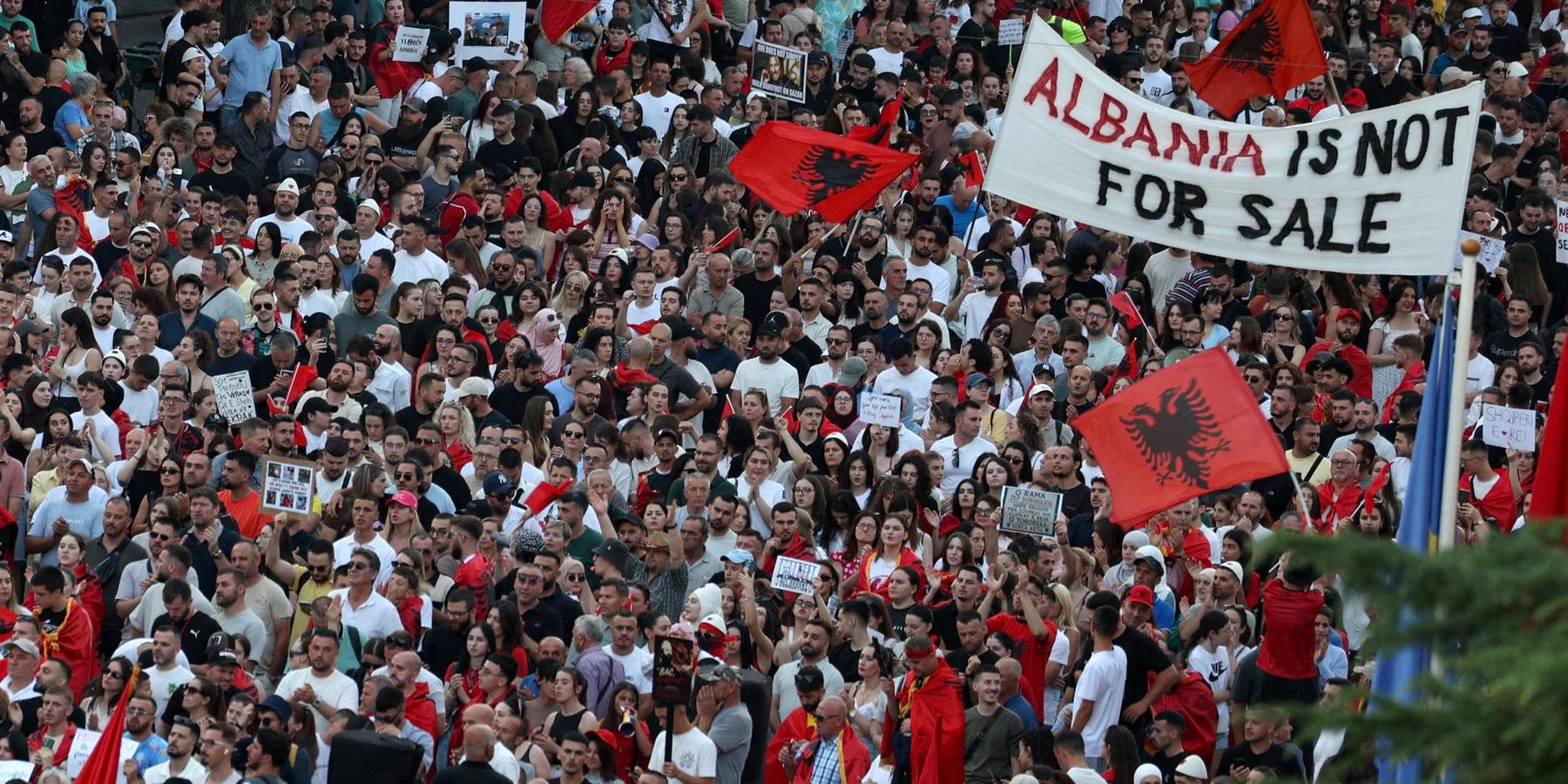
Albania, a small Balkan nation on the Adriatic coast, seldom makes headlines. But protesters waving pink flamingo cutouts on an Albanian island the Trump family wants to turn into a resort have recently attracted international media attention.
The dispute, which largely focuses on the threat the resort would pose to local wildlife, reveals more than meets the eye. Under the surface is an intricate set of problems related to Jared Kushner — President Donald Trump’s son-in-law and a close ally and confidante of Israeli Prime Minister Benjamin Netanyahu — and the presence in Albania of an Iranian exile group opposed to the current government in Tehran. All that comes on top of the news that the Albanian anti-corruption authorities have launched a probe into Kushner’s deal with Tirana, which poses a direct test also for the European Union which Albania seeks to join.
The Vjosa-Narta Delta — home to rare flamingos, pelicans, and turtle hatcheries — became Europe’s first Wild River National Park in 2023. But after Trump’s 2024 reelection, Kushner unveiled plans for a multibillion-dollar resort on the protected island. Prime Minister Edi Rama’s government granted “strategic investor status” to a Kushner-linked firm, reportedly waiving taxes and tenders and bypassing environmental reviews. When construction recently began, a “Flamingo Revolution” erupted.
What’s really important here is the possible geopolitical ramifications of this real estate project. During Trump’s first presidency, Kushner promoted the Abraham Accords – so-called normalization deals between Israel and Arab nations, including the United Arab Emirates and Bahrain. Netanyahu hailed those agreements as a great diplomatic triumph. Kushner and Netanyahu reportedly remain in close contact, even as Kushner negotiates with Iran on behalf of the Trump administration. Kushner’s investment firm, Affinity Partners, was explicitly created to deepen economic ties between Israel and the Arab world.
To understand the broader context, recall Israel’s classic “periphery strategy.” For decades, Tel Aviv has cultivated ties with non-Arab states on the edges of the Middle East — from the Caucasus to the Balkans to Africa — as a way to break its diplomatic isolation. Today, that strategy is alive and well. Israel has forged close relationships with Azerbaijan (a key energy partner and Israel’s intelligence foothold on Iran’s border), Serbia (which has significantly increased its arms imports from Tel Aviv), Romania (which announced it will move its embassy to Jerusalem), and now Albania.
Albania fits perfectly into this picture. Strategically located in the Balkans, it is a Muslim-majority but secular state, a staunchly pro-American NATO member, and an eager actor looking to prove its value to Western allies. Crucially, it is also a European Union candidate country. Having another friendly nation inside the EU — or at its doorstep — would be immensely helpful to Israel as public sentiment across Europe turns increasingly critical of Israeli policies.
With EU member states debating sanctions, the potential suspension of the EU-Israel Association Agreement, or bans on trade with the Israeli settlements in the occupied Palestinian territories, any sympathetic voice in the EU can be very helpful. Tirana is not yet a member, but its trajectory matters; and Prime Minister Rama has proved himself a strong ally.
Nowhere is Rama’s alignment with the Trump-Netanyahu tandem more visible than in his treatment of Iran. Albania is the country where thousands of members of the Mojahedin-e-Khalq (MEK), the exiled Iranian opposition group that was previously on the U.S. and EU terrorist lists, have relocated after leaving Camp Ashraf in Iraq in a deal brokered by the Obama administration in 2013.
The fact they found their new home in Tirana is mostly due to a refusal by most other nations approached by Washington to host them. The relocation was conceived as a humanitarian gesture, rather than the provision of a new operational base for the discredited group.
That arrangement was not fully respected; there is documented activity of MEK bots originating from Albania. But Rama has embraced the MEK nonetheless, using it as a cudgel against Tehran.
As the Flamingo Revolution spread, Rama publicly blamed Iran for stoking the protests. In a blistering statement addressed to the Islamic Republic, he accused Tehran of cyberterrorism, of targeting Albanian institutions, and of hostility “toward freedom itself.” He then pivoted to a full-throated defense of Albania’s decision to shelter the MEK (without naming it directly), framing its members as “Iranian men and women whom you sought to silence through intimidation, imprisonment and death.”
This is remarkable for two reasons. First, it effectively endorses the MEK as freedom fighters — exactly the language used by top officials of the first Trump administration, including former secretary of state Mike Pompeo and National Security Adviser John Bolton, who reportedly have been well compensated for their pro-MEK advocacy.
Second, it deflects entirely from the allegations of domestic corruption and environmental destruction at the heart of the protests. There is no evidence the protesters waving flamingos are Iranian agents. They are Albanian citizens worried about their coastline. But by blaming Tehran and wrapping himself in the mantle of resistance to theocracy, Rama seeks to transform a local scandal into a battle in a global proxy war — one that aligns perfectly with pro-Israel interests.
This raises the question of the extent to which Albania’s foreign policy is aligned with the EU as it seeks to join the bloc. Even as the EU relations with the Islamic Republic are arguably at their lowest point since 1979, the EU does not recognize MEK as a legitimate interlocutor; nor does it seek to endorse the group in any shape or form.
To accentuate the split with Brussels, Albania joined Trump’s so-called “Board of Peace” and even agreed to send peacekeepers to Gaza, as per Trump’s plan, endorsed by Netanyahu.
In a sign of a deeper alignment with Netanyahu’s Israel, Rama traveled to Jerusalem, spoke before the Knesset, and was praised by Netanyahu for his “moral conscience.” There, he blamed “no one else but Hamas” for the Israeli military retaliation for Hamas’ October 7 atrocities – even though that retaliation has killed over 70,000 Palestinians in Gaza in what the International Court of Justice, a U.N. rapporteur and numerous international legal experts have characterized as plausibly constituting a genocide or genocidal acts. Such alignment accrued Rama tangible benefits, such as arms deals with Israeli firms like Elbit Systems.
While this geopolitical divergence is concerning, foreign policy is still the preserve of member states and candidates to join the EU, and some EU members have strong ties with Israel anyway. However, the allegations of corruption against Rama are one dimension where Brussels can exert real leverage.
Since Albania received EU candidate status in 2014, and formal membership negotiations started in 2022, the EU has repeatedly expressed concerns over corruption and the weakness of the rule of law in Albania. When protesters ask basic questions about who benefits from a Trump-owned resort on a nature preserve, Rama not only accuses Iran of meddling but insists there is “absolutely no chance” the development will stop.
Brussels cannot afford to look away. The EU could hold the Albanian government accountable here by demanding transparency; conditioning enlargement funds on strengthening the rule of law and the fight against corruption; and, ultimately, putting the accession negotiations on hold if those conditions are not fulfilled.
What Brussels needs is political will to protect its own tattered reputation. The flamingo-wielding protesters are not Tehran’s pawns. They are citizens fed up with the political elite’s high-handed neglect and arrogance, of which the Kushner project is only the latest expression. Brussels should start listening — and acting.