

Only a few days ago, Moldova’s ambassador to the U.S. said it was likely “not an accident” that a Russian jet-powered drone flew across his country’s territory while Ukrainian President Volodymyr Zelensky’s plane was preparing to depart from Chișinău’s airport.
Armenia, meanwhile, continues to face Russian pressure over its increasing pro-Western orientation. And tensions continue to linger on Belarus’ western and southern borders following Ukrainian allegations this summer that the country is being used to advance Russia’s war effort.
Far from a disconnected smattering of events, these tensions stem from a larger regional crisis that predates — but was accelerated by — the Ukraine war. Bad U.S. policy played a crucial role in worsening this predicament.
In the decades following the end of the Cold War, the U.S. pursued a dual-track approach toward former Soviet states.
On the one hand, the West sought to integrate Russia — the strongest of all the new states and the USSR’s natural successor — as a junior partner into the U.S.-led liberal, capitalist world order. On the other, the U.S. and its European allies pursued a hedging policy across central and eastern Europe that included enlarging NATO up to Russia’s western borders, out of fear that Moscow’s historical autocratic and expansionist impulses would resurrect once more.
That dual policy “ultimately failed,” and the hedging “proved counterproductive,” as noted by Thomas Graham, one of America’s leading Russia scholars and practitioners. The Kremlin became convinced that America’s “true goal” was “eroding and containing Russian power,” a perception that drove Russia’s leaders to be “more determined to restore their might, push back against US initiatives in the former Soviet space, and drive wedges between NATO allies.”
Now that the post-Cold War unipolar era is definitively over, the U.S. must formulate a new policy toward the states stuck between NATO and Russia. This will be the key task — alongside preventing an escalation of the Ukraine war and rebalancing the trans-Atlantic relationship — for American policymakers focusing on Eurasia in the years ahead. The sum of these efforts will weigh upon two critical U.S. objectives: U.S. conventional retrenchment from Europe and the establishment of the conditions for long-term strategic stability between Russia and the West.
It was with these considerations in mind that we launched a Quincy Institute initiative focused on shaping U.S. policy toward Armenia, Azerbaijan, Belarus, Georgia, and Moldova — the so-called “in-between states.” In our newly-published inaugural report, we lay out a blueprint to help guide Washington’s policy toward this region in ways that will help advance America’s interests, support peace and prosperity, and avoid repeating the mistakes of the past.
A better approach to the in-between states would rely on a few key principles. One is that the U.S. has no vital interest at stake that necessitates it take on the risks of becoming a security guarantor for these countries. Another is that Washington should promote economic connectivity projects and political normalization efforts to strengthen Eurasian regional stability — and encourage in-between states to pursue multi-vector foreign policies that seek positive relations with all neighboring states.
Equally important here is the U.S. relationship with Russia. U.S. engagement in Eurasia must be accompanied by broader confidence-building measures with Russia, aimed at mitigating the risk of security spirals and misunderstandings.
This will require sustained dialogue with Moscow about what Washington is and is not doing, and the extent of its involvement in the in-between states. The Russians have demonstrated in both Georgia and Ukraine that they are willing to resort to the use of force to defend their interests in the in-between states, whereas NATO is not. The Kremlin has repeatedly made clear that it views the enlargement of the Western alliance into the in-between states as a red line.
It is, therefore, eminently sensible to take off the table the future expansion of NATO into former Soviet republics. Not only does it harm the foundations of Russia-West stability, but it also leads to greater instability for transatlantic partners and the in-between states themselves. When it comes to political and economic matters, however, the U.S. and the in-between states likely have greater room for maneuver.
In the context of the current security landscape, negotiating a compromise settlement to the Ukraine war will go a long way in assisting the U.S. with its other priorities across Eurasia and in the in-between states.
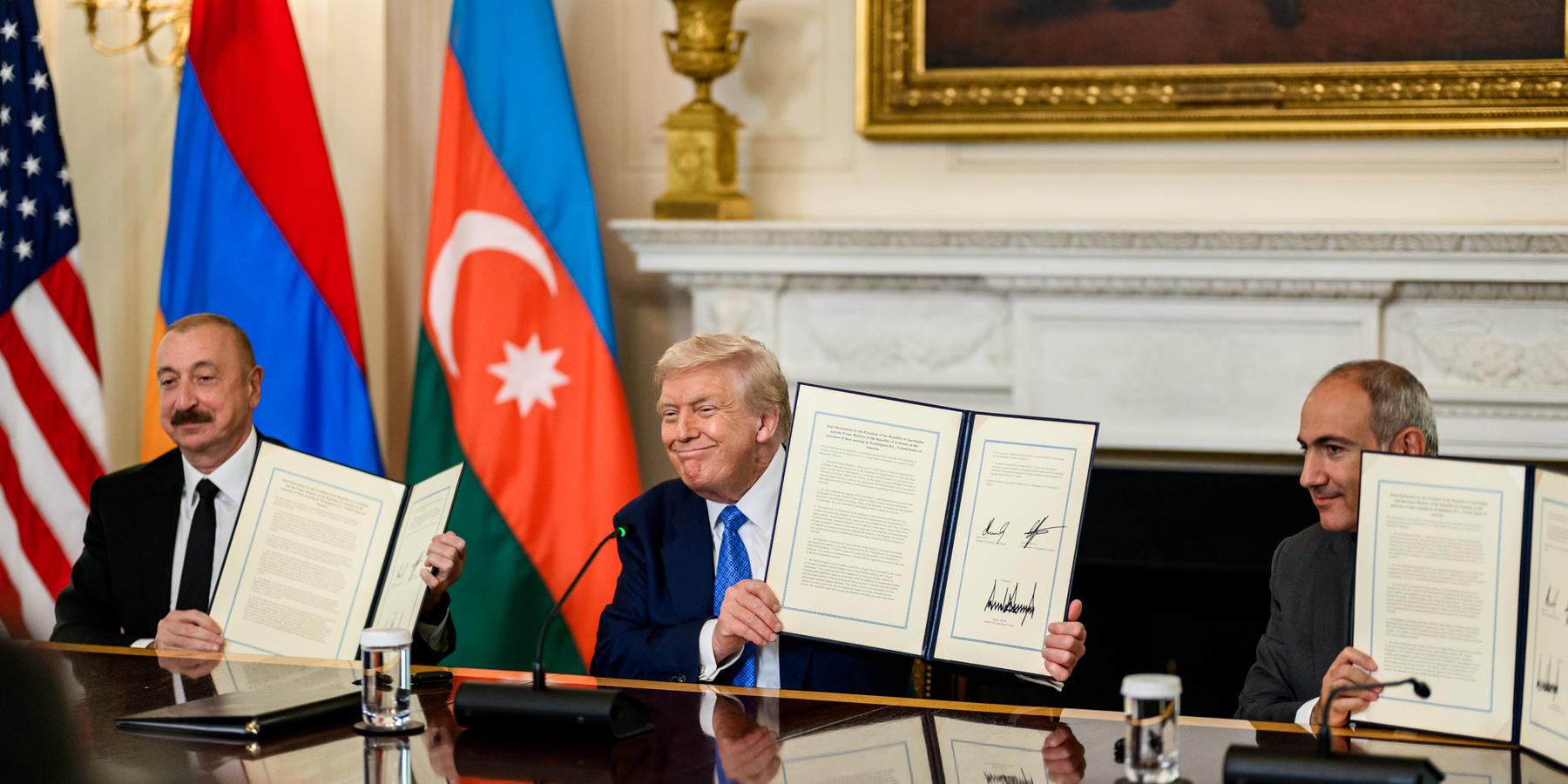
Washington’s greatest success to date in the in-between states is the August 8, 2025, announcement of the Trump Route for International Peace and Prosperity (TRIPP) at a White House ceremony with Armenian Prime Minister Nikol Pashinyan, Azerbaijani President Ilham Aliyev, and President Donald Trump. Across Central Asia, the Caspian Basin, and the South Caucasus, American and European investments are increasing and political engagement is deepening. An important opportunity exists for TRIPP to become a key supply chain along the Middle Corridor, contributing to American efforts to strengthen U.S. access to the critical minerals essential to a modern economy and armed forces.
To ensure that this deepening engagement brings economic development and security to the South Caucasus, Washington must help Yerevan and Baku implement their peace agreement and facilitate normalization of Armenia-Turkey relations.
The Trump administration has achieved important successes through its engagement with Belarus, a country the U.S. had previously all but cast aside as an appendage to Russia. Pragmatic and consistent diplomatic work led to the release of several hundred political prisoners in exchange for sanctions relief. There remains much additional space for the development of political, diplomatic, and commercial ties between Washington and Minsk. A deliverable from a future potential meeting between Presidents Trump and Aleksandr Lukashenko may be full diplomatic normalization, which would open the door to increased trade and investment opportunities.
Final resolution of the remaining political-territorial disputes across the region — Transnistria in Moldova and Abkhazia and South Ossetia in Georgia — remains elusive. Nevertheless, a negotiated end to the Ukraine war alongside broader dialogue with Russia on European security matters would set the right conditions for progress in these other areas.
It’s high time for a new paradigm in the U.S. approach to the in-between states. Incorporating the strategic principles we lay out above into a new policy is vital to advancing American interests, fostering regional prosperity, and mitigating the risk of future crises in the Ukrainian mold.