

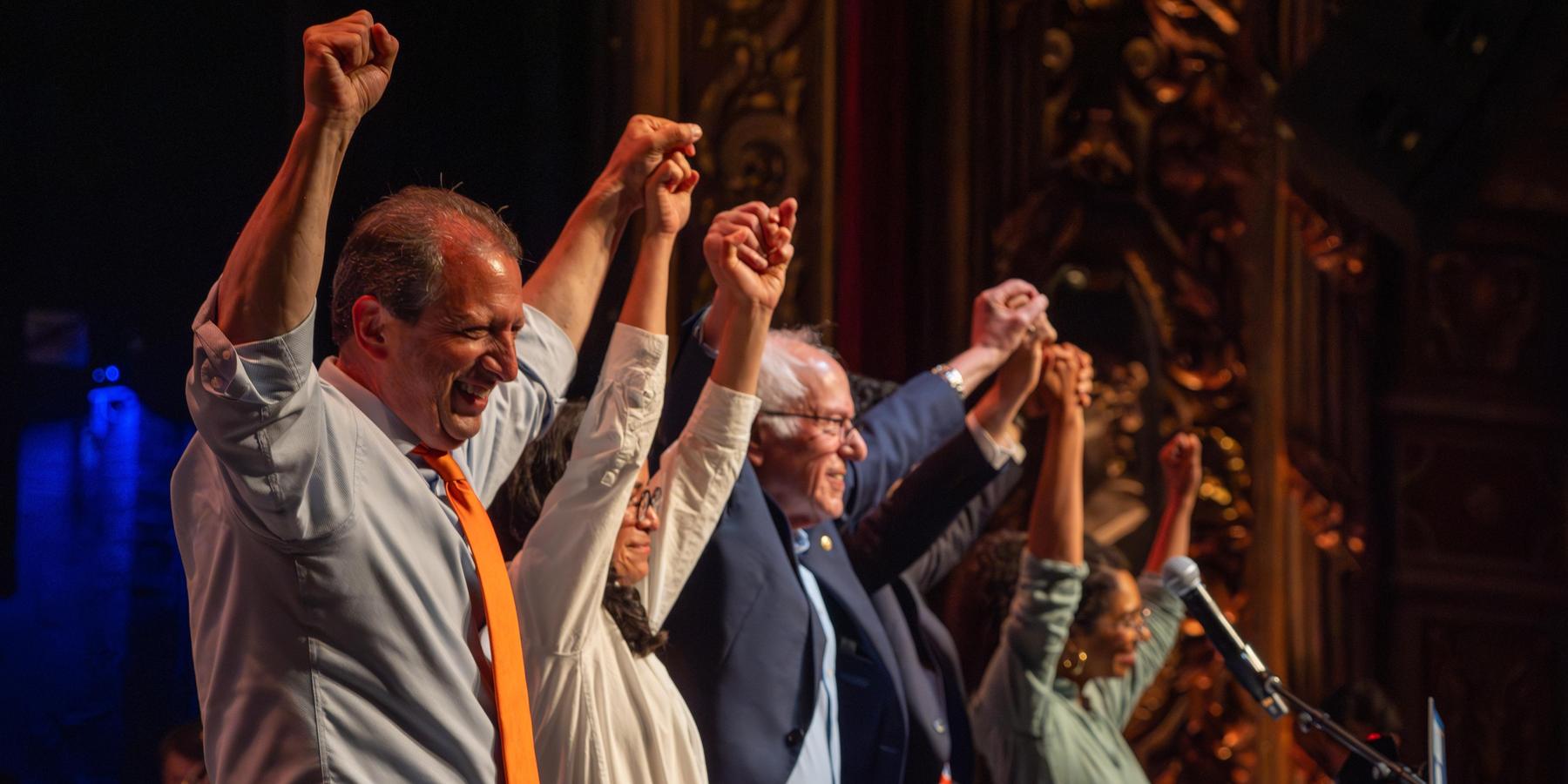
Three Democratic candidates for House seats in New York prevailed on Tuesday night in a massive rebuke to the party establishment. Though each race was representative of a broader dissatisfaction with incumbents and specific district-level dynamics, the U.S. relationship with Israel and funding from big-money lobbies, including AIPAC, became central components in each of these races.
Following in the footsteps Zohran Mamdani’s victory in the New York City mayoral election in 2025, Brad Lander (N.Y.-10), Claire Valdez (N.Y.-7), and Darializa Avila Chevalier (N.Y.-13) all scored wins in Tuesday’s primaries, putting them on a glidepath to Congress in November. Both Lander and Avila Chevalier defeated sitting House members.
Particularly in the 10th district, where Lander won nearly two-thirds of the vote, those questions were seen as central. As Politico put it, the challenger knocked out the “two-term lawmaker after a bruising campaign that focused heavily on their differences over Israel.”
“There is very little daylight between Brad Lander and Dan Goldman ideologically, except when it comes to Israel,” Adam Carlson, a Democratic pollster, told RS. “Yes, Lander has a long tenure representing much of the district, but he won by a nearly 2:1 margin because Goldman is deeply out of touch with the base of the party on Israel — and his association with AIPAC.”
In a sign of how much the discourse of the Israel’s war in Gaza and U.S. support for it has shifted since October 2023, Valdez, who ran for an open seat, criticized her leading opponent, Antonio Reynoso, for not calling the war a “genocide” until he announced his run for Congress. Nydia Velasquez, the popular incumbent who held the seat for more than three decades, endorsed Reynoso before Tuesday’s election.
In the 13th district, meanwhile, Avila Chevalier, who centered her opposition to U.S. policy toward Israel, shocked Adriano Espaillat, the current chairman of the Congressional Hispanic Caucus. Avila Chevalier has said she would support the “Block the Bombs” Act that would halt arms shipments to Israel and made headlines for attending a protest one day after the Oct. 7 attacks, which she said was in recognition of “a pattern in which whenever there is an incident, the state of Israel engages in a response that is often disproportionate and creates a greater loss of life.”
Her victory was seen as notable not only because it pitted an outsider with no prior elected experience against an established incumbent, but also because she won in a less affluent, less white district. As Alex Kane wrote in Jewish Currents before the race, progressive activists saw her race as “a sign that anti-AIPAC politics can win outside of wealthier, more highly-educated progressive districts where it’s had success so far.”
In New York’s 12th district, an area of the city which is older and more Jewish than some other neighborhoods with competitive races, there were further signs of the degree to which the politics of the U.S.-Israel relationship has changed. Carlson told RS before the vote that they would be watching for whether Nina Schwalbe, the only candidate to call the war in Gaza a “genocide,” could run close to George Conway, a former Republican and strong supporter of the traditional relationship between Washington and Tel Aviv.
At the time of writing, Schwalbe had garnered 7% of the vote compared to 6% for Conway. The two top vote-getters in the race, who were running to replace outgoing Rep. Jerry Nadler, both described themselves as pro-Israel but anti-Prime Minister Benjamin Netanyahu and said they would not vote to end military aid to Israel.
AIPAC itself kept some distance from the races in New York, though reporting indicated that apparent front organizations for the lobbying group have continued to fund candidates. Espaillat was the only candidate explicitly backed by AIPAC. Other pro-Israel groups, such as the Democratic Majority for Israel, have reportedly given money to Super PACs supporting Goldman and Espaillat.
More pro-Israel candidates have also had successes in other races, including in a Maryland Democratic primary race on Tuesday and in an earlier effort to oust incumbent Republican Rep. Thomas Massie of Kentucky earlier this year.
Some sitting members of Congress framed the news as indicative of a larger wave sweeping over the party. “The progressive movement is crushing the establishment in NYC,” Rep. Ro Khanna (D-Calif.) wrote on X. “Some have criticized my supporting progressive insurgents. Tonight shows we have a new party.”
This week’s races in New York, all in deep blue districts, were certainly tied into other political dynamics, including the power of Mamdani (who endorsed all three progressive winners) and other district-specific issues. But as Democrats gear up for more primary races, ahead of November’s midterms and 2028’s presidential elections, it has become increasingly clear that unconditional support for Israel is no longer a winning issue in the Democratic Party.
- AIPAC takes out Israel lobby critic Thomas Massie in grueling primary ›
- AIPAC steps on a rake in New Jersey ›
- Massie moves to strike $3.3B marked for Israel from the budget ›
- Tucker Carlson's left-right, third party dream | Responsible Statecraft ›
- El-Sayed overcomes $30 million AIPAC spend, wins Michigan primary ›