

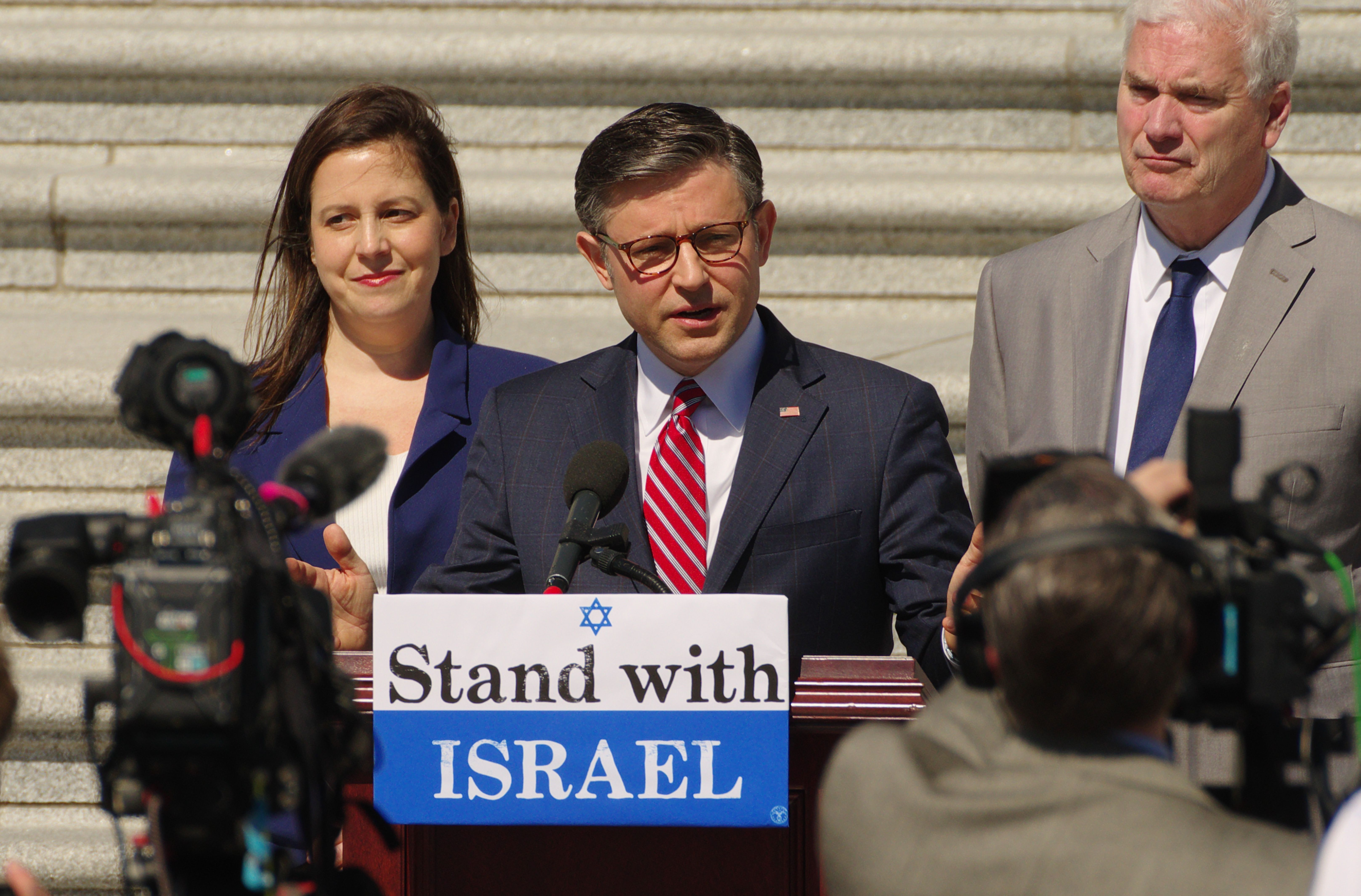
House Speaker Mike Johnson took part in a private meeting with pro-Israel leaders from a variety of organizations on Capitol Hill last Wednesday during which he reportedly expressed concern about growing “isolationism” in the GOP.
Speaking to several individuals who attended the meeting, Jewish Insider reported, “Johnson, who described himself to the group as a ‘Reagan Republican’ focused on ‘peace through strength,’ acknowledged that isolationism is rising in the Republican Party, and that the party is likely bound for a major debate on the issue after President Donald Trump leaves office.”
The report added, “And Johnson told the group that, in his candidate recruiting efforts, he’s working to filter out isolationists to prevent that wing of the party from growing larger in the House, four people who attended the meeting said.”
While it’s unclear what Johnson meant by “isolationists,” it’s likely, given his audience, that he’s referring to those who don’t support the far-right pro-Israel view, oppose Israel’s war in Gaza and/or advocate for Palestinian rights. The term is also often used by neoconservatives and other proponents of American militarism more generally to smear advocates of restraint.
In any case, the “major debate” on GOP foreign policy — particularly about Israel — that is supposed to take place after Trump leaves office has been well underway for some time. And Johnson’s crusade to root out the so-called “isolationists” — meaning those anti-war Republicans who are increasingly critical of Israel — is not new.
Almost three decades ago, when Pat Buchanan defeated the GOP establishment candidate, Sen. Robert Dole, in the 1996 Republican New Hampshire presidential primary, party heads worked feverishly to make sure that’s as far as he got.
When my former boss, Sen. Rand Paul (R-Ky.), ran for the U.S. Senate in 2010, the GOP brass didn’t want the son of Ron Paul anywhere near Capitol Hill. Sen. Mitch McConnell (R-Ky.) handpicked his own primary candidate who received the endorsements of American war machine boosters like former Vice President Dick Cheney and former New York City Mayor Rudy Giuliani.
Cheney didn’t endorse in any other GOP primary that year but insisted that Paul’s more hawkish opponent was the “real conservative” in that race.
After Paul won the general election in a landslide, former George W. Bush speechwriter and prominent neoconservative David Frum lamented, "How is it that the GOP has lost its antibodies against a candidate like Rand Paul?"
The senator’s father — himself a former member of Congress — never got anywhere near the White House in his two Republican presidential runs in 2008 and 2012, but he did help inspire a sizable anti-war populist movement, the popularity of which has worried the old guard for decades.
Ever since Donald Trump declared that the George W. Bush administration lied about the Iraq war on a Republican presidential debate stage in 2016, and went on to win the election, GOP foreign policy debates almost immediately expanded beyond the parameters of a military first approach.
It became okay to be “America First,” meaning prioritizing the interests of one’s own nation above those of others, whether it be foreign funding or foreign wars, which was kryptonite to those intent on making the world safe for democracy, as neocons often claimed they were doing.
So if Speaker Johnson is worried about internal debates on the direction the GOP is going on Israel and wants to nip that in the bud, he’s too late.
Indeed, polling has shown that Republicans are increasingly moving away from their traditional reflexive support for Israel. On the Gaza war, a new Associated Press-NORC poll revealed “a bipartisan uptick in Americans finding Israel’s military response has ‘gone too far.’”
“About 7 in 10 Democrats say this now, up from 58% in November 2023,” the report noted. “And roughly half of independents say the same, compared with about 4 in 10 in the earlier measure.”
“Republicans have also moved slightly, from 18% to 24%,” the AP noted.
A late August poll showed that 14% of Republicans had become comfortable calling Israel’s actions in Gaza a “genocide.” As RS observed three weeks ago, “The view that Washington’s support has enabled Israeli actions in Gaza was transpartisan. Nearly three out of four Democrats (72%) agreed with that proposition, as did 57% of Republicans, and 63% of self-identified independents.”
Another poll in June found that 53% of Trump voters didn’t think at the time that the U.S. military should get involved in the conflict between Iran and Israel. The poll also found that 63 percent of Trump voters said the U.S. should “engage in negotiations with Iran over its nuclear program” while just 18% said the U.S. should not.
And before Israel launched its 12-day war on Iran this summer — that Trump later joined — a whopping 64% of Republicans said in another poll that they supported negotiations over Iran’s nuclear program.
This is why AIPAC — the powerful pro-Israel lobby group that works to keep Washington in line — is ponying up hundreds of thousands of dollars to oppose restrainers like Reps. Thomas Massie (R-Ky.) and Marjorie Taylor Greene (R-Ga.). Johnson appears worried that they and a handful of other GOP restrainers might grow in number in the mid-terms, and pro-Israel leaders are being promised that this increasing “isolationism” will be stopped. Massie and others have acknowledged exactly what is happening to them.
All this is making Mike Johnson simply the latest establishment champion for war in his party’s never ending battle against any Republican who might prevent it.