

Since September, the al-Qaida affiliate Jama‘at Nusrat al-Islam wa-l-Muslimin (the Group for Supporting Islam and Muslims, JNIM) has been waging intensive economic warfare against the Malian authorities.
JNIM’s blockade on fuel supplies has upended daily life in the capital Bamako. Citizens queue in interminable lines for gasoline, Western powers have urged their nationals to evacuate, and major news outlets are speculating that Bamako — or Mali as a whole — may soon be ruled by jihadists.
There are certainly plausible scenarios that could bring a jihadist takeover, or a forceful attempt at one. JNIM could be waiting for a moment of maximum weakness to march into the capital, perhaps hoping that a desperate population would accept or even welcome jihadist rule as an alternate to the failing military junta in power since 2020. JNIM could be playing an even longer game, calculating that asphyxiating the capital will provoke a military coup, a fragmentation of the military into competing factions, a popular revolution, or a militia-fication of Bamako (akin to Tripoli).
Perhaps JNIM sees its path to power not as a matter of weeks but of months or years.
It is not clear, however, that JNIM could or would rule Bamako. As the researcher Boubacar Haidara and others have pointed out, basic mathematics make a JNIM conquest improbable: with an estimated total strength of 6,000 combatants, JNIM would face difficulty taking and holding a city of more than 3 million, even if it concentrated all of its forces (currently spread out across multiple countries) in one place.
Moreover, Haidara asks, why would JNIM skip over various “intermediate steps” — such as the conquest of regional administrative centers in areas where it already holds substantial sway — and instead make the capital the first place it conquers?
For context JNIM’s predecessor organizations did hold several northern Malian cities for months in 2012-2013, before a French military intervention dislodged them. Since then, Sahelian jihadists have refrained from overtly controlling major cities in the region. Other rebel forces that have seized capitals, such as the Séléka rebel coalition that conquered the Central African Republic’s Bangui in 2013, have had much higher manpower levels; Séléka may have had 20,000 fighters or more at its peak, and swept steadily across the country before taking the capital.
Another scenario for Mali, then, is continued degradation of security and economic conditions without, at least in the medium term, the collapse of the central government (as in CAR in 2013, Somalia in 1991, or Afghanistan in 1992). The Malian state, under its current military rulers, is already, to use an anatomical metaphor, skeletal. But that skeleton still functions in certain ways; indeed, we could say that parts of the nervous system and the musculature remain.
The brain (the military regime in Bamako) is not yet completely cut off from other parts of the country, as evidenced by recent drone strikes targeting jihadists (but, seemingly, killing civilians) in the Timbuktu Region, far from the capital. JNIM has disrupted some lines of communication and has forced the military out of some positions, but the Malian state possesses a few assets — formal control over cities, air power, and a degree of popular appeal in Bamako and elsewhere, mediated through state-owned and state-friendly media that broadcast a pro-government narrative as civil and political space remains closed to alternative perspectives.
Western powers, considering responses, find themselves awkwardly caught between various constraints. There is enough of the hangover of the War on Terror left that the prospect of Mali under the rule of “al-Qaida” (JNIM, in my reading, functions fairly autonomously, but the connection is there nonetheless) remains horrifying to many policymakers — yet it is not 2005, or 2013, or even 2020.
The War on Terror’s failures loom large, including in the Sahel where the French were expelled from several Sahelian countries (including Mali) after failing to contain the very jihadist insurgency that is now encircling Bamako; meanwhile, Western appetites for military intervention, especially troops on the ground, are low. Nor would the military government in Bamako welcome or even tolerate American, French, or other European soldiers.
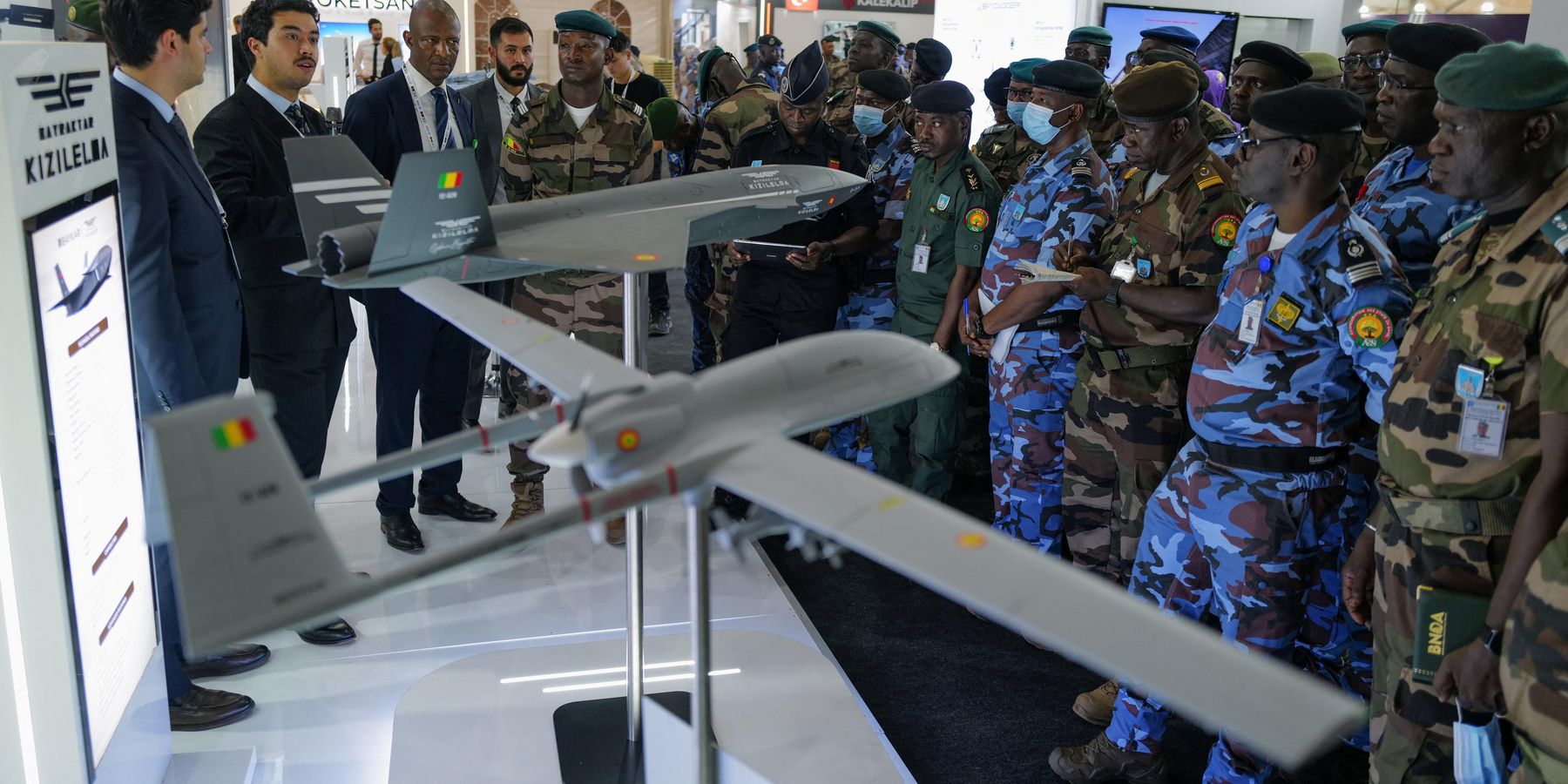
Washington could attempt to revive security cooperation with Bamako, and there were signs in recent months that the Trump administration was interested in a transactional relationship with the junta there. Certainly the military authorities and their allies are hungry for military hardware, as evidenced at a Turkey-centric defense expo that just concluded in Bamako — featuring surreal scenes of slick conference halls and sleek weapons, as though the capital were not under siege. Washington could try to cash in on the Malian authorities’ desire for weapons, but that would amount to preying upon desperation and denialism.
Given that JNIM’s intentions and timetables are unclear, and given that full-fledged intervention is probably a non-starter, a “wait-and-see” approach is a sensible path on the political-military front. Propping up a failing regime is a recipe for being drawn into a complex conflict that one Western power, France, already fumbled.
If Washington wants to help, then the way to do so is by increasing humanitarian aid to the millions of people in the Sahel region who are displaced, hungry, out of school, and out of work. That sentiment runs counter to Trump’s approach so far, but the U.S. is much better positioned to alleviate suffering than it is to dictate who will rule Mali.