

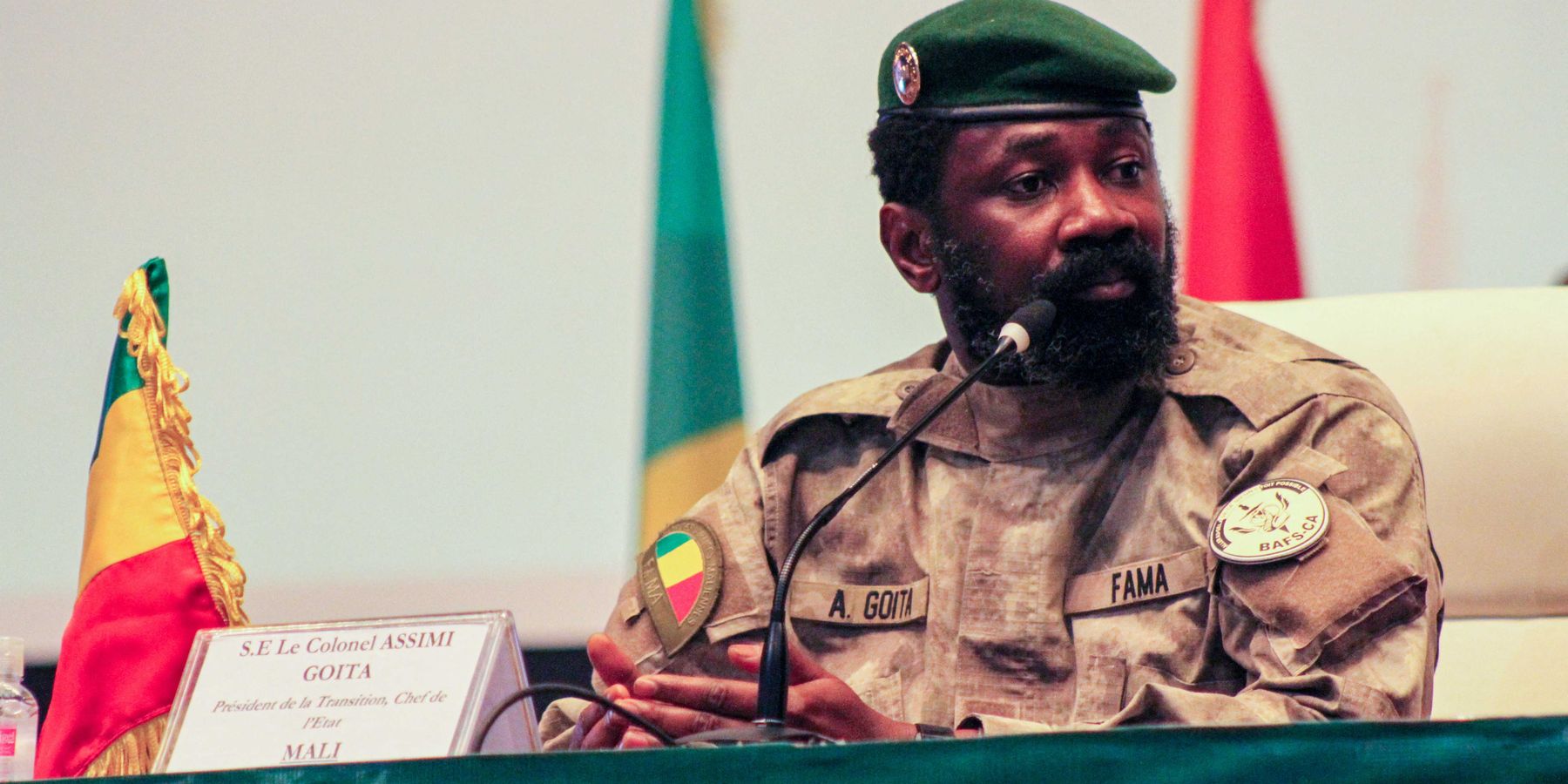
Since early September, members of the Jama'at Nusrat al-Islam wal-Muslimin (JNIM) terrorist organization have been attacking and kidnapping truck drivers transporting fuel to the Malian capital of Bamako. The effects of this blockade appear to be reaching a high point, with images this week showing residents jammed into long lines in the city’s supply-squeezed gas stations.
This comes after several days during which the blockade’s cuts to fuel forced many gas stations across the city to close. Some of the stations that have since reopened are only able to sell diesel to the city’s residents.
JNIM’s recent offensive has included a wider onslaught on surrounding businesses, attacking many local and foreign firms operating in the periphery of Bamako and in surrounding cities. Among the businesses that have endured attacks include those operating cement and sugar factories as well as mines — each of which is a critical sector to the country’s struggling economy.
According to Beverly Ochieng, a Sahel regional expert and senior analyst at the security consulting firm Control Risks, JNIM’s tactics to disrupt life in the Sahel include violent attacks against the region’s residents and militaries.
Ochieng told the BBC that JNIM plants “IEDs [improvised explosive devices] on key roads, and have long-range capabilities. They [also] target security forces in military bases, so a lot of their weapons come from that. They have also attacked civilians — in instances where communities are perceived to be cooperating with the government."
JNIM’s remarkable ability to bring the transport of fuel to the country’s capital to a near halt is the clearest sign yet of the organization’s extraordinary growth from a collection of disparate armed groups to a powerful player whose actions implicate the physical and economic security of Malians.
Formed in Mali in 2017 from the coalescence of five preexisting armed groups, JNIM is an al-Qaeda-affiliated organization seeking to overtake the governments of Sahelian countries and implement its strict form of Sharia law.
In recent years, the armed group has dramatically increased the territory under its control. According to Dr. Daniel Ezienga, a research fellow at the Pentagon-affiliated Africa Center for Strategic Studies, “The JNIM coalition now exerts much more influence and control over territory in Mali than at any other previous time during the 13-year insurgency.”
Along with the group’s geographic expansion have come a rise in attacks. According to the BBC, in the first half of 2025 JNIM was responsible for carrying out 280 attacks — double the amount of attacks for which the organization was responsible over the same six-month period last year.
Beyond a rise in the number of attacks overall, JNIM’s geographic expansion has increased the breadth of attacks across parts of the country that had previously experienced only limited JNIM activity.
Whereas last year the vast majority of JNIM’s offensive was concentrated in the country’s north — with only 8 percent of JNIM-induced violence occurring in the country’s southwest — this year, close to 20 percent of JNIM’s violent activity has taken place in southwest Mali. Bamako, which houses the seat of the country’s junta government, is located in the far southwest and is increasingly surrounded by JNIM activity and violence.
Among the major cities JNIM has aggressively bombarded in recent months is Kayes, located about 380 miles northwest of Bamako in the heart of the country’s southwest region. Kayes is the country’s second-largest contributor to national GDP, after Bamako, and a major transport route. Straddling the Senegal River, many of the goods transported from neighboring Senegal travel through Kayes on their way to the rest of the country. Both the cities of Kayes and Nioro du Sahel, located to Bamako’s north, have been primary locations of JNIM’s blockade. JNIM has banned all fuel imports from Senegal, Guinea, Côte d’Ivoire, and Mauritania, and has placed fighters on strategic locations along the country’s roads and riverways to ensure the blockade holds.
JNIM hopes the rippling effects of the blockade will upend the social contract between a population unable to obtain fuel and other basic necessities and a junta government that JNIM views as governing in violation of Islamic principles.
According to Ochieng, “JNIM [has] an ability to embed in local communities or to be able to use local grievances as a means of recruiting or winning sympathy towards their cause.” The economic strife created by the successful blockade, therefore, serves as a way to recruit disaffected Malians.
This fuel blockade and its effects have potential geopolitical consequences. The Malian junta had been receiving extensive support from the Russian Wagner mercenary group until recently, when the Kremlin decided that they would replace Wagner fighters with those from Africa Corps. In exchange, Russia receives payment and access to Mali’s resources. The Russian government has more control over Africa Corps, and uses this group less offensively than
Wagner, which suffered a major loss on the battlefield in 2024 when 84 Wagner fighters were reportedly killed in an ambush in Mali’s northern border city of Tinzaouaten. Whereas Wagner traditionally conducts more direct counterterrorism operations — such as ground-to-ground combat — Africa Corps is focused more on training and logistical support for national militaries with whom it partners.
Russia’s influence in the region grew after the United States and France left. The United States and France — the two traditional counterterrorism partners for Sahelian countries — have completely pulled their troops out of Mali and the neighboring junta states of Niger and Burkina Faso following failed counterinsurgency efforts there, and the rise of coup governments that oppose Western influence. The junta governments then turned to Russian mercenaries for counterterrorism support, believing that Russian aid would come with fewer stipulations.
This recent fuel blockade and its widespread effects on the residents of Bamako is an indication that Russia’s influence in the region is limited, and has thus far failed to defeat the armed groups against which Russian mercenaries have been fighting.
With JNIM threatening the stability of the Malian government and beating down on Bamako’s economic health, Russia’s Africa Corps has a difficult task ahead. If the war’s current trajectory continues, Africa Corps, too, could soon be on its way out of Mali, having failed to deliver peace for a junta government that might not survive the pressures caused by the country’s collapsing economic and security situation.
- Wagner's Africa momentum tested by deadly clash with Mali rebels ›
- Wagner, Mali, and prospects for peace in Africa ›
- Militants' blockade of Mali capital is a test for the US | Responsible Statecraft ›