

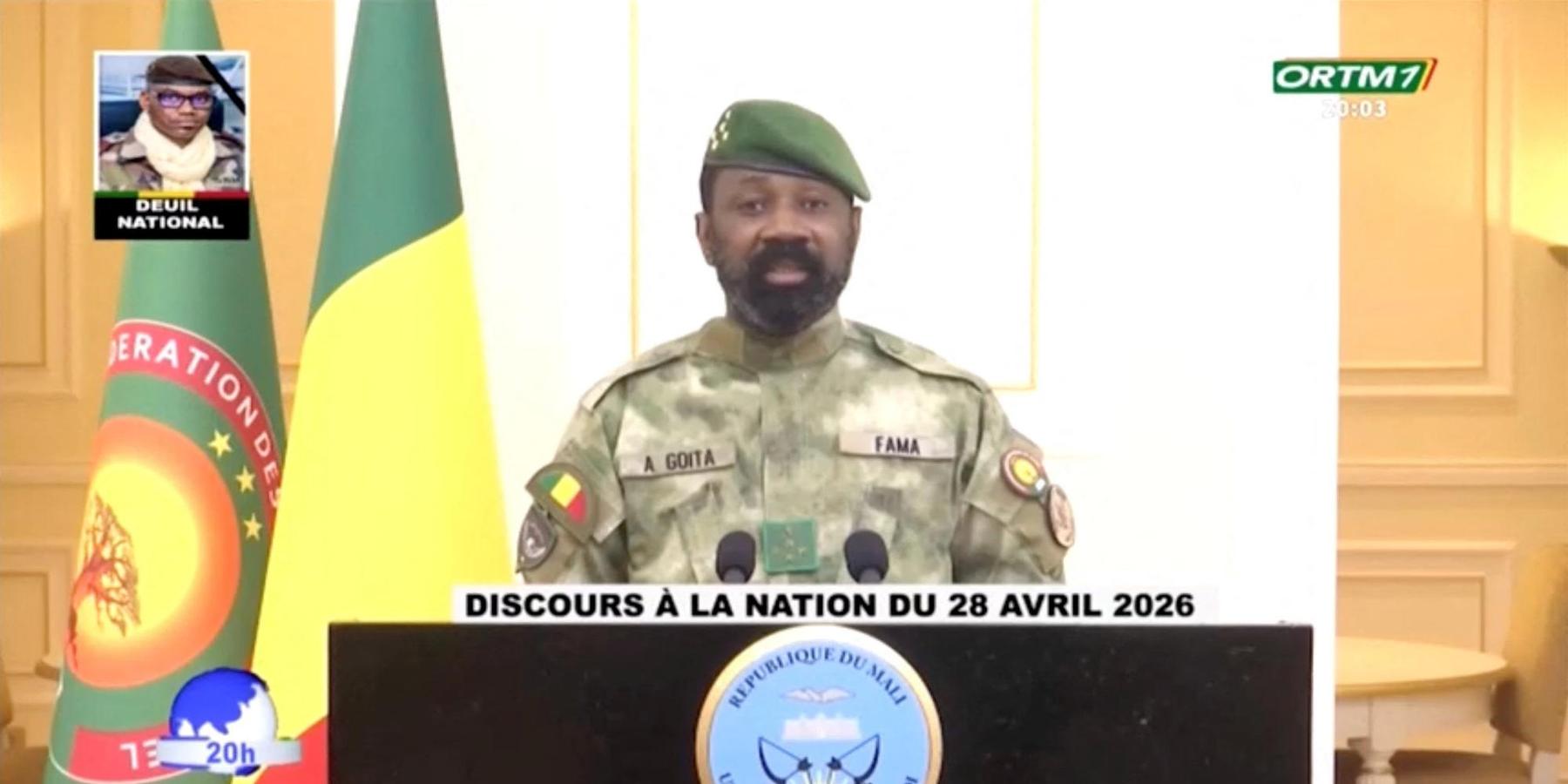
Jihadists in Mali launched massive attacks across the country on April 25, sparking widespread speculation about whether Mali’s ruling junta will fall.
Among the casualties on April 25 was a core junta member, Defense Minister Sadio Camara, whose death underscored the vulnerability of the authorities; Camara was also a major broker in Mali’s relationship with Russia, one of the few powerful allies the junta authorities have. Will Mali be ruled, sooner or later, by militants? Could the United States live with such a scenario?
Before turning to that question, there are good reasons to believe that those militants – Jama‘at Nusrat al-Islam wa-l-Muslimin JNIM), which is part of al-Qaida – could not actually take over Mali and do not want to do so.
The first reason is a likely lack of sufficient manpower. JNIM’s fighting strength is often estimated at around 6,000. Even a force double that size would struggle to control a country of more than 460,000 square miles.
Second, JNIM clearly desires the fall of the junta that has ruled Mali since 2020, but that doesn’t mean the group wants to run the country. In an April 30 statement, JNIM boasted of the success of its April 25 attacks and noted “the extreme fragility of this illegitimate, oppressor regime.” JNIM has also temporarily taken control of some towns and renewed its blockade of Bamako, Mali’s capital. Yet JNIM has not begun to carve out a formal territory of its own, preferring to exercise shadow governance in some areas while retaining overall flexibility and mobility.
Third, seizing control of the capital Bamako and proclaiming itself the sole governing authority in Mali would generate profound dilemmas for the group: how would it provide services and justice to a country of 25 million, where as much as two-thirds of the population live in profound poverty? And how would ruling Mali affect internal balances of power and priorities within JNIM, a broad coalition that operates in Burkina Faso, Niger, Togo, Benin, and Nigeria as well, and whose leaders are already “concerned that pushing outward too fast could fragment the movement’s ranks”?
Let us say for the sake of argument, however, that JNIM could or would induce Russia’s departure, and then shatter Mali’s junta and proclaim a jihadist emirate in Bamako. Could regional and Western powers tolerate such a scenario? And if not, what kinds of military responses might follow?
JNIM is now frequently compared to the Taliban in Afghanistan and to Hay’at Tahrir al-Sham (HTS) in Syria, both of which have been – reluctantly in the first case, and more enthusiastically in the second – tolerated or accepted by Western powers and by neighbors as rulers of their respective countries.
Yet in some ways JNIM is a more purely military organization than either of those entities and is therefore a greater unknown in terms of how it would govern. JNIM has virtually no external diplomatic presence, has less historical experience in administering territory, and has a more insular leadership. Unlike HTS, JNIM has also declined to break with al-Qaida, however weak the once-powerful terror group may now be.
All these factors mean that JNIM’s rule in Mali could be highly repressive, openly hostile and expansionist at the regional level, and incompatible with regional and international financial systems. On day one of JNIM rule, everyone from neighboring governments to the International Monetary Fund would be alarmed.
On the other hand, there could be a path to tolerating JNIM. A JNIM that ceased attacks in neighboring countries, disavowed al-Qaida, and offered a structured transition framework might be acceptable to other governments in the region, in Africa, and in the West. JNIM has shown a degree of political pragmatism. The group has negotiated with Sahelian states on narrow questions (such as, reportedly, prisoner release deals and election-related ceasefires); concluded pacts with local communities; and, most recently, openly coordinated with rebels and separatists in the north (who are longtime interlocutors of JNIM but are not themselves jihadists).
There would be severe risks, downsides, and outright moral ugliness to tolerating JNIM; at the same time, Mali’s current configuration of a highly repressive and failing junta, along with severe insecurity and uncertainty, is simply unsustainable.
In the end, there might not be much of a choice about tolerating JNIM. The possible structures for mounting a military intervention to topple them – whether the Economic Community of West African States (ECOWAS), the African Union, the United Nations, or an ad hoc coalition led by France or some other party – exhibit various states of exhaustion and incapacity.
When Nigerian President Bola Tinubu threatened in 2023 to mobilize ECOWAS to overturn a coup in Niger, he backed down after the limited political appetite among member states – and the fierce resistance he and ECOWAS would have met in Niger, to say nothing of domestic political backlash – became clear. France, which charged into Mali in 2013 to topple a jihadist emirate built by JNIM’s predecessor organizations, would likely find considerably less domestic support at home and considerably greater suspicion in West Africa should it attempt to repeat that earlier intervention. And the United States, embroiled in the Middle East, is in no position to coordinate a credible operation in Mali.
Any coalition bold enough to take on JNIM would soon find itself in a quagmire, holding a shattered Bamako but facing attacks over the rest of Mali’s vast and politically complex territory.
JNIM rule over all of Mali appears unlikely at present. But if I were a Western diplomat, I would be thinking through scenarios for the fall of Bamako – be it to JNIM, or even more likely to a new military junta which would then either start negotiating with JNIM or drift into the predicament of the current authorities. I would also be thinking through the possibility of a more overt partition of the country, a process already accelerated by the April 25 attacks, which led to the northern rebels’ capture of the city of Kidal. And I would be seeking channels of communication to all parties in the conflict – including the junta in Bamako, the rebels in the north, and JNIM itself.
Likelier than a clear winner emerging is a scenario of even more fragmented control; and in that scenario, Washington might as well be talking with all the major actors.
- Militants' blockade of Mali capital is a test for the US ›
- Violence in Mali is pushing Mauritania to the brink | Responsible Statecraft ›