

Soon after Syria experienced its Arab Spring uprising in 2011 and slid into a gruesome civil war, the country became a battleground for Russia, Iran, and Lebanon’s Hezbollah supporting the former regime on one side, and Qatar, Saudi Arabia, and Turkey backing rebel groups on the other.
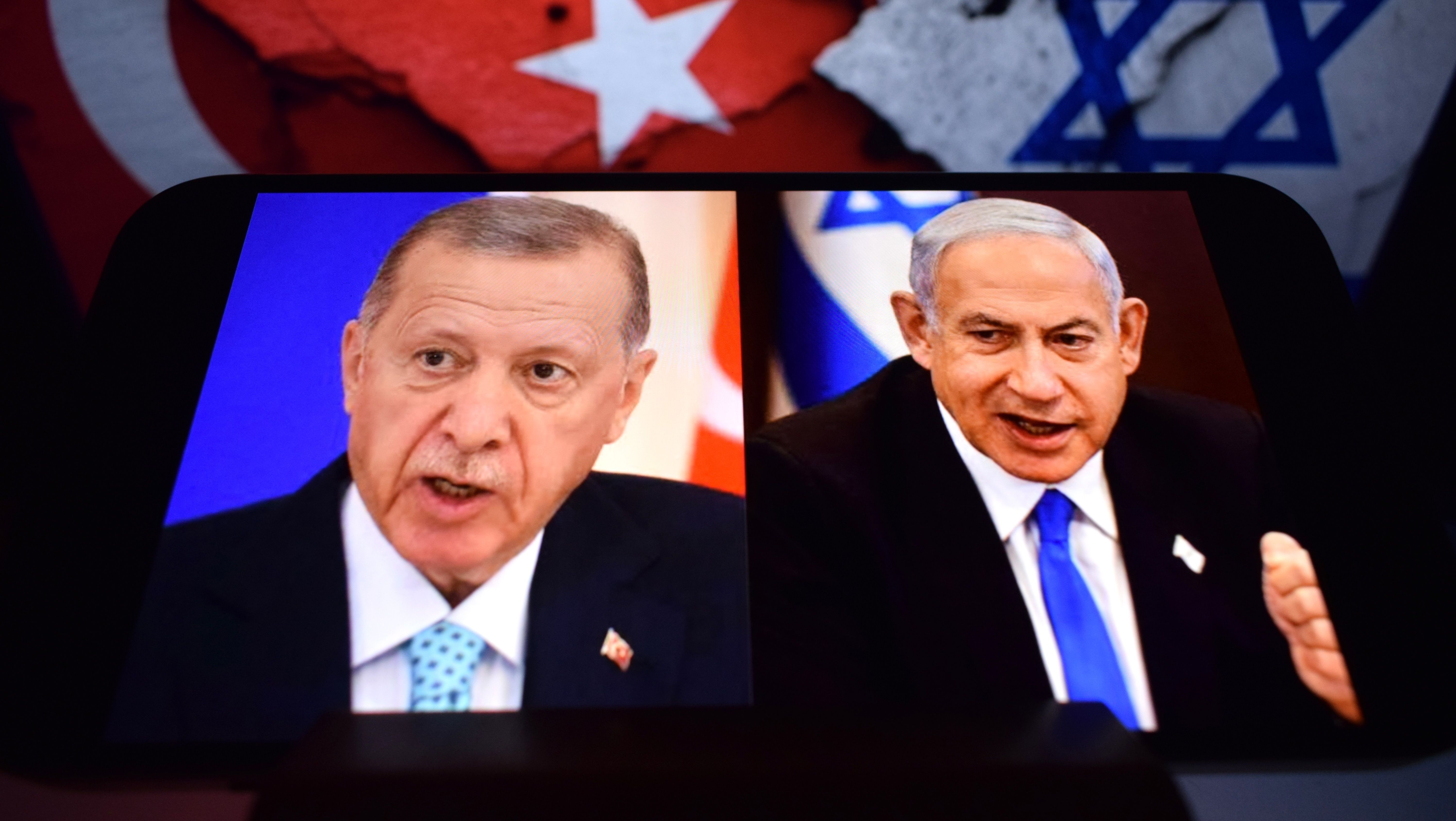
Since Bashar al-Assad’s ouster late last year, however, dynamics have shifted, transforming Syria into an arena of Turkish-Israeli competition. A major source of tension between Turkey and Israel stems from the former’s desire to see Syria emerge as a strong, unitary state with a Turkey-oriented government in Damascus while the latter wants Syria permanently weak and divided along ethno-sectarian lines.
The Israeli government’s perspective is that Turkey’s growing clout in post-Ba’ath Syria poses a grave threat to the Jewish state. At the start of this year, an Israeli government committee that assesses regional security issues put out a report warning that Syria’s new Sunni Islamist authorities might pose a graver threat to Israeli security than Syria did under Assad. The committee considered the possibility of the new Damascus government becoming a "proxy" of Ankara, citing “Turkey’s ambition to restore the Ottoman Empire to its former glory.”
Meanwhile, Turkish President Recep Tayyip Erdogan and other officials in Ankara have used strong language to condemn Israel’s aggression, not only in Gaza and Lebanon, but also in post-Assad Syria.An intensifying showdown
Israel began bombarding Damascus and other parts of Syria, while also illegally usurping more Syrian land past the Golan Heights, in the immediate aftermath of the former regime’s collapse nearly five months ago.
Then late last month and at the start of this month, Israeli military operations struck Syrian bases in which Ankara had indicated interest following much talk about Turkey formalizing a military alliance with post-Ba’ath Syria. Ultimately, Israel wants to prevent a future in Syria where Ankara acts as Syria’s security guarantor and can effectively deter the Israelis from carrying out bombing or ground attacks on Syrian territory at will, which has been happening since Assad’s ouster, and was also taking place to a significant degree during Assad’s final years in power.
The Israelis have gone as far as lobbying Washington to support a Russian military presence in the country to serve as a bulwark against Turkish influence.
“Israel saw an opportunity and a power vacuum in Syria after Assad, launching numerous airstrikes and even attempting ground incursions. It also tried to stir up minority groups like the Druze and Kurds to keep Syria fragmented and weak,” explained Dr. Mustafa Caner, an assistant professor at Sakarya University Middle East Institute, in an RS interview.
“In this context, Israel views Turkey as a threat, because Turkey has made it clear that it will not accept a divided and weakened Syria. In this picture, Turkey acts as a balancing force against Israel.” Despite there being a possibility of the tensions between Turkey and Israel playing out on Syrian soil escalating into a direct state-to-state confrontation, many experts see that as unlikely.
On April 9, Turkish and Israeli officials met in Azerbaijan for talks aimed at bringing Turkey and Israel to a common understanding on Syria’s security landscape. The discussions centered on the establishment of a “deconfliction channel” to reduce the risks of the two powers entering a direct confrontation on or over Syrian territory.
“At this stage, I absolutely do not expect a conflict [between Turkey and Israel],” Dr. Pinar Dost, a nonresident fellow at the Atlantic Council and an associate researcher with the French Institute for Anatolian Studies, told RS.
"During the nearly 14-year-long civil war, similar mechanisms were established between many countries that supported opposing groups, such as Turkey-Russia, Turkey-U.S., and Russia-Israel. A similar mechanism is likely to be established between Israel and Turkey.”
Dr. Karim Emile Bitar, a lecturer in Middle East Studies at Sciences Po Paris, shares this assessment that a direct military confrontation will probably not erupt. However, he stressed that “the proxy wars in Syria are not over yet” and that the combination of “Israeli overreach” and a “growing Turkish appetite” increases the risk of “growing fragmentation” of an already weak Syria as its more powerful neighbors compete for influence on its soil.
"As the old African proverb says, ‘When two elephants fight, it is the grass that suffers.’ Lebanon historically was always the grass. Now Syria is becoming the grass," said Bitar.
The US role
While tensions between these two U.S. allies over the “New Syria” remain hot, Washington is a center of gravity. The Trump administration has signaled its determination to pull Turkey and Israel back from their hostilities.
"When we consider that the U.S. plans to withdraw its troops by the end of the year [and] is imposing an agreement between the [Syrian Democratic Forces] and Damascus, and Turkey’s efforts to form an anti-ISIS coalition with Iraq, Syria, and Jordan, the picture becomes quite clear," Dost said.
"As it withdraws from Syria, the U.S. government would like to leave behind an environment where its allies can reach an understanding. It will also want to ensure normalization between Israel and Syria before leaving," she added.
During the Trump-Netanyahu Oval Office meeting on April 7, Trump praised Turkey for its role in the Assad regime’s collapse and spoke of his “very, very good relationship” with Erdogan.
"I happen to like [Erdogan], and he likes me ... and we've never had a problem," said Trump, who signaled to Netanyahu his belief that Israel’s problems with Turkey will remain under control and even offered to mediate between the two. Trump told the Israeli prime minister that he must be “reasonable” in Syria when it comes to issues with Ankara.
“In my view, when Trump spoke positively about Turkey’s strong role in Syria and told Netanyahu to ‘be reasonable,’ it was a warning to Israel that it had gone too far in its actions there. This amounted to an acknowledgment of Turkey as a balancing power. Netanyahu was not pleased but had no choice but to accept it,” Caner said.
“Trump essentially told Netanyahu to respect Turkey’s priorities and positions. It's hardly necessary to state how much Israel relies on U.S. backing, so Trump’s warning was intended to put the brakes on Israel’s activities in Syria — and I believe it will,” he added.
Recognizing Trump as a “leader who speaks the language of power,” Dost noted his respect for Erdogan’s “success in bringing about change in Syria” but she does not believe that issues concerning Ankara’s role in post-Assad Syria will fuel much tension between the White House and Netanyahu’s government. In Dost’s opinion, the real issue is Washington’s diplomatic engagement with Iran on the nuclear file with ongoing talks set to continue in May.
“In his meeting with Netanyahu, Trump effectively scored two goals against him: first, by announcing plans to negotiate with Iran, and second, by praising Turkey and President Erdogan for more than two minutes. These were major blows, and Netanyahu will have a hard time overcoming them. As a result, I don't think Israel can act as recklessly as before, and it certainly cannot afford a direct confrontation with Turkey,” Caner said.
- Is Israel expanding territorial control toward Syria? ›
- Is Turkey's big break with Israel for real? ›
- Turkey and Israel are reaping rewards from the chaos in Syria ›
- Trump's wise, bold Syria reset | Responsible Statecraft ›
- Is Trump ghosting Israel? Not so fast. | Responsible Statecraft ›
- Why Israel is now turning its sights on Turkey | Responsible Statecraft ›
- Shotgun wedding? Israel and Syria go to the altar. | Responsible Statecraft ›
- Israel-Syria clash puts US policy in the crosshairs, again | Responsible Statecraft ›
- ‘This ain’t gonna work’: How Russia pulled the plug on Assad | Responsible Statecraft ›