

Despite the strong anti-Iran stances of several Gulf Arab states, all of the members of the Gulf Cooperation Council (GCC) called on Washington and Tehran to exercise restraint following the US killing of Iranian al-Quds Force commander Qassem Soleimani in early January. The desire to avoid a conflagration in the Gulf region has been the one unifying position within the fractured GCC since the Qatar crisis developed in June 2017.
There has been a sigh of relief that President Donald Trump and the Iranian leadership have not escalated matters since Iran’s retaliatory strikes on Iraqi bases housing US military personnel. Still, however, the Gulf Arab states are still worried that a US-Iran confrontation could transpire down the road, one in which they themselves could be targeted or, at a minimum, see their economic interests adversely affected.
The concerns of these states stem from their feelings of vulnerability and the fact that they perceive the United States increasingly as an unreliable and erratic ally. Despite the hundreds of billions of dollars they have spent on their own defense, the Gulf Arab states are unsure how their militaries would fare against Iran. Moreover, a war in the Gulf would not only disrupt important oil flows but would set back the gains the states have made in building large physical and financial infrastructure projects. These have been the hallmark of Gulf development over the past several decades and thwarting their benefits could lead to sectarian strife within some countries of the region.
Unifying Message of Restraint
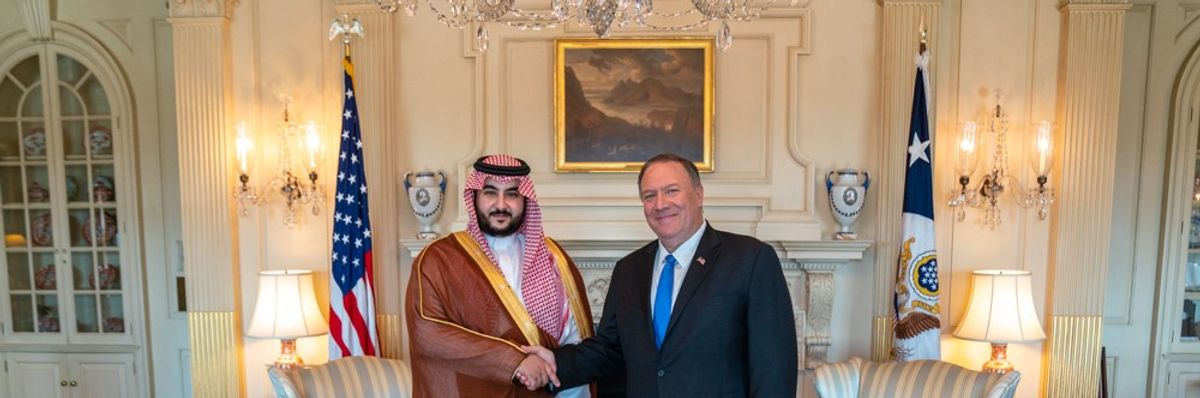
Immediately after the US strike and the killing of Soleimani, the Gulf Arab states employed diplomacy and diplomatic language to try to defuse the crisis. Saudi Arabia dispatched Deputy Defense Minister (and former ambassador to the United States) Khaled bin Salman to Washington where he met with President Trump and other high-ranking officials. Bin Salman’s message was to urge the United States to exercise “restraint.” That seemed to have been the buzzword all around. Qatari Foreign Minister Mohammad bin Abdulrahman Al Thani visited Iran and met with Iranian President Hassan Rouhani and urged Iran to do the same. His visit to Tehran was followed by that of the Qatari emir himself. Meanwhile, Anwar Gargash, Minister of State for Foreign Affairs of the United Arab Emirates, made a public statement calling on all parties to put “wisdom, balance, and political solutions above confrontation and escalation.”
Avoidance of a military escalation in the Gulf region seems to be one unifying message on which all GCC states agreed, as the GCC itself remains fractured following the economic and political boycott of Qatar by Saudi Arabia, the UAE, and Bahrain (along with non-GCC member Egypt) since June 2017. Although there have been some efforts to mend fences in recent months between Qatar and its neighbors, a true rapprochement is still elusive. Nonetheless, the fact that Qatar has developed close relations with Iran (made closer by the boycott) arguably works to the benefit of other GCC states because different states could then use their equities with Washington and Tehran to help calm the situation down.
Despite the harsh language over the past few years between Riyadh and Tehran, as well as between the latter and Abu Dhabi, there have been efforts by both Saudi Arabia and the UAE to open back channels to Iran in recent months. This was probably due in part to the realization that the Yemen war, in which all three countries are belligerents to varying degrees, cannot be solved militarily and that Yemen needs a political solution to end its humanitarian nightmare. In addition, sharp differences between Saudi Arabia and the UAE in Yemen made the Saudi-led military coalition much less viable in recent months, rendering a political solution all the more desirable.
The fact that the Soleimani killing occurred when these GCC states were trying to reach out to Iran made the US-Iran crisis even more disturbing, as it threatened to derail the easing of Gulf Arab-Iran tensions. Indeed, Iraqi Prime Minister Adel Abdul-Mahdi told the Iraqi parliament that he had been mediating between Iran and Saudi Arabia and that Soleimani, shortly before he was killed, was bringing a message to the Saudis from Iran. Although US Secretary of State Mike Pompeo has dismissed this claim, if it were true, it would also explain why the Saudis were especially eager not to see a military confrontation in the Gulf region.
It should be noted that Oman, the country within the GCC that has traditionally been a conduit between Washington and Tehran, was not in a position to play its traditional role as mediator in this case because the US-Iran crisis coincided roughly with the death of Oman’s Sultan Qaboos. While Oman’s new leader, Sultan Haitham bin Tariq Al Said, has emphasized that there will be continuity in his country’s foreign relations, he was not yet positioned to insert himself as mediator in the US-Iran crisis, having just ascended to the throne.
Fear of Iranian Military Strikes…
The Gulf Arab states have substantially developed their military establishments in recent decades, using abundant oil revenues to pay for very expensive military equipment and training. However, as the Yemen war has shown, training and hardware do not necessarily translate into building effective military forces. The Saudi bombing campaign against the Houthi rebels in Yemen has illustrated the limits of such massive investments, as many errant bombs have killed hundreds of civilians, according to the United Nations. While the Gulf Arab states may be able to hold their own against states or groups in the Arabian Peninsula (for example, in the case of possible border clashes), they fear they may not be able to stand up to a major regional power like Iran which has a much larger and more powerful military establishment than their own, and one that has been battle-tested.
Moreover, Iran has already used force in the region as a way of signaling its superior might to the Gulf Arab states. In the past year, Iran has not only mined Gulf waters and scuttled oil tankers, but has directly attacked Saudi oil facilities on the Saudi mainland with missiles and drones last September, causing significant damage to the country’s oil infrastructure.
Neither the UAE nor Saudi Arabia responded militarily to these attacks and provocations. They and other Gulf Arab states reportedly were counting on the United States to come to their aid by possibly attacking some Iranian military facilities in response. When that did not happen, even after the Iranian attack on Saudi oil facilities, they began to reassess their situation.
… and Seeing the United States as an Unreliable Partner
The Gulf Arab states came to understand that the United States would respond militarily to Iran only if a US citizen were harmed (as was the case when an American contractor was killed in Iraq by a pro-Iran militia). However, Washington’s response to target this militia and Soleimani—leaving aside the issue of whether he was imminently planning to attack the US embassy in Baghdad, a claim that Democrats in the Congress have debunked—was seen as unnecessarily provocative and dangerous by these states. Soleimani was not only a high-ranking Iranian official but also one who was revered by militant Shias the world over. It is likely that these Gulf Arab leaders were not sure that Trump understood the ramifications of his order, nor did the president think through subsequent steps.
Therefore, and despite all of Trump’s efforts to stay in the good graces of the Gulf Arab states, particularly Saudi Arabia, over the past three years he came to be viewed by officials of these countries as both unreliable and erratic. If he could order the targeted killing of Soleimani, what else might he do?
Shortly before the Iranian military response to the Soleimani killing, many political analysts in Washington and the region were speculating that Tehran might take out its anger against some of the Gulf Arab states, which could be a less risky proposition in Iranian eyes than an attack on a US target where American service members might be killed. Such discussions must have made Gulf Arab leaders extremely nervous. In their eyes, relying solely on the US security umbrella clearly was not a safe bet. The better choice in the minds of the Gulf Arab leaders was to try to cool things down before the situation spiraled out of control and made their own countries targets of Iran’s wrath.
Furthermore, with the US elections in November, the American electorate might choose a new president who would likely be less friendly than Trump is to the Saudi government. For example, former Vice President Biden has called Saudi Arabia a pariah state; Trump, for his part, has defended Riyadh politically and has sent more US troops to the region. The idea, then, of counting on Washington for protection against Iran could look even less promising down the road.
A Lot to Lose
Although heightened tensions in the Gulf temporarily led to higher oil prices for a period of time in early January—enabling the Gulf Arab states to collect more revenue—the economic costs outweighed the short-term gains. First, there was a spike in the cost of shipping crude oil through the Strait of Hormuz, and Saudi Arabia’s oil tanker company, Bahri, actually suspended shipments through this vital waterway for a time. Second, shares of Saudi Aramco, which were recently offered on the world market and which have been on a downward slope since their peak in mid-December 2019, dipped 1.7 percent after the Soleimani killing as investors worried about another Iranian strike on Aramco’s facilities. Even a small dip in the value of these shares can cost the kingdom hundreds of millions of dollars. Importantly, Saudi Crown Prince Mohammed bin Salman has been counting on the revenue from these shares to help build up the non-oil sectors of the Saudi economy as part of his “Vision 2030” diversification campaign.
In addition, the Gulf states have made enormous investments in both physical and financial infrastructures in recent decades and they are very worried that a US-Iran war could lead to devastating consequences. An unnamed former US intelligence official who had just returned from the Gulf was quoted as stating: “Everyone from Kuwait to Oman is fearful of escalation. Everyone realizes that a military conflict could be a disaster.” This former official then added that if an Iranian missile hits an office tower in Dubai, “its reputation as a financial center is in jeopardy.” One does not have to watch the Travel Channel on cable television to understand that all the efforts to create a western-style commercial center and playground in the Gulf—such as Dubai, which has attracted business people and tourists from around the world—could potentially come crashing down if a war were to envelop the Gulf.
Several of the Gulf states are worried that a US-Iran war might lead to a rekindling of sectarian strife that was manifestly evident in 2011-2012, particularly in Bahrain (whose population is 60 percent Shia but which is controlled by a Sunni monarchy), and Saudi Arabia (whose Shia population resides mostly in the oil-rich Eastern Province). Although most of the Shia in the Gulf Arab states are not loyal to Iran, some militant groups are, and they could foment trouble in the event of a US-Iran war. Efforts to repress such groups could escalate into sectarian clashes and give the Iranian regime an excuse to intervene, something the Gulf Arab states want to avoid at all costs.
Relief for Now but Worries about the Future
There was a great sigh of relief in the Gulf Arab states that the Iranian retaliatory strikes on Iraqi bases housing US military personnel did not lead to American deaths, enabling Trump and the Iranian leaders to stand down. However, this does not mean that the crisis is completely over. With the Iranian regime under enormous stress because of the US “maximum pressure” campaign, it might lash out at US targets in the region or against the economic interests of the Gulf Arab states once again. The regional situation is still very tense; to be sure, it is not unreasonable to assume that there will be another US-Iran clash. The rhetoric in both Tehran and Washington at this stage is still uncompromising.
To ease the anxieties in the Gulf Arab states, this rhetoric needs to scale down. Gulf Arab officials should continue to urge restraint on both sides. Though they have no love for Iran, the Gulf Arab states have come to realize that a war into which they are likely to be drawn would have disastrous consequences for their economy and security and for their people. At a minimum, US policy makers should not interfere in these states’ outreach to Iran that may indeed help to defuse tensions; after all, Trump has said he does not seek war with Iran and has campaigned against US involvement in another Middle Eastern quagmire—a sentiment that continues to resonate with the American people.
This article has been republished with permission from Arab Center Washington DC.