

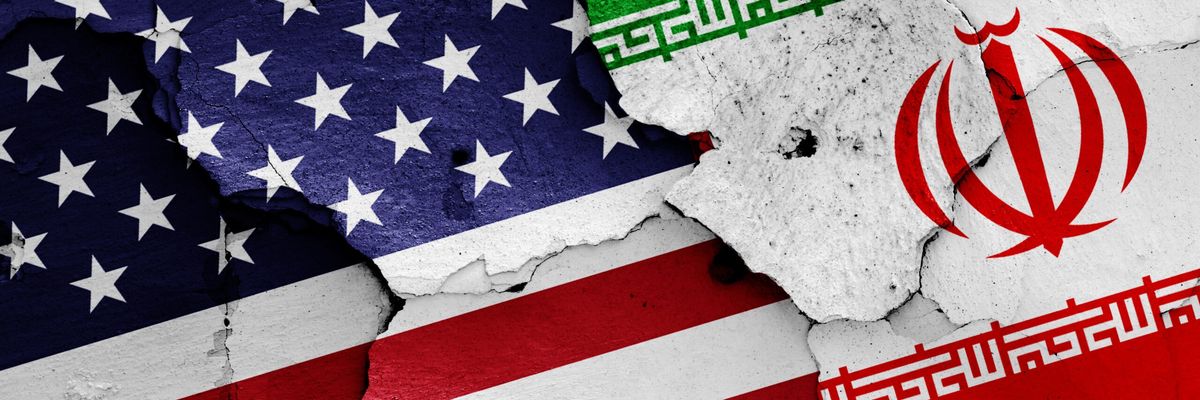
In May 2018, Donald Trump withdrew from the 2015 nuclear deal with Iran (the Joint Comprehensive Plan of Action or JCPOA) and President Joe Biden has yet failed to revive it. The Biden administration has not reached a clear political decision to complete the negotiations. On the one hand it insists “diplomacy is the best option,” while, on the other, it says that the JCPOA is “not on the agenda.” This is a mistake.
Since September 2022, negotiations over JCPOA have been stalled. Suspected export of Iranian weapons to Russia for use in Ukraine and unrest in Iran following the killing of Mahsa Amini for not wearing a headscarf turned the U.S. and European focus away from reviving the JCPOA.
In August 2022, the European Union’s foreign policy chief, Josep Borrell, said that a final agreement to revive the Iran nuclear deal was ready to be signed. Although Iran’s government did not agree at the time, during recent months it has indicated that it is ready to do both that and a prisoner deal.
Iran and the United States have agreed on the details of a prisoners exchange but Washington is likely nervous about the domestic political reaction because that deal would involve the release of approximately $7 billion of Iran's funds that have been locked up abroad. Moreover, the Key “sunsets” for JCPOA limits on Iran’s nuclear and missile program and arms trade range from 2023 to 2041. Based on the JCPOA, in October 2023, the UN Security Council is supposed to lift restrictions on Iran’s missiles and drones with a range of greater than 300 kilometers. The Biden administration is required to seek congressional legislation that ends some of the U.S. sanctions in this area.
Such sanction lifting could be grist for Republican political attacks on the Biden administration during an election season. But further delay brings its own dangers. Iran’s nuclear program has already reached the point where the country could within two weeks produce enough weapon-grade uranium for one nuclear bomb.
In the face of this complex situation, the Biden administration is dithering. It may be considering a "temporary agreement" as a middle way for the U.S. to contain this situation. This would be consistent with the Biden administration’s recent policy of "No Deal, No Crisis" with Iran in which the administration is also trying to avoid a major military conflict. In March, there was a clash between Iranian and U.S. forces in Syria.
The United States and Europe are therefore faced with three policy options.
The first is this aforementioned "temporary agreement" or plan B. Most probably, the U.S. would demand a freeze on critical parts of Iran’s nuclear program, including no more enrichment of uranium to near weapon grade, and reductions in Iran's stockpile of highly enriched uranium in exchange for limited relaxation of U.S. sanctions. Iran has already rejected this option because it would lose the bargaining leverage provided by its stock of highly enriched uranium in exchange for limited sanction relief in an unsustainable temporary agreement.
A more realistic version of this option would be a more-for-more alternative. Iran would like to see sanctions lifted on both its financial institutions and oil exports. The U.S. and Europe are concerned about Iran’s stockpile of highly enriched uranium and reestablishing Iran’s voluntary compliance with the Additional Protocol to its safeguards agreement with the International Atomic Energy Agency (IAEA). Inspections allowed by the Additional Protocol would help the IAEA determine whether Iran has built any secret nuclear facilities during the period it suspended its transparency.
A temporary agreement would not be a sustainable solution, however, and it is unlikely in any case that the Biden administration would agree on lifting sanctions on Iran financial institutions and oil exports as part of a temporary agreement.
The second option that is under consideration by European parties to the JCPOA would be activation of the "trigger mechanism" in the UN Security Council Resolution 2231 backing up the JCPOA. This would restore all of the sanctions suspended by the JCPOA. France, UK, and Germany have recently held a meeting with 10 non-permanent members of the UN Security Council to discuss the "trigger or snap back mechanism."
This scenario could have major risks as Iran may respond by withdrawing from the Nonproliferation Treaty which allows the IAEA to monitor its nuclear materials. Any U.S. or Israeli military strike would dramatically change Iran’s calculus of immediate security threats and therefore, would most likely push Iran towards building a nuclear weapon. The consequences of a war with Iran would be well beyond those resulting from the wars on Iraq and Afghanistan, at the same time the U.S. and Europe are engaged in a proxy war with Russia in Ukraine. Moreover, while current relations between the EU and Iran already are experiencing unprecedented tensions, any EU initiative to activate the snap back mechanism would be a nail to coffin of bilateral historical relations with Europe and the West.
The third and best option would be for Iran and the United States to resume direct negotiations, compromise on some confidence-building measures to contain tensions, revive the JCPOA based on the August 2022 draft agreement and carry out the prisoner exchange. Recently, in a modest step in this direction, on May 1, the IAEA began reinstalling cameras at certain nuclear facilities in Iran under an agreement the agency reached with Tehran in March 2023. Such confidence building measures are helpful if proportionality reciprocated by the U.S. and other world powers.
Simultaneously, to address regional issues, a dialogue should be started between Iran other Persian Gulf countries. The recent agreement to reestablish diplomatic relations between Iran and Saudi Arabia has created a golden opportunity to start a regional dialogue on collective security. Such a dialogue could result in agreements to cooperate on security of energy and maritime issues in the Persian Gulf, Arab-Persian rapprochement, and resolving the regional crises in Yemen, Lebanon, Syria, and Iraq.
“The JCPOA is widely regarded as a cornerstone of nuclear non-proliferation, and an example of what dialogue and diplomacy can achieve,” said United Nation Under-Secretary-General Rosemary DiCarlo. The JCPOA should be considered as a pathway toward rebuilding a peaceful regional security system in the Persian Gulf and the broader Middle East.
Five years after Trump’s strategic mistake of withdrawal from the JCPOA, President Biden should not let the quixotic quest for a better deal kill the JCPOA — which is most comprehensive non-proliferation agreement in history — thereby blocking opportunities for creating a new security and cooperation mechanism in the Persian Gulf enhancing sustainable peace and facilitating the path to a regional zone free of all weapons of mass destruction.