

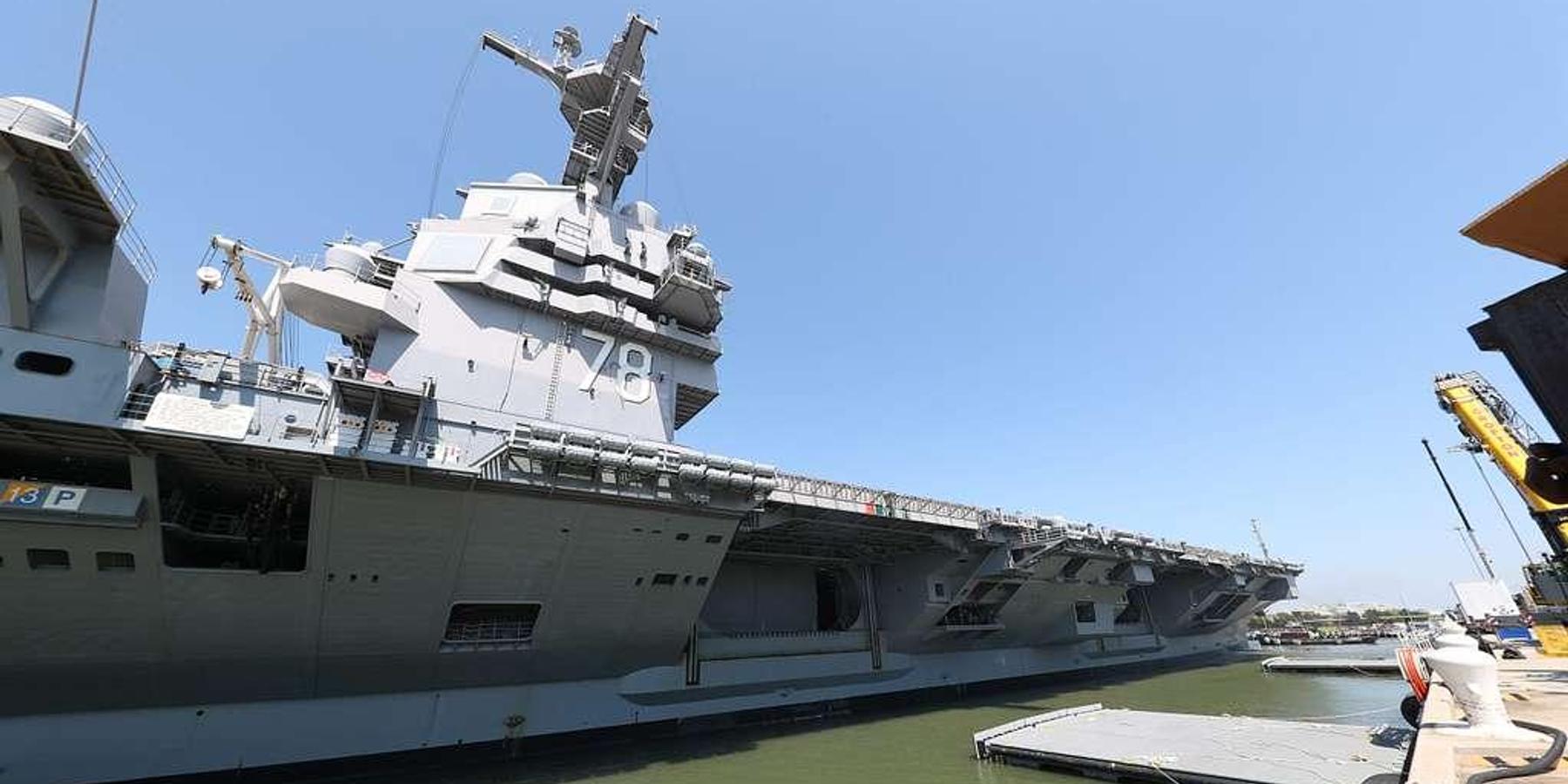
A March 12 fire that injured 200 sailors is just the latest embarrassing incident in the history of the USS Gerald R. Ford. The vaunted aircraft carrier has become a case study demonstrating how such a program will fail when policymakers prioritize economic and political concerns over military effectiveness. Navy leaders pulled their premier ship from the front lines after the laundry room fire and sent it to the island of Crete, where it will undergo urgent repairs for at least a week.
Construction on the Ford began in 2009, but the ship wasn’t commissioned until July 2017. Even then, the ship was far from ready for service. It took another five years for the Navy to put the ship to sea on its first operational deployment.
Almost from the beginning, the Ford has been plagued by developmental problems. In the early 2000s, Navy leaders decided to replace the existing fleet of Nimitz-class aircraft carriers, which have provided reliable service for more than 50 years, with a newly designed ship. Doing so meant the contractor could milk the development process given that the government would reimburse the company for the research and development costs.
The process incentivized the inclusion of nearly two dozen new, unproven technologies. This complicated the development process and delayed delivery by at least three years and increased costs more than 25%, from $10.5 billion to $13.2 billion.
This spending has done little to improve the vessels’ capabilities. But the inclusion of so many new technologies did create economic opportunities all over the country. More than 200 suppliers, spread across the country, build components for the Ford-class program.
The architects of the Ford-class abandoned steam-operated aircraft catapults and hydraulic elevators — technologies proven reliable in the Nimitz-class — with 21st Century electrical systems. The Ford’s catapults are called the Electromagnetic Launch System, or EMALS. The system stores an enormous amount of electricity, enough to power 13,000 homes, generated by the ship’s nuclear reactors. The electrical charge is released through a sudden burst in the system’s electromagnets, which pushes the magnets and the launching aircraft down the track.
Specifications for the system said it could launch more than 4,000 aircraft before and between any critical failures. But, as with many modern electrical systems, EMALS has proven far less reliable than expected. The Navy and Department of Defense haven’t released specific figures for several years, but reporting in 2021 shows the Ford’s catapults failed after only 181 launch cycles. The latest report from the Pentagon’s testing office said the system’s performance hasn’t improved much and still requires “off-ship technical support.”
The Ford has four catapults, so the crew can shift from one to another in case of a failure. But the catapult system includes a significant design flaw. Sailors do not have any way to electrically isolate each catapult. To work on one, the entire EMALS system has to be deenergized. That means the crew would have to stop launching aircraft to make repairs. Doing so would be clearly problematic if multiple catapults failed at the same time during combat operations.
The Navy’s glitzy new aircraft carrier isn’t very good at launching aircraft, but the crew has even more reason to knock the ship’s delicate plumbing system. The vessel’s designers rejected a traditional sewage system and instead charged taxpayers to develop a vacuum system similar to the kind used in commercial aircraft, but scaled up to accommodate the needs of a 4,000 person crew.
The Government Accountability Office, however, warned in 2020 that the sewage system clogged frequently and required regular acid flushes to clear calcium buildups in the system’s narrow pipes. Each flush costs approximately $400,000.
Not surprisingly then, the Ford’s sewage system has been a constant source of trouble. Sailors report daily breakdowns of the system. NPR reported that during a four-day period in 2025, engineers logged 205 breakdowns. Embarked sailors are frequently told the heads (the nautical term for toilets) are unavailable for a period because technicians are making urgent repairs to the system.
The effect on the crew’s morale must be profound. Reports from the ship include finding socks and pieces of rope in the sewage system. A single incident could be chalked up to an accident, but when it happens repeatedly, it begins to look like sabotage. No clear evidence of foul play has emerged, but a disgruntled crew can certainly resort to such means if quality of life on the ship continues to deteriorate.
Sailors have no choice but to trust their lives to the ship. If the Navy can’t provide them working toilets, how can they really trust the rest of the ship’s capabilities? The Ford’s catapults don’t work like they are supposed to. It would be perfectly reasonable for a sailor to question whether or not the ship’s missile defenses will work as required.
All the Ford’s problems could have been avoided if industry leaders, Navy officials, and politicians simply kept their priorities straight. If they had simply prioritized military effectiveness ahead of economic and political considerations, the Ford would have a robust sewage system capable of meeting the crew’s needs. The American people would have their capital ship — for which they paid more than $13 billion — in action during a hot war, rather than seeing it laid up dockside for urgent repairs to its laundry facilities.
- After sinking Iranian ship, did the US Navy commit a war crime? ›
- The US Navy just lit another $9 billion on fire ›