

This article is part of an RS series reflecting on the 250th anniversary of American Independence and its impact and meaning for modern U.S. foreign policy, war, and peace.
When it comes to war, the Trump administration faces a credibility problem. According to CNN, between late March and early June, the president claimed he was on the verge of reaching a peace deal with Iran at least 38 times. Such fabrications came nearly a full year after Trump declared that Iran’s nuclear facilities had been “obliterated” and suffered “monumental damage.”
Secretary of Defense Pete Hegseth has been equally sanguine these past months, bragging at one April Pentagon press conference that Operation Epic Fury, the campaign against Iran launched on February 28, had been “a historic and overwhelming victory on the battlefield, a capital-V military victory.” And yet the war continued on.
Now, a tenuous “memorandum of understanding” to reopen the Strait of Hormuz and lift Iranian sanctions, while raising alarm among some members of Congress, has been painted by Trump as a major win thanks to a “record high” stock market and “tumbling” oil prices.
Such optimistic yet fallacious progress reports elicit memories of another American war in which credibility became contested ground, both at home and abroad. The lies of Vietnam created a “credibility gap” between the White House and American public — one that has now turned into a credibility chasm undermining the trust necessary for political leaders to deliver on their national security promises.
It is with good reason that the American war in Vietnam has come to be seen as one of the most contentious conflicts in our nation’s 250-year history. The political-military struggle set a historical benchmark for how we talk about — and lie about — war. Distortion and deception seemed indivisible from the very conduct of American military interventionism.
The duplicity started early. Gen. Paul D. Harkins, the first chief of the U.S. military assistance command in Vietnam, openly boasted that “I am an optimist, and I am not going to allow my staff to be pessimistic.” Not surprisingly, rosy reports flowed into Washington. The communist insurgents were diminishing in strength and influence. The Saigon government was attracting loyalty among the rural population. The war was being won.
In August 1964, months after Harkins’ tour ended, Washington Post reporter Arnold Beichman shared a popular refrain Americans were still singing outside of Saigon. “We are winning, this we know / General Harkins tells us so.” When Beichman asked a group of U.S. advisors if they thought the South Vietnamese indeed were winning, they unanimously declared “no.”
Less than a year later, there seemed little doubt about the U.S. advisory mission’s inability to stanch the communist tide. In the spring of 1965, President Lyndon Johnson dispatched ground combat troops to South Vietnam at the behest of senior military commanders. At Johns Hopkins University that April, the president suggested he had little choice but to escalate. “We do this in order to slow down aggression,” he shared.
But the falsehoods only multiplied. Johnson spoke of the “deepening shadow of Communist China,” masking the reality that this conflict was, at its core, a Vietnamese civil conflict. He spoke of strengthening the world order by defeating North Vietnam, avoiding questions of how such a small Southeast Asian country could pack such a huge international wallop. And he spoke of increasing “the confidence of the brave people of South Vietnam,” overlooking the damage being done by American firepower on an already dispossessed rural population.
As American troops poured into South Vietnam, journalists took note of the disconnects between official White House narratives and their own observations. David Wise of the New York Herald Tribune first used the term “credibility gap” in May 1965, followed by Murrey Marder of the Washington Post that December. Marder found “creeping signs of doubt and cynicism about Administration pronouncements” and a “perceptibly growing distrust…about the candor or validity of official declarations.”
White House untrustworthiness was undermining U.S. foreign policy. Worse was yet to come.
By the summer of 1967, two years after U.S. Marines first landed at Da Nang, the war had devolved into a blood-stained impasse. The military command in Vietnam dutifully reported progress at daily press briefings, disparagingly called the “Five O’clock Follies” by skeptical journalists. Back home, the media increasingly spoke of a “stalemate” that only “moved to a higher level of combat, casualties, and destruction.”
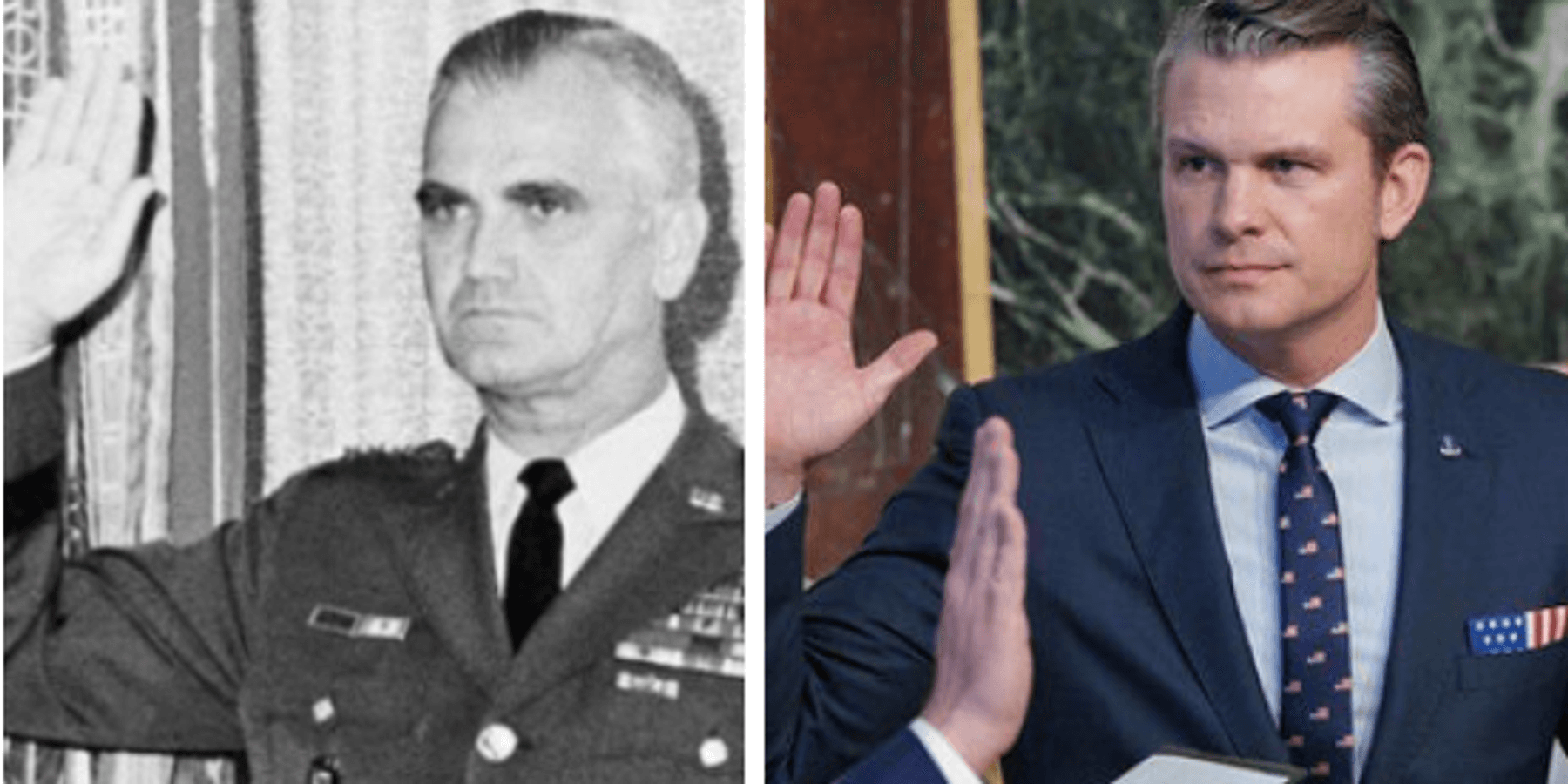
Concerned about growing domestic discord, the president summoned home his war managers to help “sell” the war. In November, General William Westmoreland, Harkins’ successor, and U.S. Ambassador Ellsworth Bunker presented an optimistic report on Meet the Press. The general highlighted “significant evidence” of “real progress being made,” while Bunker intimated that media reports were misrepresenting the allied war effort. Days later, the president castigated the disparities between “constructive dissent and storm-trooper bullying.”
Then the walls crumbled. In early 1968, Vietnamese communists launched a general offensive across South Vietnam during the Tet holiday, hoping to spur a general uprising among the southern population. The American public relations campaign came crashing down as television viewers back home watched military police fighting across shattered U.S. embassy grounds.
When word of the attacks reached respected news broadcaster Walter Cronkite, his reaction mirrored many of his fellow Americans. “What the hell is going on,” he reportedly asked. “I thought we were winning the war.” And still, the war dragged on.
By the time of Richard Nixon’s presidency, in historian Christian Appy’s words, “the credibility gap took on Grand Canyon-like proportions.” The New York Times’ June 1972 decision to publish the “Pentagon Papers,” a classified record of duplicitous decisions leading the nation to war, surely aided in this massive breakdown of trust. When asked to justify leaking the secret report, whistleblower Daniel Ellsberg turned the tables, asking what made officials “feel like they had a right to keep silent about the lies that had been told…the crimes that had been committed, the illegalities, the deception of the American public?”
The lies of which Ellsberg spoke matter because they endure, having been replicated, if not intensified, by a Trump administration indifferent to being truthful about the causes, conduct, and consequences of war. Indeed, the administration seemingly has gone out of its way to hide any inconvenient truth from the American public. Earlier this month, Secretary Hegseth declared the Pentagon press office a “classified space,” curtailing journalists’ ability to report on national security issues. The Five O’clock Follies look comparatively transparent.
Of course, Vietnam was not the only case of political leaders using deception to justify military adventurism. The Bush administration’s decision to invade Iraq in 2003, for instance, was far less an “intelligence failure” than a comprehensive case of intelligence manipulation.
Yet the war in Vietnam, perhaps better than any conflict over the nation’s 250-year history, lays bare how dishonesty perpetuates conflict and how the responsibility, if not burden, of citizens in a democracy is to demand a more truthful accounting of wartime decision-making and to question overzealous “progress” reports.
Historian Barbara Tuchman thought the solution for opposing senior officials who peddle falsehoods lay outside the halls of government. Writing less than a decade after Saigon’s fall, she believed that avoiding similar “betrayals” like the one in Vietnam depended upon “educating the electorate to recognize and reward integrity of character and to reject the ersatz.”
If Americans haven’t necessarily rewarded integrity at the ballot box lately, we shouldn’t lose hope that credibility and character still matter when it comes to wartime leadership. There is no better time than our 250th anniversary to demand that our leaders shrink the credibility chasm that we are peering across today.
- Trump: Question the strikes = demeaning the troops ›
- Hegseth: fears that stockpiles depleted are 'foolishly' overstated ›
- 25 years after 9/11, the US still doesn't know 'why they hate us' | Responsible Statecraft ›