

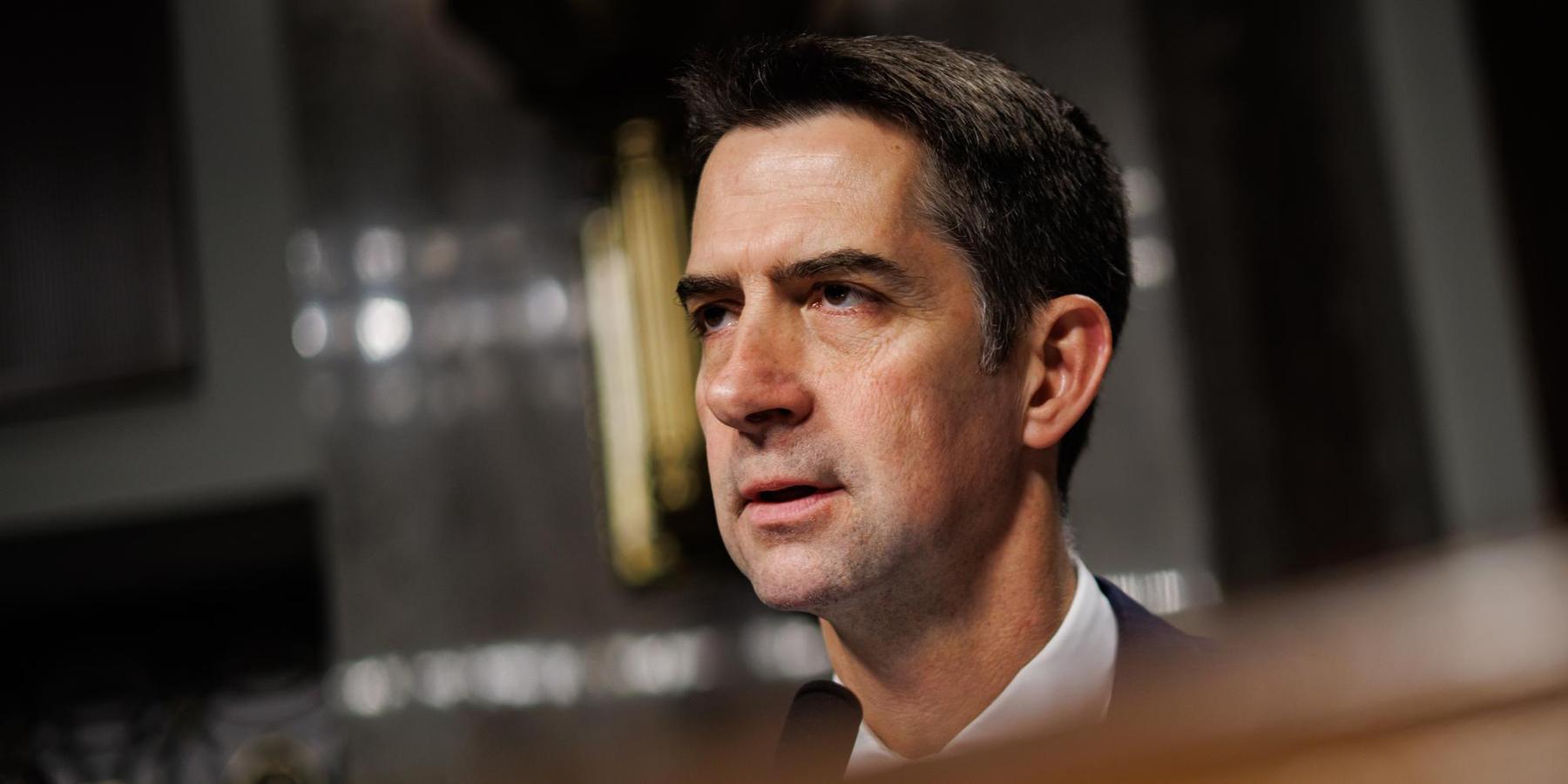
Buried deep inside a 192-page intelligence authorization bill is Section 622, titled “United States-Israel Intelligence Sharing Enhancement.” It would require the president, acting through the director of national intelligence and as necessary the secretary of defense, to “expand and enhance intelligence sharing with the Government of Israel” on a list of subjects that encompasses almost every topic of intelligence interest in the Middle East.
The bill, put forward by Sen. Tom Cotton (R-Ark.), the chairman of the Senate Intelligence Committee, would prohibit any suspension, reduction, or limitation of such sharing “except on the basis of a specific and identifiable national security concern determined by the President.” Any such exception would require a report to Congress within fifteen days detailing not only the reason for the change but also the categories of information involved. The same report would require an assessment of the anticipated impact on regional security and various other matters.
This proposal is one of several recent moves by those in Washington who carry the Israeli government’s water to keep the United States tied to Israel despite plummeting support for the country among the American public. The most salient form of U.S. support to Israel has been more than $300 billion in economic and especially military assistance. Israeli Prime Minister Benjamin Netanyahu has tried to get ahead of the declining public support and avoid embarrassing losses by suggesting it would be fine with him to phase out the military aid.
Israel’s strategy and that of its U.S. supporters is now to rely on ties with, and support from, the United States that are not as salient as the military aid with its prominent price tag. The strategy includes forms of military integration that are less visible than congressionally appropriated grant aid and therefore less publicly accountable. Section 224 of a defense authorization bill currently in the House of Representatives embodies this form of integration.
The mandating of intelligence sharing carries this strategy further by moving it into the shadowy world of relations between intelligence agencies. That world is even farther removed from public visibility and accountability than the defense integration, and even less likely to stimulate thoughts about American taxpayers’ money going to a foreign country. So far, Section 622 of the intelligence bill has received less attention than Section 224 of the defense bill.
The notion of legislating an intelligence liaison relationship in this way, with any foreign country, is bizarre. Liaison with counterpart foreign services, including exchanges of information, is an important but complex part of the intelligence business. The nature of a liaison relationship depends partly on the temperature of the overall political relationship with the country in question but also on other factors known mostly to intelligence officers. These include the collection requirements levied on them, their ability or inability to meet those requirements with national resources, their assessment of the foreign service’s ability and willingness to fill collection gaps, the role that any trading of information plays as quid pro quos in operational cooperation, and the risks of compromising intelligence sources and methods.
Moreover, no single liaison relationship exists in isolation. The U.S. intelligence services need to consider possible implications for their other foreign relationships. For example, one generally does not share with country A information about country B if the United States has a relationship with B that is about at the same level as it has with A. Intelligence liaison involves a hierarchy of relationships, ranging from extensive cooperation with close allies to carefully limited ad hoc exchanges with adversaries. The intelligence community has a staff with the full-time job of monitoring and managing this set of relationships to prevent crossed wires. A congressional mandate regarding a single relationship increases the chance of crossed wires.
An irony is that the Congress considering this mandate is the same Congress that has in effect surrendered to the president its powers under Article I of the Constitution to set tariff rates and to decide whether to wage war. And yet, Section 622 would involve congressional micromanagement of a matter that by its nature needs to be the business of the executive branch and especially the intelligence agencies.
In intelligence, Israel is more of an adversary than an ally. Being an adversary in intelligence means indulging in the hostile act of espionage. Israel has a long record of conducting that type of hostile act against the United States. The best-known case involves the spy Jonathan Pollard, who stole such an overwhelming volume of U.S. secrets that then-Secretary of Defense Caspar Weinberger stated to the court that sentenced Pollard that it was difficult “ to conceive of a greater harm to national security than that caused by the defendant in view of the breadth, the critical importance to the U.S., and the high sensitivity of the information he sold to Israel.”
When Pollard completed his prison sentence and parole in 2020, he was given a hero's welcome, led by Netanyahu himself, on his arrival at Ben Gurion Airport in Israel. There was nothing noble in Pollard’s actions. Although he liked to say he was motivated by concern about Israel’s security, before selling his espionage services to Israel he offered to sell U.S. secrets to three other countries and made the same offer to a fourth country even when spying for Israel.
The Israeli espionage threat to the United States has only intensified. Last week, NBC News reported that the Defense Intelligence Agency raised the threat level for such espionage, evidently a reflection mostly of U.S.-Israeli differences over the Iran war. The New York Times quotes an official saying that Israeli intelligence operations aimed at senior U.S. officials during the second Trump administration have become so aggressive as to be “unhinged.”
Any sensitive information, including intelligence secrets, shared with Israel entails a high risk of Israel passing it to other countries, including U.S. adversaries. Israel has a long record of that, too, and not just because Israel probably passed some of the secrets Pollard purloined to the USSR, in exchange for Moscow allowing Soviet Jews to emigrate. Israel’s sharing of U.S.-origin military technology with China has been an issue. That the partner may be a rogue state has not stopped Israel from military and technical cooperation, as demonstrated by its relationship with apartheid-era South Africa, which extended even to the development of nuclear weapons.
The risk of Israel passing sensitive U.S. information to other states continues partly because Israel is hungry for cordial relationships — and especially establishment of new formal diplomatic relations — with any country willing to have such relations despite Israel’s continued subjugation of the Palestinians. Secrets from U.S. intelligence would be very attractive to some of Israel’s partners or potential partners, and thus attractive to Israel as trading material. Those other countries may include China, with which Israel continues to have extensive technical cooperation, and Russia.
Even without any passing to third countries, Israel’s own use of much U.S. intelligence is apt to be contrary to U.S. interests and the interest of peace and security in the Middle East, and for many of the same reasons underlying the reduced popularity of Israel among the U.S. public. Israel has started more wars and attacked more nations than any other country in the Middle East. In recent years it has inflicted more death and destruction on civilians through military operations than any other Middle Eastern state. It uses violence to seek regional hegemony and destroy Palestinian nationhood in ways that are inconsistent with U.S. interests.
The current ill-advised war with Iran demonstrates the sharp divergence of U.S. and Israeli interests. After being the principal influence on President Donald Trump’s decision to launch the war, Netanyahu’s government has been sabotaging efforts to end it. It currently is doing so mainly with relentless attacks in Lebanon that have killed thousands and displaced over a million people. The divergence of objectives was reflected in an expletive-laden phone call last week between Trump and Netanyahu that was mainly about those attacks.
Attacks that sabotage diplomacy are among the Israeli operations that might use shared U.S. intelligence. The United States also will be blamed for aiding other violent Israeli operations because of the “enhanced” intelligence sharing, even if it were no longer paying for Israeli arms.
The supposed escape clause in Section 622 of the intelligence bill would in practice be so cumbersome as to be useless. The required report to Congress would dump the issue on Capitol Hill, where the Israel lobby would quickly depict it as a question of being for or against the security of Israel. The mandated intelligence sharing in the bill thus would tie the president’s hands and prevent any administration from using management of the intelligence liaison relationship as leverage to deter destructive conduct by Israel.
- In new peace, US firms will help Israel spy on and target Gazans ›
- Congress quietly moves to integrate US and Israeli militaries ›
- Israel targets X users, right-wing media with $2 million ad push | Responsible Statecraft ›
- Record number of Dems vote to scrutinize Israeli violence in West Bank | Responsible Statecraft ›