

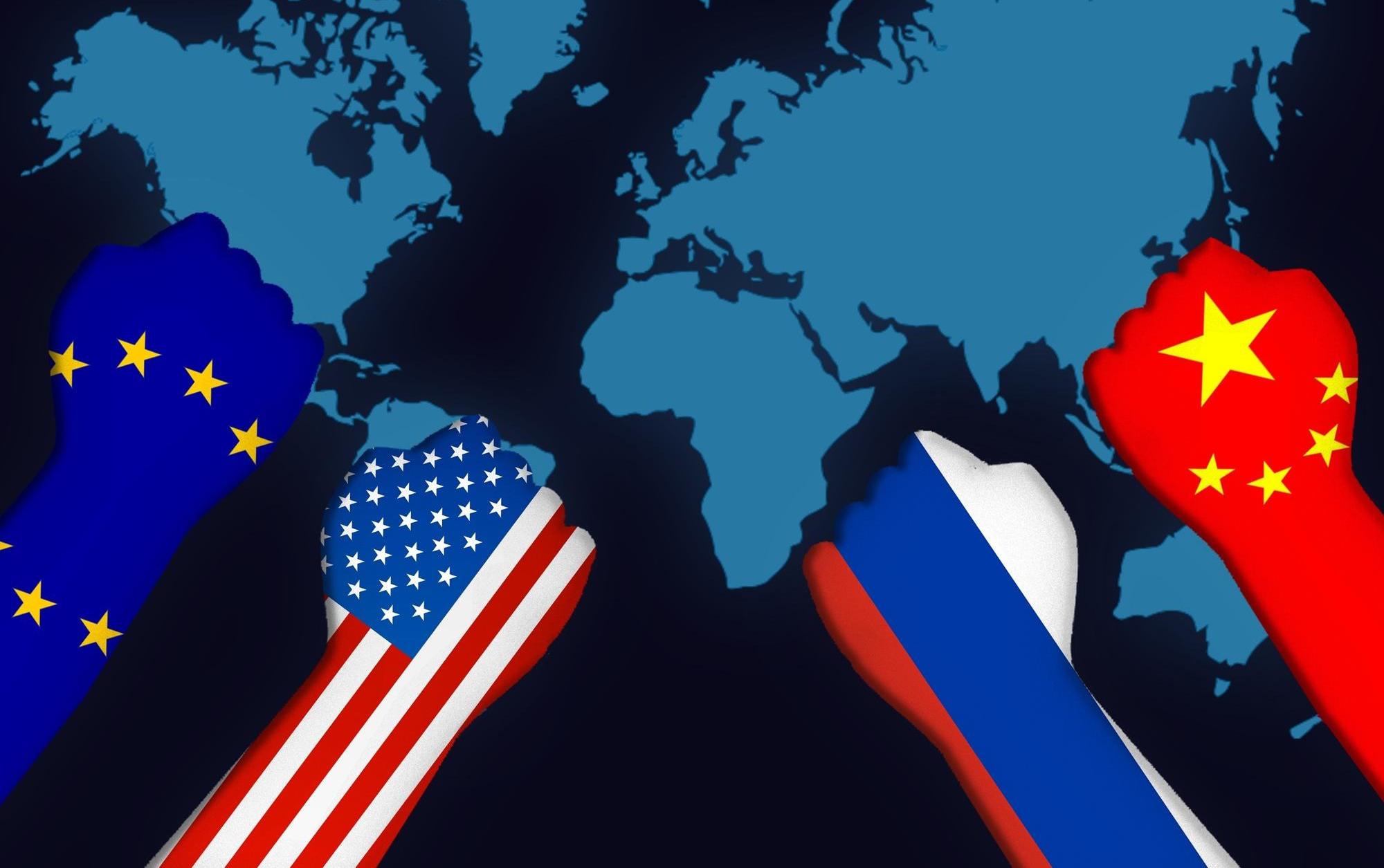
In the new National Security Strategy and National Defense Strategy, the Trump team charges that the Monroe Doctrine has been "ignored" by previous administrations and that the primary goal now is to reassert control over its economic and security interests in the Western Hemisphere.
"We will guarantee U.S. military and commercial access to key terrain, especially the Panama Canal, Gulf of America, and Greenland," states the NDS. The U.S. will work with neighbors to protect "our shared interests," but "where they do not, we will stand ready to take focused, decisive action that concretely advances U.S. interests."
The U.S. appears to embrace the concept of its own "sphere of influence" (though it does not use that term). The language of the NSS suggests that Washington would be pursuing a balance of power in other regions, particularly China, but declares there are U.S. interests that need to be defended in the Indo-Pacific, too. We asked 14 experts to assume as an exercise that the Trump administration is serious about powers maintaining their own spheres of influence. But where in the Pacific should the U.S. sphere end and China's begin? How do they think the Trump administration would answer that question?
***
Ron Dodson; Matt Duss; Lyle Goldstein; Paul Heer; Sahar Khan; Jen Kavanaugh; Ransom Miller; Robert Ross; Karthik Sankaran; Evan Sankey; Sarang Shidore; Marcus Stanley; Jake Werner; Ali Wyne
***
Ron Dodson CEO Dallas North Capital Partners, author at The American Mind
The very structure of the United States government, at least in its theoretical constitutional purity, lends itself to focus on near-abroad security and a recognition of the reality of spheres-of-influence. While this was ignored in the GWOT era, it is returning most obviously in the Donroe Doctrine. Article II does not specify geography, but its grant of executive authority effectively empowers the President to act with near-blanket latitude in defending the nation’s proximate security perimeter — or it’s “near-abroad.” But finite resources and short election cycles should prevent anything like the two-decade Afghanistan war or Middle East adventurism of the past quarter century.
The reality is power projection as global hegemony is a vastly more expensive endeavor now, as distance now equals risk and defensive costs vastly outweigh the cheap(er) drone and unmanned submersible offensives. A regionalized world requires more fences, suggesting to other global (middle) powers that nuclear deterrence may be the way to go.
The importance of supply chain security in both the tactical and strategic realms is increasing. Robustness equals security, global just-in-time is not conflict-survivable, the nodes are swarm-vulnerable, especially if distant.
Critical material independence — that of food, fuel, medicines, raw materials and shipping optionality — all point to returning to the safety net provided by two oceans, vast shorelines, and frankly, weaker neighbors.
The critical question is, where does the American near-abroad terminate? At Catalina? Hawaii? Guam? Attu? Japan? It certainly does not extend to Taiwan, and therefore careful planning in light of that reality’s impact on the aforementioned factors must be undertaken and not delayed.
Matt Duss, Executive Vice President, Center for International Policy
When trying to interpret or impose a strategic logic onto Trump’s foreign policy, it’s important to remember that Trump is first and foremost interested in himself and his family’s financial interests. Thus far in his second administration, while he certainly seems more comfortable with the idea of allowing militarily powerful countries set rules in their regions — whether with Russia in Europe, China in Asia, or Israel in the Middle East — he still clearly believes that they should accept a global security order largely determined by the United States.
As he has done so often in various other areas of policy, Trump has turned the subtext of the “rules based global order” into text, and now openly treats it as a protection racket, with the United States — and the Trump family and their billionaire backers in particular — owed tribute, and quite willing to use various economic, financial, military and other means to extract it if necessary. While the other powerful families will mostly be allowed to run affairs in their own neighborhoods, the United States, and Donald Trump, remain at the head of the table, and when those families’ interests collide with his, he will expect them to give way. When they don’t, especially in the case of China, there will be a danger of conflict. This emerging global mafia order will be inherently unstable. If we really want to advance Americans’ safety, prosperity and freedom and avoid pointless conflicts we should support efforts to establish a more genuinely rules-based and equitable one.
Lyle Goldstein, Director of the Asia Program at Defense Priorities; Director of the China Initiative, Brown University
Spheres of influence are a reality of world politics, and it will be good if present and future U.S. administrations embrace the concept, instead of ‘fighting against gravity,’ so to speak. Properly implemented, spheres-of-influence cognizant policies adopted by Washington could help mitigate conflict by erecting buffer zones, defining red lines, dousing brushfires within spheres, averting adventurism, and promoting needed bargaining between the great powers, as scholars Lindsey O’Rourke and Joshua Shifrinson cogently explain.
It must be stated at the outset that the Beijing establishment is rather hostile to the use of this terminology, so other phrases like “new type great power relations” should be employed instead. A logical outcome of such an approach to Asia-Pacific security will leave Taiwan decidedly in the Chinese sphere — a fact of geography, history, and culture that is also consistent with the evolving balance of power. The U.S. simply has no vital interests at stake in Taiwan’s future, so it is ridiculous to make it the cornerstone of U.S. national security policy. On the other hand, Japan and South Korea, not to mention Australia and the Philippines would remain firmly in the American sphere — again a byproduct of geography, history and culture. As to the sensitive matter of offshore rocks and reefs, here the U.S. would wisely yield to Beijing, so it could focus on defending the home islands of America’s long-time treaty allies. Such simple adjustments would go a long way toward pacifying the Pacific for the coming century.
Paul Heer, Non-Resident Senior Fellow at the Chicago Council on Global Affairs
The Trump administration’s emphasis on asserting a U.S. sphere of influence in the Western Hemisphere does not mean it is inclined to cede one to China in the Indo-Pacific. On the contrary, the NSS and the NDS emphasize that the administration will work with U.S. allies and partners to build a “position of strength” and a “favorable balance of military power in the Indo-Pacific” for the expressed purpose of ensuring that China cannot “dominate this broad and crucial region.”
Moreover, the NDS states that the U.S. will build a “strong denial defense along the First Island Chain.” In as much as this reflects the views of Undersecretary of Defense Elbridge Colby, the emphasis on the first island chain is specifically aimed at preventing Chinese “hegemony” in the region by denying Beijing control over Taiwan. The Trump administration would probably claim the first island chain plus the 38th Parallel as its preferred dividing line between Chinese and U.S. spheres of influence — with the U.S. sphere wholly encompassing that island chain and South Korea. But spheres of influence need not be exclusive or hostile to each other. Indeed, the United States and China already have overlapping spheres of influence in the region, especially in the economic and diplomatic realms. A U.S. approach that sought exclusive American influence and/or Taiwan’s perpetual separation from China would invite a regional cold war — if not inevitable conflict — with China.
Alternatively, U.S. acceptance of overlapping spheres of influence could avert such a conflict.
Sahar Khan, geopolitical analyst
Both the NSS and NDS make it seem as if the Trump administration is serious about great powers maintaining their own spheres of influence but a closer examination indicates otherwise. First, Trump-era thinking resists formal cartography. Under the NSS/NDS logic, the U.S. sphere is not a fixed longitude but fluid—and ends where allied and partner interests fade. China is implicitly acknowledged as the predominant power near its shores, but not one entitled to exclude the U.S. from regional waters or coerce neighbors. Second, in this flexible framing, India becomes central to the Pacific balance, not as a formal ally (which India doesn’t want to be), but as an anchor deliberately outside China’s sphere, which could potentially prevent China from expanding its “sphere of influence” eastward. India’s naval presence in the Indian Ocean and coordination with the Quad may make it seem that it effectively extends the U.S. strategic envelope west to east and preserves American flexibility, but India’s “strategic autonomy” logic contradicts this.
“Spheres of influence” may seem like a fashionable way to make sense of the Trump administration’s ad hoc foreign policy, but it may be more useful to think of the U.S. as a great power whose thirst for imperialist conquests has returned. The real question is: How will the rest of the world deal with a U.S. that believes it is above everyone else?
Jen Kavanagh, Senior Fellow and Director of Military Analysis, Defense Priorities
The Trump administration’s 2026 National Defense Strategy (NDS) makes a long overdue admission: the United States can not maintain military pre-eminence in Asia. “We will…be clear-eyed and realistic about the speed, scale, and quality of China’s historic military buildup,” it states, acknowledging that the military balance in the Western Pacific has shifted sharply in China’s favor over the past decade and that even a belated U.S. “pivot to Asia” cannot restore U.S. military dominance in the region.
Instead, the NDS (like Trump’s National Security Strategy) adopts a new goal, specifically, “a balance of power in the Indo-Pacific that allows all of us to enjoy a decent peace.” This is a reasonable and achievable end state. To maintain a favorable balance of power in Asia, the United States needs only to ensure that major industrial centers like Japan and South Korea remain sovereign. Not only do these U.S. allies have strong militaries and nationalist traditions of their own, but both the NSS and NDS reaffirm the U.S. commitment to the first island chain and the Korean Peninsula, making a Chinese regional hegemony unlikely.
The Trump administration’s strategy is more conciliatory toward China than that of its predecessors (including Trump 1.0), aiming for coexistence not containment. However, it cannot be characterized as a “spheres of influence” approach. Trump clearly seeks to avoid a war over Taiwan (which is not mentioned in the NDS), but he has given no sign that he is ready to recognize East Asia as Beijing’s proprietary domain. To the contrary, the new “balance of power” strategy seeks to ensure and institutionalize U.S. military and economic access and influence in the region, even as China’s military power grows.
The United States, under Trump, is ready to accept China as a geopolitical peer, but it is a long way from leaving Asia for good.
Ransom Miller, research associate, Institute for Global Affairs
The National Security Strategy states that “the United States rejects the ill-fated concept of global domination for itself.” But even if the administration does not intend to dominate globally, U.S. hegemony in the Asia-Pacific is still in practice.
Trump’s tariff program is one example of this continued dominance. It has attacked China’s superior economic position within Asia, where a Chinese sphere of influence might be purported to exist. Vietnam’s framework agreement imposes higher tariffs on transshipped goods, explicitly to target Chinese businesses in the country. Malaysia's deal was even more restrictive: its government agreed to allow U.S. review of foreign deals concerning its critical minerals and infrastructure and mirror U.S. tariffs on third-party countries, sacrificing major elements of its economic sovereignty. Many of these same components were included in the Cambodia deal, and reporting suggests that the administration views it as a model for ongoing negotiations with Indonesia.
Meanwhile, the U.S. continues to maintain one of the largest military presences in the region, with around 78,000 servicemembers deployed across the region as of last September. That includes several hundred military advisers helping to train Taiwan’s military, just across the strait from China. Meanwhile, the Seventh Fleet remains the United States’ largest forward-deployed naval component, and freedom of navigation operations continue with the USS Higgins’s transit near the contested waters of the Scarborough Shoal, which China claims as its own.
This isn’t to suggest that the Trump administration isn’t changing the character of American hegemony in the Asia-Pacific. But they can hardly be said to have curbed U.S. influence in the region.
Robert Ross, non-resident fellow at the Quincy Institute, professor of political science at Boston College
Donald Trump’s preoccupation with hemispheric defense does not reflect a military imperative. China’s navy has not been seen near Greenland in over 10 years. There is no Chinese security presence in Canada. And China’s naval presence in Latin America is negligible, comprised of one-off port calls. Trump’s hemispheric policy is pure performance. It enables Trump to exercise power over the weak to establish his greatness, while coercing the weak simply indicates American weakness.
Because hemispheric defense requires no greater allocation of U.S. military assets to the Americas, it has no strategic consequences for U.S. competition with China in East Asia. U.S. reconsideration of its East Asian defense commitments reflects its accommodation of the decades-long rise of China and the corresponding decline of U.S. regional hegemony and U.S. reluctance to risk a costly and uncertain war on China’s periphery. China’s large and accurate force of intermediate range ballistic missiles currently target U.S. bases throughout East Asia, so that these bases will be useless for U.S. Navy and Air Force operations during a future war. Going forward, the high cost to the United States of defending its regional security partners is not offset by any strategic gain.
And because U.S. security partners understand that the United States can no longer protect them in war, their commitment to cooperation with the United States has diminished, as they, too, have accommodated the rise of China. The U.S. is not leaving East Asia. It remains committed to participating in balance of power politics to resist Chinese regional hegemony. It continues to develop U.S.-Japan defense cooperation along the first island chain to contain Chinese capabilities in East Asian waters.
Farther from Chinese shores, it continues to expand and distribute its military presence in the West Pacific. Its defense cooperation with India and Australia is unaffected by trade conflicts and Trump’s “rapprochement” with China. The United States is retrenching in East Asia. The cause is not Trump’s hemispheric swaggering, but the rise of China.
Karthik Sankaran, senior fellow, Quincy Institute
The Trump administration has left little doubt that it believes that the Western Hemisphere should lie uniquely in the U.S. sphere of influence. And yet South America is likely to present a challenge to that view for largely economic reasons. In the National Security Strategy published last November, the administration stated that it wanted a hemisphere “free of hostile foreign incursion or ownership of key assets” and to “ensure … continued access to key locations.” This, however, is likely to run up against three brute facts. The first is that China is the largest trading partner for much of South America, which is less a reflection of nefarious intent and more one of economic complementarity between a resource-rich continent and a country that is very short of them.
The second is that China leads the world not just in extracting, processing, and transporting resources, but also in building alternative energy-based electricity generation and transmission infrastructure at scale — a proposition the U.S. simply cannot match. And the third is that China could construe American attempts to gain ownership of infrastructure that governs the production or exports of key raw minerals to China in much the same way that the U.S. construes Chinese ownership or operation of ports that might host a Chinese warship. This is likely to be a recipe for tensions (with both China and its major trading partners in the Western Hemisphere) unless the U.S. dials back its understanding of what constitutes a “key asset.”
Evan Sankey, policy analyst at the Cato Institute
President Trump’s unilateral assertion of American power in the Western Hemisphere is a difference of degree, not kind, from the historical baseline of U.S. foreign policy. But, as has been the case since at least the end of World War I, the U.S. seeks foreign deference to the Monroe Doctrine and tries very hard to avoid extending the same courtesy to rivals. Overall, Trump’s policy stands in this lineage.
The administration’s new strategy documents call for a balance of power in Asia and a “decent peace” acceptable to China, but the stated operationalization of that goal focuses U.S. military resources on a “strong denial defense” of the first island chain, the archipelago closest to China’s maritime frontier which includes Taiwan. This is the reinforcement of America’s post- World War II military position in the Pacific, not its diminution or relinquishment. It is a continuation of our traditional policy: “spheres for me, but not for thee.”
Since the 1970s, the U.S. has respected a narrow Chinese sphere of influence over Taiwan in the form of the One China Policy. Otherwise, it stations large military forces in Asia in order to deny the emergence of other spheres. China’s military modernization and home court advantage has made these forces increasingly vulnerable and costly, which will incentivize U.S. policymakers to negotiate with China about basic issues of the Asian security order. But unless they do, the U.S. prefers running heightened military risks over respecting any sweeping Asian sphere apart from its own.
Sarang Shidore, Director, Quincy Institute Global South Program
All signs are that any U.S. conceptualization of a sphere of influence for itself would likely range far and wide beyond the Americas and well into Asia. The Trump administration has already acted militarily and otherwise to circumscribe domestic and foreign policies of distant states and the global commons. Washington has indeed signaled a greater understanding of Beijing’s pressure on Taiwan and adopted a more equidistant tone on Japan. However, an enormously-risen China that’s practically a U.S. peer would likely demand concessions well beyond its immediate coastal backyard. Beijing would expect to be recognized as pre-eminent in Southeast Asia (including the South China Sea) and South Asia. In other words, there is likely to be a severe mismatch between what each side thinks the other “deserves.” A mutually acceptable “line in the water” is difficult to foresee.
Moreover, Asian middle powers are sure to counteract any backroom territorial understanding between Beijing and Washington. As I have argued previously, unlike the 19th and 20th centuries major parts of the Global South are wealthier, savvier, and more autonomous. It is true that India, Indonesia, Vietnam, and others do not have the power to reorder the international system. But these states do have the means to enormously complicate plays of hegemonic dominance by either great power in their immediate neighborhoods. If a carve-up of Asia is attempted, count on an intense nationalist response in South and Southeast Asia to resist it.
Marcus Stanley, Director of Studies, Quincy Institute
I don’t see the Trump administration as pursuing any “spheres of influence” policy. The administration has never claimed to do so; the term “spheres of influence” never appears in the National Security Strategy or the National Defense Strategy and both documents contain many assertions of U.S. security interests in distant regions close to China or Russia. The administration’s own preferred term for their approach is “peace through strength,” a very different concept.
The invocation of “spheres of influence” seems a kind of optical illusion motivated by the Trump administration’s recalibration of the U.S. approach to major authoritarian rivals in a more pragmatic and less ideological direction, as well as the assertion of U.S. dominance over the Western Hemisphere. But aggression in the U.S. near abroad does not imply ceding other regions of the world entirely to China or Russia. In that sense “spheres of influence” feels like a rebranded version of the now obviously mistaken “isolationist” accusation.
We don’t need to wonder about the Trump administration’s view of U.S. interests in other regions. The National Security Strategy tells us directly that Europe is “strategically and culturally vital” to the U.S., while the National Defense Strategy asserts the need for the U.S. to maintain a favorable balance of military power in the Indo-Pacific, which would not be possible without defending U.S. treaty allies in China’s near abroad like Japan and South Korea.
Jake Werner, Director of East Asia Program, Quincy Institute
The Trump administration has no intention of ceding China a sphere of influence in Asia or anywhere else. Trump’s NSS defined Asia as a “key economic and geopolitical battleground” and mooted a U.S.-led economic bloc to coerce China. The NDS’s top priority after excluding migrants and dominating the hemisphere is to restrict China’s power to 100 miles of its coast with “a strong denial defense along the First Island Chain.” In trade agreements and peace negotiations alike, the administration seeks to muscle China out of important markets and sources of raw materials around the world — most provocatively in Southeast Asia.
But dropping the illusion of separate spheres is nothing to mourn, because dividing the world into discrete areas of great power predation is not a viable basis for peace. The growth of international conflict over the last decade is not a result of great power interdependence but of an increasingly zero-sum global system pushing the powers against each other. Undisguised imperialism would only exacerbate these pressures, driving each to seek pieces of the others’ spheres — and points to a far more explosive conflict. In any case, China would never accept the framework.
A far better course is to pursue impulses, largely from Trump himself rather than his advisers, at odds with the strategic thrust on China. The “deal” Trump is always envisioning with China is not an agreement to separate but to squeeze new benefits from connectedness. Unlike the typical victim, China is powerful enough that it could force such a deal to work for both sides.
Ali Wyne, senior research and advocacy adviser for U.S.-China relations at the International Crisis Group.
The Trump administration’s National Security Strategy cites “[t]he outsized influence of larger, richer, and stronger nations [a]s a timeless truth of international relations.” Coupled with its call to revive the Monroe Doctrine, the document seems to point to the reemergence of spheres of influence. It is unclear, though, how rigid geographic delineations of influence would operate given existing security arrangements and a highly interconnected global economy.
President Trump could conceivably consider paring back America’s military posture in Asia were his Chinese counterpart Xi Jinping to pledge that China would boost its purchases of U.S. exports and crack down more aggressively on its shipments of fentanyl precursors. Notwithstanding continued speculation about a potential “grand bargain,” though, the United States maintains an extensive network of treaty alliances (and non-treaty military arrangements) in Asia, and China’s trade with Latin American and Caribbean countries has soared over the past quarter-century.
It also seems premature to assume that the world’s two foremost powers would brook, let alone enforce, voluntary restrictions on their own accretions and exertions of power. Despite prioritizing the Western Hemisphere, the Trump administration is employing economic coercion and military force well beyond. And while China avows that its brightest red line is Taiwan’s independence, it is using trade deals and technological offerings to undergird a quartet of initiatives — concerning global development, security, civilization, and governance — that aim to sketch an alternative vision of international order.
One hopes that Washington and Beijing will learn how to coexist indefinitely within a global sphere of influence.
- A farewell to Oz: Trump’s strategy for a multipolar world ›
- Paradoxically, 'Donroe Doctrine' could put US interests at risk ›