

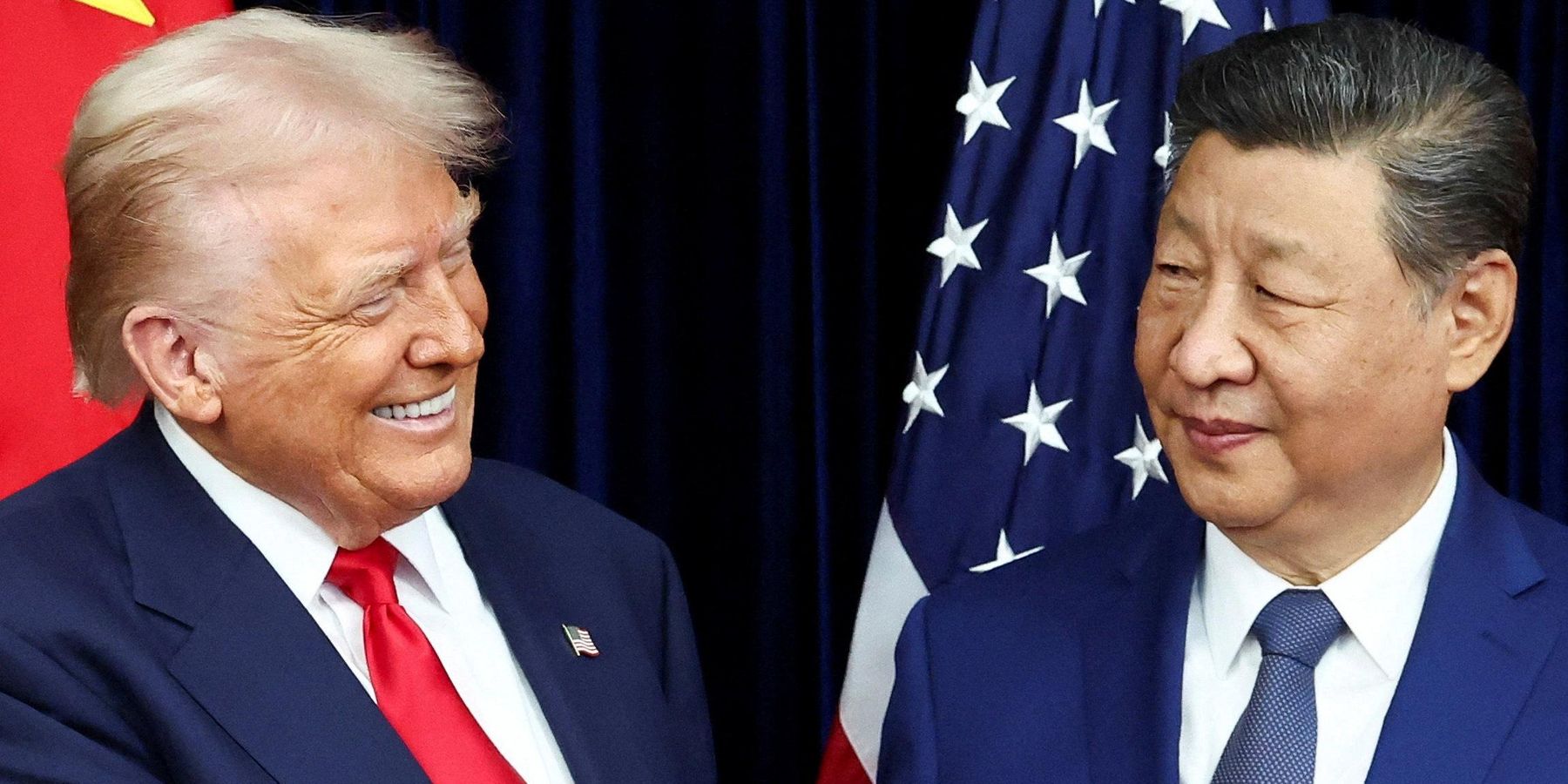
UPDATE 10/30: President Donald Trump and Chinese President Xi Jinping emerged from much anticipated meeting in South Korea Thursday with a broad framework for a deal moving forward. Trump said the U.S. would lower tariffs on China, while Beijing would delay new export restrictions on rare earth minerals for one year and crack down on the trade in fentanyl components.
As Donald Trump prepares for his long-awaited in-person meeting with Xi Jinping on Thursday, he faces a fateful choice.
Will he embrace the machinery of geopolitical confrontation established by his first-term Secretary of State Mike Pompeo and then systematized by the Biden administration, pushing the United States and China to a permanent rupture? Or will he chart a new kind of great power peace, defined not by utopian expectations of harmony but instead by wary mutual exploitation?
The Biden administration’s China policy emerged from a broad sense of crisis among mainstream Democratic leaders. As they entered office in 2021, their dream of a multicultural meritocracy at home and liberal American hegemony abroad was crumbling around them in the face of populist politics and surging authoritarianism around the world.
If Trump was the face of this crisis in the domestic arena, China was its face in international politics — seemingly the opposite of democracy, free markets, and U.S. global primacy (never mind that China was little involved in the disastrous Middle East wars, the financial deregulation that delivered the 2008 financial meltdown, or America’s increasingly corrupt and unresponsive politics). In then-Secretary of State Antony Blinken’s words, “China is the only country with both the intent to reshape the international order and, increasingly, the economic, diplomatic, military, and technological power to do it.”
Since the Biden project was a restoration of the status quo, such a challenge was unacceptable.
Ironically, Biden was building on what he inherited from Trump’s first term. China hawks under Trump had taken advantage of the president’s trade grievances and Covid-era recriminations to pursue an agenda of geopolitical dominance focused on military brinkmanship and a campaign to destroy China’s technologically advanced companies.
The Biden administration accepted these measures and built on them. Top Biden officials believed that containing China — organizing U.S. allies against it, cutting off its development in high-value sectors, discrediting it in the eyes of rising powers in the Global South, casting it as the antagonist in a worldwide struggle between democracy and authoritarianism — was not just a desirable agenda in its own right. It also offered a narrow path to reviving American economic dynamism and domesticating the populist passions threatening establishment political leaders.
Why? Because hostility to China seemed to be the common ground that most of the warring groups in American life shared. Center-left and center-right pundits like David Ignatius or David Brooks portrayed China as the foreign enemy that would allow America to overcome its internal divisions and turn back the threat of populism. As Matthew Yglesias put it, “anti-China politics could be the unifying national project we need.”
Antagonism to China was so appealing to so many in Washington — and the prospect of looking weak on China was so terrifying — that the bipartisan decision for confrontation received almost no critical discussion. In the space of a few years, the debate over China swung 180 degrees from compulsory support for free trade to compulsory support for undermining and excluding China. But official Washington was out of touch with the American people. By a 2-to-1 margin or more, Democrats, Republicans, and independents all preferred working to avoid military conflict with China over preparing for it.
In hindsight, we can now see the wisdom of popular thinking. The Biden gamble that the United States could suppress China’s power without significant cost to American interests has failed, leaving the United States weaker and the world a more dangerous place.
Far from rallying the rest of the world to join the containment of China, even allies dragged their feet while developing countries overwhelmingly rejected a coerced choice between Beijing and Washington. Building up three- or four-country military formations to surround China was more successful, but also exacerbated Beijing’s own fears and set off a menacing arms race in the region.
Biden’s homilies about democracy rang hollow in the rest of the world, as the United States backed illiberal regimes when convenient and poured weapons into war crimes. His pretensions to world leadership foundered on instability in the United States and foreign resentment against his economic nationalism.
The Biden failure was most spectacular in the realm of technology. The administration claimed its decision to stymie Chinese advance in the most strategically important sectors was motivated solely by national security considerations. But because the blockaded technologies, like advanced semiconductors or quantum computing, are not primarily military in nature but the basis for high-value development across the whole economy, the administration committed itself to sabotaging China's entire growth strategy. If the attempt had succeeded, the two superpowers would have entered open conflict.
It did not succeed. Chinese companies found gaps in the regulations or smuggled in supplies. Beijing poured resources into building out domestic capacity in the targeted technologies. What was originally meant to be a precisely targeted “small yard, high fence” approach to halting China’s development predictably became an inexorably expanding roster of blocked goods, blacklisted firms, and new restrictions. Yet China continued to record stunning technological breakthroughs.
American companies lost billions of dollars and China was convinced that the U.S. would never tolerate Chinese economic competition. We now face a stronger, more independent, and more aggrieved China.
China went beyond skirting the American restrictions. It carefully studied American export controls, sanctions, and tariffs. Beijing slowly but systematically erected its own mirror-image system — often using word-for-word phrasing in the regulations — capable of doing serious damage to the U.S. economy. When Trump started a new trade war this year, China throttled the supply of rare earth elements, forcing some companies to idle production before the U.S. agreed to step back from the brink.
Today former Biden administration China officials and their neoconservative brethren in the Republican Party are demanding that we double down on this failed policy, driving it all the way to a permanent split in the global system. Parts of the Trump administration are pushing Trump in this direction, while Democrats on the outside are trying to goad Trump into conflict by calling him “chicken.”
Whatever his other faults, Trump is immune to this sort of manipulation. In fact, he savors casting aside the kind of sanctimonious moralizing that blinded the foreign policy establishment to the steep costs and terrible risks of the Biden China policy.
But can Trump build a different basis for the relationship? Secretary of State Rubio has suggested a framework, arguing that the era of unchallenged American dominance is past and we need to accept “a multipolar world, multi-great powers in different parts of the planet” in which “avoiding war and armed conflict” among powers is a crucial priority.
What that might look like in practice is more difficult. The immediate agreements teed up for Trump and Xi’s approval at their meeting are a good start, but will not rebuild the shattered foundation of the relationship.
Trump’s emphasis on trade and investment, coupled with China’s newly established power to hold him in check, shows real promise. Trump wants investment in the American economy to drive reindustrialization. Chinese companies — among them world leaders in manufacturing — want to restore access to the world’s largest economy, and Chinese leaders want a stable international environment. Indeed, China has already offered major investments. What remains is establishing prudent but flexible safeguards and a mechanism to channel Chinese investment into American priorities.
These are thorny problems that would be difficult under the best of circumstances. But if Trump can accept China as a peer power rather than constantly seeking new sources of leverage and can impose his vision of great power peace on his fractious administration, he could finally swing the world off a trajectory toward conflict.