

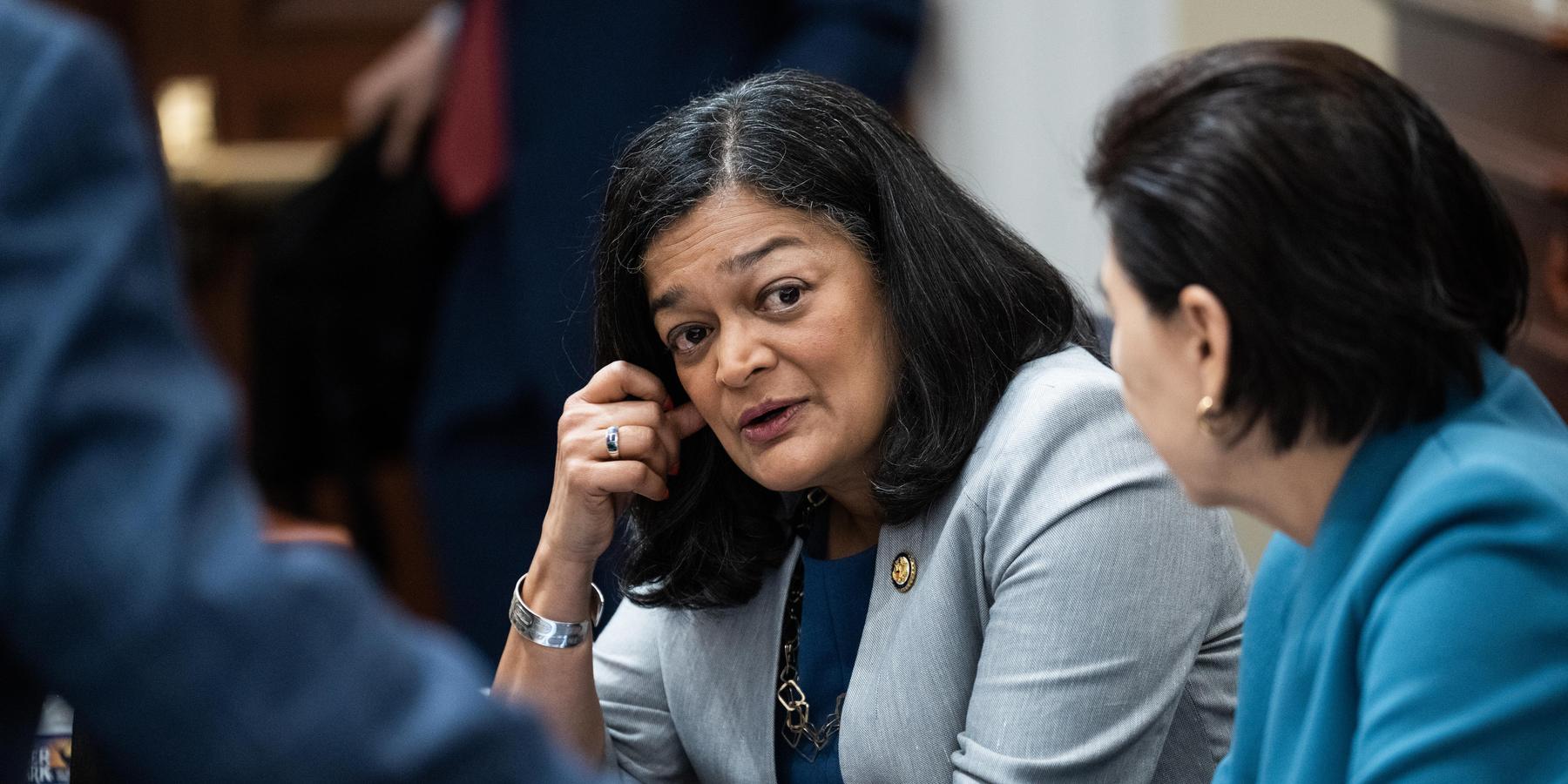
As Cuba’s economy struggles under the weight of a near-total American oil blockade, Rep. Pramila Jayapal (D-Wash.) is pushing for a change in Washington’s policy toward the Caribbean island nation.
Jayapal and fellow Rep. Jonathan Jackson (D-Ill.) traveled last week to Cuba, where they met with senior officials and a range of civil society groups. Since returning stateside, Jayapal has urged the Trump administration to enter a “real negotiation” with Cuba and put an end to America’s decades-old regime of sanctions on the island, which she called a “Cold War-era remnant that no longer serves the American people or the Cuban people.”
RS spoke with Jayapal Wednesday to get her take on U.S.-Cuba relations and the possibility of reaching a deal that would bring the island back from the brink. The following conversation has been edited for length and clarity.
RS: You're one of the very few members of Congress who has visited Cuba not once, but actually twice. Can you describe a little bit how the island has changed since the last time you visited?
Jayapal: The last time I was there was in February of 2024, and I believe that was the last congressional visit to take place before this one, it was already extreme conditions. Bread lines were starting to form. We were starting to see some of the energy shortages show up.
But I have to say this was significantly different this time. Most of the country is blacked out for, in some cases, 20 hours a day. You would go along the streets, and there are some lights that are driven by solar panels, but for the most part, everything was black. Kids are not going to school. You don't see traffic during the day. I mean, the roads are pretty much completely cleared because nobody's going anywhere. Nobody can afford fuel to go anywhere.
There's very few shops that are still open and have anything available. That was true two years ago. We would go into a pharmacy and the shelves would be bare. This time, those pharmacies often are just not even open. There are private markets now that have a little bit more than the state markets and are open for longer. But this is a situation where only 10% of the food needs of the country are being produced on this island.
You just really see the desperation. People are just sitting outside their homes. They can't be in their homes because there's no electricity, there's no refrigeration. And then you see it in the hospitals with just the massive strains and stresses on the public health system, which, as you know, Cuba has a really good one. But the cruelty of the blockade, on top of the decades of embargo and financial strangulation of the island, have brought everything to quite a breaking point.
RS: During your time there, you and Congressman Jackson also met with a lot of senior officials, including President Miguel Diaz-Canel. What did you gather from those conversations? To what extent are they ready for negotiations with the U.S. and on what terms?
Jayapal: Things have really shifted, and it did feel like sort of a new moment. This was starting a couple of years ago. When I was there last time, I met with the families of political prisoners, and we actually went into our meetings with government officials with a list of names of people to be released. This time, while we were there, the president announced the release of 2000 prisoners. Some of them are just regular prisoners, but there are political prisoners within that.
We met with a lot of voices from across the political spectrum, and in our discussions with government officials, it was very clear that they have been working towards reforms to the country. That's going back to the constitutional reforms that they passed before we were there last time, but also new policies for economic liberalization, like the policy around Cuban Americans being able to invest in Cuban businesses [and] the growth of the private sector and the willingness of the government to promote the private sector.
So much of what we talked about were the opportunities for investment of American businesses in Cuba, and the only thing really strangling that at this point are American restrictions on the financial sector — being able to open bank accounts, being able to transfer money, being able to legitimately engage in export of U.S. agricultural products, for example.
One very important sign, also, is that the Cuban government invited the FBI to investigate the speed boat shooting. Who would have imagined that the Cuban government would be inviting in the FBI? So there are already changes that are happening. The Cuban government is in a very different place. There is a real opportunity for an actual negotiation that is not about the threat of bombing Cuba or taking Cuba, but is actually about what does it look like if Cuba and the United States were to be in partnership, with many of the reforms that the United States has wanted being legitimately on the table right now?
RS: Of course, there's two sides of the coin here. Do you have a sense of the extent to which the Trump administration is receiving these signals?
Jayapal: There is a narrow path that has opened. The trade minister, Oscar Fraga, has had one conversation, as I understand it, with Secretary [Marco] Rubio. That, I think, is promising. But as yet, there haven't been ongoing, actual negotiations. There's been the beginning of some dialogue. I think that's very important.
My belief is that this fuel blockade is illegal. [But there are good signs like] the fact that the Russian tanker did go through, and I think there's a second one due to come now, and Trump himself said, 'I have no problem with oil from anywhere going to Cuba.' Let's see what happens here, but the first thing is, in the short term, relieving the humanitarian crisis and simultaneously starting real negotiations around what a new future looks like for the United States and Cuba.
We were thinking about all the different ways that we could actually have partnership that benefits Americans. I'm from an agricultural state. I know that the last time we were there, there was a delegation of agricultural secretaries, primarily from Republican states, who were there because they're looking for export markets. What a perfect place to go, 90 miles south of the border, to an island that needs to import a lot. The United States would be a natural trading partner.
The same [goes] for energy, energy going from the United States to Cuba instead of driving the Cubans to Russia and China. We would have the opportunity also for tourism, which we saw, in the Obama years, really led to a lot of investment of American businesses in Cuba. And then health — the Cuban public health system has been so fantastic, and one of the things is that, over the years, they've developed this new treatment for Alzheimer's. A Colorado doctor has been going and actually getting that treatment for some of his patients, and watching with amazement the positive results. We have millions of people here who suffer from Alzheimer's that could benefit if we were able to really form these kinds of partnerships.
RS: Obviously there are a lot of other players in Latin America that are interested in helping out and trying to find a resolution to the longstanding crisis between the US and Cuba. Do you have a sense of how they're hoping to play into all this?
Jayapal: Yes, that was actually a really important part of our visit. Last time we had met with ambassadors from five countries, it was probably one of the most productive, thoughtful, strategic conversations we had. And so I specifically wanted to do that again.
We stayed in touch with some of those ambassadors. The same ambassadors from Mexico and Brazil came. We had two other African ambassadors there [as well], and it was an incredibly important conversation because I think people don't realize it's not just the United States and Cuba. The entire Latin American region is affected. They watched what happened in Venezuela. They're watching what's happening in Cuba. The United States has put pressure on Spanish banks, which were engaged in financial transactions with Cuba, to stop, and so that has been a real strangulation. [Or] the ESTA visa waiver, which allows Europeans to not have visas to come to the United States, but if they go to Cuba, then they give up that privilege. So it really affects people from other countries.
Brazil had, I think it was 15,000 Cuban doctors who were part of the humanitarian program, and they had to end that because of pressure from the United States. Same with Qatar, by the way. We heard there's a huge number of doctors in Qatar that were forced to end that program because of U.S. pressure. So there are a lot of reasons why other Latin American countries care about this and are very engaged.
And as you saw, the Mexican president has been very strong and sent a humanitarian shipment while we were there. And there's indications that there will be more. The Mexican people feel a real solidarity with the Cuban people, and so there's a lot of pressure from the population in these countries, also, for their governments to stand up and be strong, both for Cuba but also for what it means for their own countries.
RS: What steps are you planning to take to follow up on the trip? Is there any specific legislation you're looking to push?
Jayapal: While we were there, [we released] our letter that was signed by 52 Democrats to President Trump and Secretary Rubio demanding an end to the fuel blockade. The most immediate thing is an end to the fuel blockade because the island desperately needs not just one tanker, which is good for maybe 10 to 14 days, but the regular flow of oil to the island.
In addition to that, [Rep.] Greg Meeks (D-N.Y.) and I introduced legislation to not allow for any funds to be used for war against Cuba. There's also a Cuba War Powers Resolution introduced by [Rep.] Nydia Velazquez (D-N.Y.) and [Sen.] Tim Kaine (D-Va.). [Rep.] Jim McGovern (D-Mass.) has a piece of legislation to lift the embargo. All of these are efforts to reshape the conversation and to push towards a new future.
I'm also crafting some legislation that focuses on what benefits the American people could get if we were able to at least in a couple of areas — agriculture, tourism, health — establish real collaborations that allow for a lifting of these restrictions.
The important thing is to be clear to the American people that this is a new day. This is not the same Cuban government. It has done a lot of things that indicate their willingness to change, to do some of the things the United States has wanted.
But also, I just don't think any American who knew what we were doing to this island of 11 million people would want that being done in their name. I really don't. It's a level of cruelty that's hard to imagine. We've just been saying, ‘imagine that you didn't have a drop of fuel for four months. Imagine all the things that would happen to your life if that were the case.’ The more we can get Americans to think about that, the more we can push back on the old narratives, the more we can move forward towards a new future.
- A deal that Cuba (and Trump) cannot refuse? ›
- Is Rubio backing off Cuba regime change for his own political good? ›
- Vatican quietly steps up role in US-Cuba talks ›