

In 2020, during the last year of the Trump administration’s first term, President Trump asked then-Defense Secretary Mark Esper a shocking question: why can't the United States just attack the Mexican cartels and their infrastructure with a volley of missiles?
Esper recounted the moment in his memoir, using the anecdote to illustrate just how reckless Trump was becoming as his term drew to a close. Those missiles, of course, were never launched, so the entire interaction amounted to nothing in terms of policy.
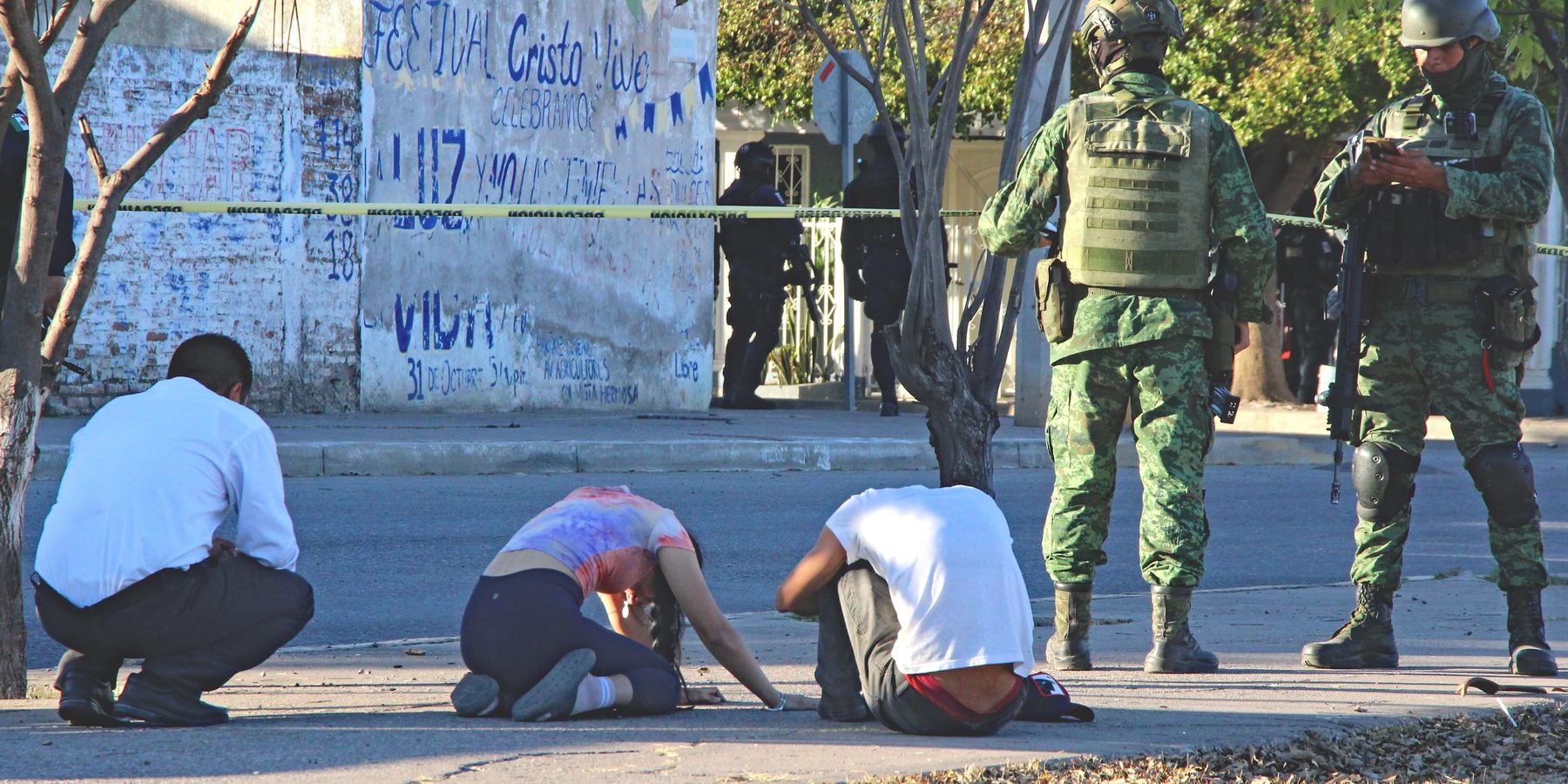
Yet five years later, Trump still views the Mexican cartels as one of Washington’s principal national security threats. His urge to take offensive action inside Mexico has only grown with time. Unlike in Trump’s first term, using the U.S. military to combat these criminal organizations is now a mainstream policy option in Trump’s Republican Party. According to the New York Times, Trump has signed a presidential directive allowing the Pentagon to begin using military force against specific cartels in Latin America, and U.S. military officials are now in the process of studying various ways to go about implementing the order.
While this may come as a shock to some foreign policy commentators, it shouldn’t. Trump, Vice President JD Vance, Defense Secretary Pete Hegseth, U.S. Ambassador to the U.N. (and short-lived national security adviser) Mike Waltz and U.S. Ambassador to Mexico Ron Johnson have all left the door open to military force, whether it takes the form of striking fentanyl-production facilities by air or deploying U.S. special operations forces to take out top cartel leaders on Mexican soil.
The Trump administration wasted no time going down this road. The CIA is engaging in more surveillance flights along the U.S.-Mexico border, and inside Mexican airspace, to gather information on key cartel locations. The U.S. national security bureaucracy was already in preliminary discussions about the possible use of drone strikes against the cartels as well. And on February 20, the U.S. State Department designated six Mexican cartels as foreign terrorist organizations, which is designed to deter Americans from working with the cartels and lay the foundation for future strikes.
This is all good politics for Trump, who recognizes implicitly that getting tough on Mexico economically and politically is red meat for his base. But politics isn’t nearly as important as policy, and the policy implications of U.S. military operations in Mexico — even if the purpose is a noble one — is riddled with costs and make managing the problems the Trump administration ostensibly cares about even harder.
First, we should remember one thing right off the bat: using the military to tackle cartels is not a new phenomenon. The Trump administration may present this as some magic solution that will win the drug war once and for all, but the reality is bullets and bombs have been lobbed at the narco-traffickers repeatedly to little positive effect. Successive Mexican governments since the turn of the century, from the conservative Felipe Calderón to the leftist Andres Manuel López Obrador (AMLO), have relied on the military under the presumption this was the best way the Mexican state could pressure criminal organizations into extinction.
Calderón, for instance, declared a full-blown war on the cartels immediately after his election in 2006, deploying tens of thousands of Mexican troops into some of the country’s most violent states. Despite lambasting the military-first strategy during his own presidential campaign, Enrique Peña Nieto largely continued Calderón’s strategy with a special emphasis on targeting so-called “kingpins” of the narcotrafficking world. When AMLO entered office in 2018, he tried to get the Mexican army back into the barracks but wound up expanding their authority and rushing Mexican soldiers into hot spots, like Culiacan, whenever large-scale violence broke out.
The result was a bloodbath. Rather than submit to the state’s diktats, the cartels fought the Mexican state with ever greater levels of force. Politicians, police officers and soldiers were all targeted and killed with greater frequency. Areas of Mexico previously insulated from cartel violence were suddenly drawn into the maelstrom. Although senior narcotraffickers were killed and captured in the process, Mexico’s cartel landscape was shattered into a million different pieces; as my colleague Christopher McCallion and I wrote in July, the demise of the cartel’s senior leadership merely opened up these organizations to extreme bouts of infighting between replacements who sought to grab the crown.
The end product was a massive uptick in Mexico’s homicide rate, which is now three times greater than it was before Calderón declared war almost two decades ago.
Of course, the Trump administration is unlikely to mimic the Mexican government’s past strategy entirely. It’s hard to envision tens of thousands of U.S. troops deploying to Tamaulipas, Guanajuato or Sinaloa, sealing off neighborhoods, establishing checkpoints and conducting offensive operations against cartels that in some instances have more firepower than the Mexican army. If Washington is going to do anything militarily, it’s more likely to come in the form of air power. Bombing fentanyl manufacturing plants would be more economical and wouldn’t involve U.S. ground forces, so the risk to U.S. personnel would be much lower.
Still, if the objective is to bomb the cartels into submission or convince them to stop producing and shipping drugs across America’s southern border, then an air campaign will fall flat. We can say this with a reasonable degree of certainty because there’s first-hand experience to go by. The U.S. Air Force did something similar in Afghanistan in 2017-2018, taking out opium labs in Taliban-controlled areas to deprive the Taliban insurgency of the revenue it needed to wage the war.
But as the Special Inspector General of Afghanistan Reconstruction reported, the bombing campaign failed to do anything of significance. The U.S. air campaign didn’t dent the Taliban’s revenue streams to the point where it made a negotiated resolution on U.S. terms possible. As David Mansfield, the world’s leading expert on Afghanistan’s drug patterns, wrote in a 2019 report, “it is hard to see how the campaign offered anything in terms of value for money, with the cost of the strikes and ordnance used far outweighing the value of the losses to those involved in drugs production or potential revenues to the Taliban.”
Why would Mexico be any different than Afghanistan? If anything, denting cartel revenue via an air campaign would be even more difficult than it was with respect to the Taliban. Unlike heroin, fentanyl is a synthetic drug that can be easily produced, isn’t particularly labor intensive and doesn’t require acres upon acres of poppy fields that can be easily located. Sure, the United States is bound to find some of these facilities, but the cartels responsible for production will still have a monetary incentive to set up shop somewhere else. Fentanyl nets the cartels billions of dollars every year; this is a very large financial resource that the Sinaloa and New Jalisco Generation cartels — or frankly anyone in the business — will be hard pressed to pass up.
And if even if they magically did find a new line of work, other players would step into the void to increase their own market share.
These are only several problems associated with treating the U.S. military as a panacea to the drug problem. But the important thing to take away is that effectively declaring war on Mexico, America’s top trading partner and neighbor with which we share a nearly 2,000 mile-long border, presents the illusion of progress without actually making any. And it will inject immense tension in a U.S.-Mexican relationship that Washington should be strengthening, not undermining.
- Why designating Mexican cartels terrorists would make things worse ›
- Ripping up Trump's 'battle plan' of attack on Mexico's cartels ›
- Trump's big idea: Deploy assassination teams to Mexico ›
- Cartels are bad but they're not 'terrorists.' This is mission creep. | Responsible Statecraft ›
- CIA deaths in Mexico: Is Trump playing with fire? | Responsible Statecraft ›