

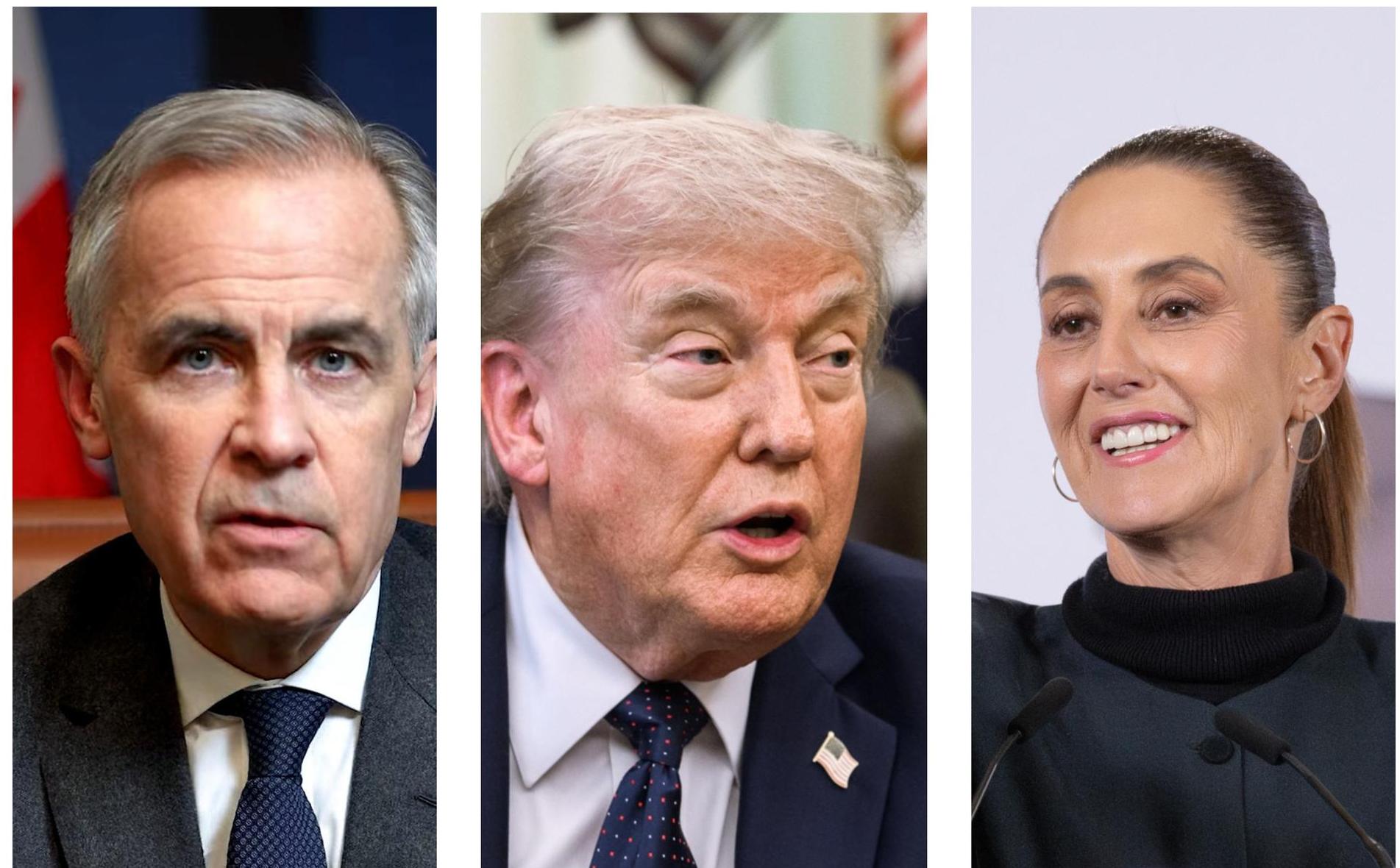
It is virtually certain that the trade agreement between the U.S., Canada, and Mexico (USMCA) negotiated in President Donald Trump’s first term will not be renewed by the deadline of June 30. And indeed, Trump confirmed Wednesday that he would not be reauthorizing the agreement before the July 1 deadline.
This might not be catastrophic: the relevant proviso of USMCA states that a failure to renew only triggers a series of annual joint reviews for the next 10 years unless one of the parties formally announces its withdrawal. Nevertheless, the tenor of discussions heading into the deadline points to bubbling trade and geopolitical stresses in North America.
These discussions also suggest the U.S. intends to reshape the agreement substantially in ways that would be relatively favorable for Mexico and quite unfavorable for Canada.
One of the more surprising outcomes of Trump’s second term has been the extent of the deterioration in U.S.-Canada relations, even as relations with Mexican President Claudia Sheinbaum have been (at least until recently) relatively stable. Trump has interfered to some extent in Mexican politics, most recently through a CIA operation in an opposition-led state and the indictment of a governor from Sheinbaum’s party.
But this falls well short of the level of interference in a neighbor’s sovereignty suggested by the American ambassador in Ottawa retweeting his president’s reference to Canada as the 51st state, or Treasury Secretary Scott Bessent implicitly backing separatism by referring to an independent Alberta as a “natural partner” for the U.S.
The atmospherics at the highest level are indeed terrible, reflecting geopolitical differences of opinion across the Rio Grande and (to a much greater degree) across the 49th parallel. There are some signs that trade bureaucracies are experiencing something of a thaw. Still, significant political divergences over the economic outcomes desired in each capital loom large.
What Washington wants from the USMCA review is not just a strengthened regional trading bloc that reduces imports from the rest of the world (and, above all, from China) but rather one in which more high-value economic activities are located within the United States rather than in its trading partners.
In a recent conversation at the Council on Foreign Relations, U.S. Trade Representative Jamieson Greer expressed his concern that while the administration’s trade actions had lowered the trade deficit with China, the trade deficit with Mexico had increased. He also made it very clear that the U.S. is “going to be talking about rules of origin in a way that enhances U.S. content in these goods.”
This would mark a significant departure from USMCA as it currently stands, where there is nothing in the rules of origin that explicitly favors the U.S. Instead, the current agreement only calls for a minimum of 75% of all automotive content to be sourced within the USMCA and for 40-45% of automotive content to be produced by workers making at least $16 an hour. With average hourly wages for autoworkers in both the U.S. and Canada above that level at around $30, the measure is essentially just a ceiling on Mexico’s content.
However, recent reports suggest that the Trump administration is going to push in the review for measures that would raise the minimum required level of North American content that qualifies for USMCA preferential access to 82%, and the minimum level of specifically U.S.-produced content to 50%. It is also possible that the U.S. could ask for formal rules of origin to be extended beyond the automotive sector to other industries (a recommendation made in a recent Quincy Institute brief) given concerns that Mexico is serving largely as a final assembly point for Asian exporters, particularly for electronics. This would be in accordance with low levels of USMCA content in industries like Information Technology and Electronics, as suggested by some OECD research.
If the U.S. does want to increase minimum content requirements on two axes – more U.S. content in automotive (and perhaps other) industries, as well as higher USMCA content across all industries – the impact would likely differ across the three members. U.S. auto workers would benefit from the requirement for increased U.S.-only content and Mexican workers would benefit if foreign exporters were to respond to minimum USMCA content requirements by investing in Mexico. But the impact of such a combination could end up being a net negative for Canada, a country with wage levels that are close to those of the U.S. The paired incentives could mean that firms decide to put new plants servicing U.S. markets in either the U.S. or Mexico, but not in Canada (and conversely, choose Canada when it comes to deciding which plants to shut down).
There are other irritants. Unlike the multiple administration officials who delight in trolling the very idea that Canada is an independent nation-state, Greer has not taken the low road but has nevertheless suggested that Canada’s decision to retaliate against Trump’s Liberation Day tariffs was an affront. It might be possible to compartmentalize trade issues, but stresses in the relationship are likely to linger as long as the U.S. is dismissive of Canadian sovereignty even as it pushes a USMCA review that is overtly unfavorable to Canada.
Mexico’s calculations may be somewhat different. Mexico’s export mix to the U.S. is weighted heavily towards manufactured goods (which makes it different from the rest of Latin America), and the country has benefited from the industrialization occasioned by the process of closer regional integration that took off with North American Free Trade Agreement (NAFTA) in 1994. And for all of Washington's desires to reshore industry to the U.S., there may be a limit to such a process because of the American private sector’s need for a lower-wage production base to maintain profits (as well as the administration’s political interest in holding down prices). Canada does not answer those same needs.
Compounding matters is a deep disagreement within USMCA on the future of automotive technology as the White House has signaled its doubts over Electric Vehicles (EVs) by cutting subsidies and halting the buildout of charging infrastructure, while both Sheinbaum (a climate scientist) and Canadian Prime Minister Mark Carney seem to have more faith in an EV future. Trump himself has blown hot and cold on whether he would allow Chinese inbound investment (including in EV technologies) into the U.S., but the reaction in much of Congress to any such prospect has been overwhelmingly negative.
Meanwhile, Carney sparked a huge row earlier this year with the U.S. when he announced a partial retreat from Canada’s earlier mirroring of America’s 100% automotive tariffs on China by allowing low-tariff entry of up to 49,000 EVs from that country. Despite Sheinbaum’s own views, Mexico seems to have decided that it is important for reasons of USMCA diplomacy to hew closer to the U.S. line, imposing a 50% tariff on auto imports from all countries with which it has no free trade agreement, effectively targeting China more than any other country. One irony in this divergence is that it is likely that consumer automotive preferences in Canada look more like those in America (bigger and powered by internal combustion) than those of Mexican consumers looking for cheaper EVs.
There are thus so many different points of contention that it could be hard to see a full trilateral agreement any time soon, particularly given increasing reservations in Canada about the future of Ottawa’s relationship with Washington. The question is whether the signatories follow the path of least resistance and allow USMCA to limp on as the zombie it has been since last January, when the U.S. imposed tariffs on Canada and Mexico, or whether they formally decide to bury it.
- Is the CIA car bombing narcos in Mexico? ›
- Canada's moves suggest USMCA is on life support ›
- This Trump-approved trade deal is no tariff, in fact, it's duty free | Responsible Statecraft ›