

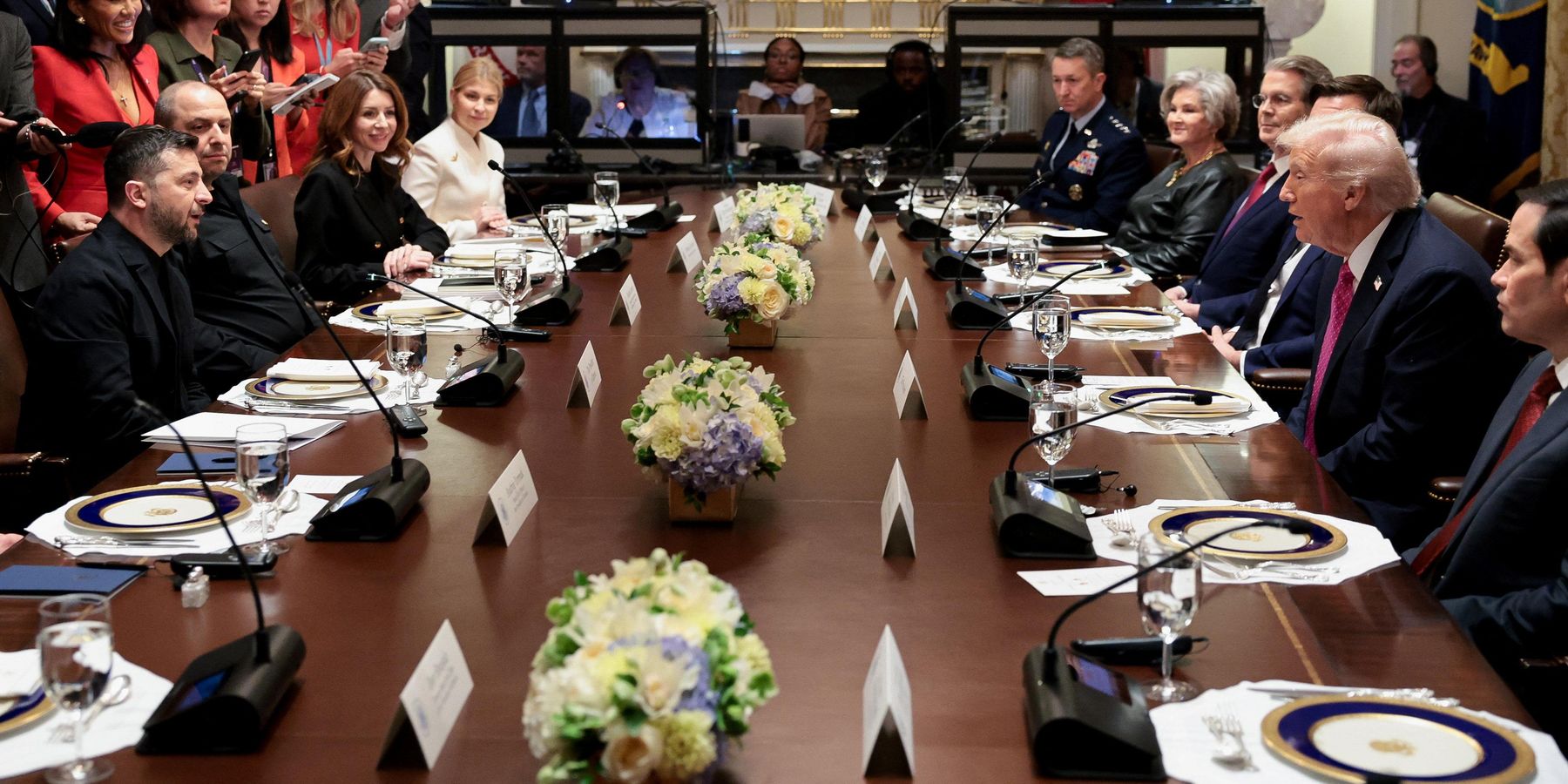
Claims that President Trump bullied President Zelensky and urged him to withdraw from the whole of the Donbas at their latest meeting in Washington will doubtless cause the usual furore in the Western media and commentariat, but they cannot be substantiated and are a distraction from the really important issue concerning U.S. and NATO strategy, which is whether the alliance should continue support to Ukraine at existing levels or seek radically to escalate.
Here, President Trump made the right decision by pulling back from his previous suggestion that the U.S. might provide Tomahawk cruise missiles to Ukraine — presumably as a result of his recent telephone discussion with President Putin.
On the one hand the very limited number of land-based Tomahawks that the U.S. could provide would not seriously change the balance of forces between Ukraine and Russia — as Putin doubtless warned Trump. But in political terms the missiles would be seen in Russia as a huge escalation. They would be able to strike Moscow and far deeper into Russia, and they would need the direct assistance of the U.S. military both to set them up and to guide them onto their targets.
President Trump will hopefully exercise the same prudence and responsibility in his approach to two other wildly dangerous suggestions coming out of Europe: to shoot down Russian warplanes that violate NATO airspace, and to seize Russian cargoes on the high seas if they enter the ports or territorial waters of NATO countries. It is highly unlikely that European countries would take such steps without guarantees of U.S. backing. These suggestions should be categorically denied.
As I was told repeatedly during a visit to Russia this month, if NATO countries took either of these steps, Putin would have no choice but to order immediate military retaliation. NATO aircraft would be shot down. The Russian Navy would attempt to convoy Russian trade, and if intercepted, would fight. If the Scandinavians and Baltic States took such action in the Baltic — as they threatened to do in the summer — this would be seen as a blockade of St. Petersburg and Kaliningrad and therefore as an act of war.
At this point, a full-scale Russia-NATO conflict, possibly leading to nuclear exchanges, would take a huge leap closer.
Apart from being hideously dangerous, no such actions on the part of NATO are necessary. Of course, if Russian planes dropped bombs or fired missiles at NATO territory they must be shot down; but so far nothing of the sort has happened. And above all, thanks to the tremendous advantages that contemporary military technology gives to the defense, the Ukrainian front is holding extremely well. The Russian army is advancing, but very slowly. Thus fighting for the small town of Pokrovsk in Donetsk province has now been going on for almost 15 months with no Russian breakthrough.
Nor is there any sign of the appearance of new weaponry (like the tank and the bomber aircraft in the First World War) that could allow Russia quickly to break the stalemate.
At this rate — even if Russia can eventually conquer the remaining 30 percent of Donetsk province held by Ukraine, or if Trump can somehow pressure Ukraine into withdrawing from this territory as part of a peace settlement — much greater Russian conquests will remain out of sight, and Russia will have no chance to bring about a collapse the Ukrainian state.
As to the idea of a deliberately planned and successful Russian invasion of NATO itself, this is such self-evident rubbish that Western military “experts” should be ashamed to peddle it. By the same token however, the idea of Ukraine reconquering its lost territory from Russia has also long since been revealed to be hopeless.
At present therefore Ukrainian independence is secure, and will remain so even if a few towns in Donetsk fall to Russia. The real danger is rather that if the war continues indefinitely, domestic political change in Europe will lead to the evaporation of willingness to go on supporting Ukraine, leading to a collapse of Ukraine’s capacity to continue the war. Political developments in France, Germany and Britain make this possibility obvious.
However, this development would take years to come to fruition; and in the meantime, the Russian economy is also suffering, with inflation beginning to eat into living standards and efforts to control inflation hurting businesses. It seems likely therefore that if Russia can eventually take the whole of the Donbas, then Putin would be willing to stop if Russian concerns in the wider areas of U.S.-Russian relations and European security were addressed.
In the meantime however, the result of growing Russian military frustration has been to increase demands by hardliners to bring the war to a victorious end by some act of radical escalation that would terrify the West into imposing Russian terms on Ukraine.
They seem however to have no clear idea of what this escalation should consist of; and so far Putin has consistently rejected a strategy that would be both immensely dangerous and would offer no sure prospect of success. This nationalist pressure means that it would be even more difficult for Putin to avoid military retaliation if the escalation came from the Western side.
This danger is increased by the truly grotesque nature of much of the present security debate in Europe — though “debate” is a truly misleading term for a scene that more closely resembles a hen-house spooked by a (possibly imaginary) fox. Three Russian planes that deviated for 12 minutes by a maximum of five miles from their legal corridor over the Gulf of Finland have been turned by parts of the Western media and commentariat into a massive campaign of violations of NATO airspace.
Meanwhile, some unarmed drones over Poland have generated a spate of reported sightings of alleged (but so far wholly unproven) Russian drones from Norway to Italy, quite possibly by the same people who in peaceful times report UFOs. Some fires (without casualties), many of them with no proven links to Russia at all, have been turned into a supposedly massive Russian campaign of hybrid warfare.
As so often, this hysteria comes served with a giant helping of hypocrisy. In this “reporting” and “analysis” there is rarely the slightest mention of the fact that by far the greatest act of sabotage in Europe since the start of the war — the destruction of the Nord Stream 2 pipeline — was directed against Russia, and that the only actions that have caused deaths have been mines planted on ships with Russian cargoes in the Mediterranean.
Instead of engaging in this kind of frenzy, responsible European establishments that truly had the interests of Ukraine at heart would be helping the Trump administration to craft a detailed peace proposal that would freeze the existing borders of NATO and the Russian-dominated Collective Security Treaty Organization (CSTO) and place limits on NATO forces on Russia’s borders and Russian forces in Belarus in return for Russia moderating its demands on Ukraine.
They should also be developing a compromise solution to control over the western Donbas involving neutralization under U.N. control. This might not work at present if Putin is really determined to take the whole of the Donbas, but at least we would have a viable proposal ready if the situation on the ground does shift somewhat in Russia’s favor.
And in the meantime, we should all keep calm. The fox is nowhere near our hen coop yet, and nothing is to be gained by running around squawking.