

The Trump administration’s new National Security Strategy (NSS) not only spends significantly more space discussing and developing an approach to the Western Hemisphere than any recent administration, but it also elevates the Americas as the primary focus for the administration — a view U.S. Secretary of State and national security adviser Marco Rubio iterated shortly prior to his first international trip to Central America.
The NSS lays out a specific vision of how to approach the Americas described as “Enlist and Expand” — by “enlisting regional champions that can help create tolerable stability … [and] expand our network in the region… [while] (through various means) discourag[ing] their collaboration with others.”
While finding reliable partners is crucial to promoting U.S. regional interests, the Trump administration’s approach is short-sighted and runs the risk of creating long-term backlash that could undermine U.S. interests and cooperation across the Americas.
From benign neglect to the Trump Corollary
Latin America and the Caribbean have frequently been an afterthought in U.S. foreign policy, with more attention paid to global hotspots like Asia, the Middle East, and Europe. However, even before taking office, analysts were discussing a marked shift in what a Trump 2.0 approach to the region would look like.
Not only did Trump rapidly fill his foreign policy team with established Latin Americanists and name ambassadorial appointments to posts in the Western Hemisphere — naming 10, including to Canada and the Organization of American States, by the end of 2024 — but also quickly taking up issues related to regional affairs. This has included the administration pushing back against Chinese engagement in the Americas, calls to “retake” the Panama Canal, a harsh line on immigration, lower tariffs than other regions, taking a hardline on Venezuela, and a large of number of senior level visits to the region.
All of these actions have led analysts to announce the emergence of a “Donroe Doctrine” — a play on the “Monroe Doctrine” which declared the Americas off limits to extra-Hemispheric powers, but has become affiliated with U.S. interventionism and imperialism by many in Latin America and the Caribbean. Trump himself has embraced the Monroe Doctrine moniker. Just days before the release of the 2025 NSS, he released a presidential proclamation on the anniversary of the Monroe Doctrine in which he declared the reaffirmation of a Trump Corollary to the “legendary” Monroe Doctrine — a position that was reiterated and outlined as part of the 2025 NSS.
While there is much debate about what the Trump Corollary to the Monroe Doctrine will entail — beyond the enlist and expand description and maintaining U.S. hegemony over extra-hemispheric actors — there is a line in the NSS that highlights a key tenant of Trump’s actions so far in the region: “We will reward and encourage the region’s governments, political parties, and movements broadly aligned with our principles and strategy.”
Notably, this line highlights a key tension — not only will the administration work with existing governments, but also with political parties and movements. And on this issue, the Trump administration has made a stark shift from recent administrations. Since the end of the Cold War, the United States has opted to support democratic movements in Latin America but has rarely sought to shift the outcome of an election in the region directly.
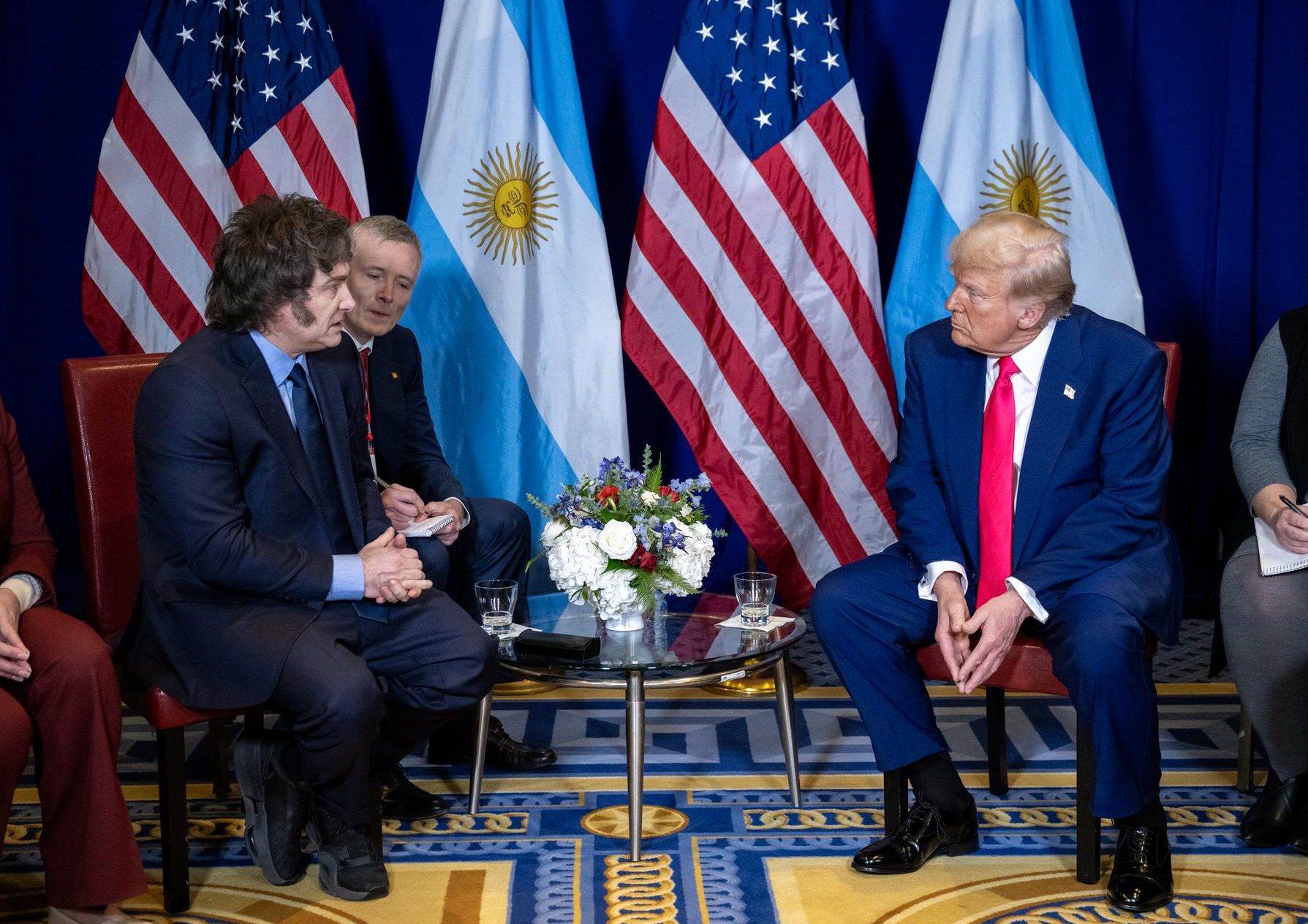
However, since taking office, Trump has weighed in on several elections in the region and even taken actions that appear designed to signal support to one political party or another. This has included his vocal support for Javier Milei in Argentina along with a proposed $20 billion bailout to support Milei in the country’s midterm elections as well as voicing his preference in the recent Honduran election while releasing former President Juan Orlando Hernández, who was convicted of drug trafficking in the United States. Similarly, we have seen the administration weigh in on efforts to prosecute former presidents in both Brazil and Colombia. And more recently of course, Trump has escalated rhetoric and action in an apparent attempt to oust Venezuela’s President Nicolas Maduro.
While the NSS notes that the United States “must not overlook governments with different outlooks with whom we nonetheless share interests and who want to work with us,” the approach so far has focused on rewarding those with similar positions while punishing countries that disagree with the administration. Interfering in the domestic politics of Latin American countries may not be entirely new, but this element stands out as a key component of what constitutes the new Trump Corollary.
The inevitable political pendulum
The approach of finding regional champions with which to cooperate and then expanding it to a broader group runs into a core challenge — politics in Latin America and the Caribbean have been known to alternate widely between the left and right. This phenomenon is often referred to as a political pendulum triggered by shifting voter preferences on issues related to inequality, crime, and other key issues. However, while usually driven by domestic political considerations, the swings in Latin America’s politics can impact foreign affairs.
One stark example of how the political pendulum has influenced U.S.-Latin America comes from Argentina. While the Trump administration has sought to improve relations with the country under Milei, relations in the 1990s were particularly close — with the relationship being so close that then-Argentine President Carlos Menem referred to them as “carnal.” However, the political pendulum swung away from Menem in Argentina and U.S. relations with the country severely deteriorated under the Kirchner governments of the 2000s and 2010s.
While political swings have traditionally occurred in Latin American politics, the Trump Corollary’s component of interfering in domestic affairs risks exacerbating the degree to which political backlash may occur — a move that would undermine the enlist and expand strategy laid out by the administration. Even since taking office, Trump’s hardline international tactics have provoked push back from constituents abroad — in countries including Canada, Brazil, and Panama — that have undermined the administration’s own objectives.
Over the longer term, pushing hardline policies in the region will create political backlash that results in the elections of parties that do not want to cooperate with the United States. This backlash will be all the stronger if these parties feel as though the United States has actively campaigned against them and interfered in their domestic political opportunities. While supporting democracy abroad may anger dictators, only supporting certain political groups or leaders will lead to significant foreign policy hurdles in democratically elected societies when the political pendulum inevitably swings in the other direction.
Building a lasting coalition
If the United States wants to counter Chinese influence in the region and improve relations with countries in a way that last, it needs to develop partnerships that run across the political spectrum in every country in the region and recognize that there will be times where agreement will not be universal.
Enlisting and expanding needs to focus not on political ideology or short-term objectives, but rather on developing deep and lasting ties with civil servants and the general populations of countries across the region. This creates less incentive for anti-Americanism to play a role in the political swings within countries.
However, if the Trump administration resurrects a ghost of Monroe that interferes in the domestic politics of the U.S.’s neighbors, opposing parties will benefit from tapping into strains of anti-Americanism and highlight U.S. intervention in their campaigns — thus undermining the U.S. interests.
- Trump's Latin American sticks could end up stuck in his spokes ›
- Trump NSS puts S. Korea at center of US primacy aims in region ›
- Trump's 'Monroe Doctrine 2.0' completely misreads Latin America ›
- Trump national security logic: rare earths and fossil fuels | Responsible Statecraft ›
- US-China symposium: Spheres of influence for me, not for thee? | Responsible Statecraft ›
- Is America still considered part of the 'Americas'? | Responsible Statecraft ›