

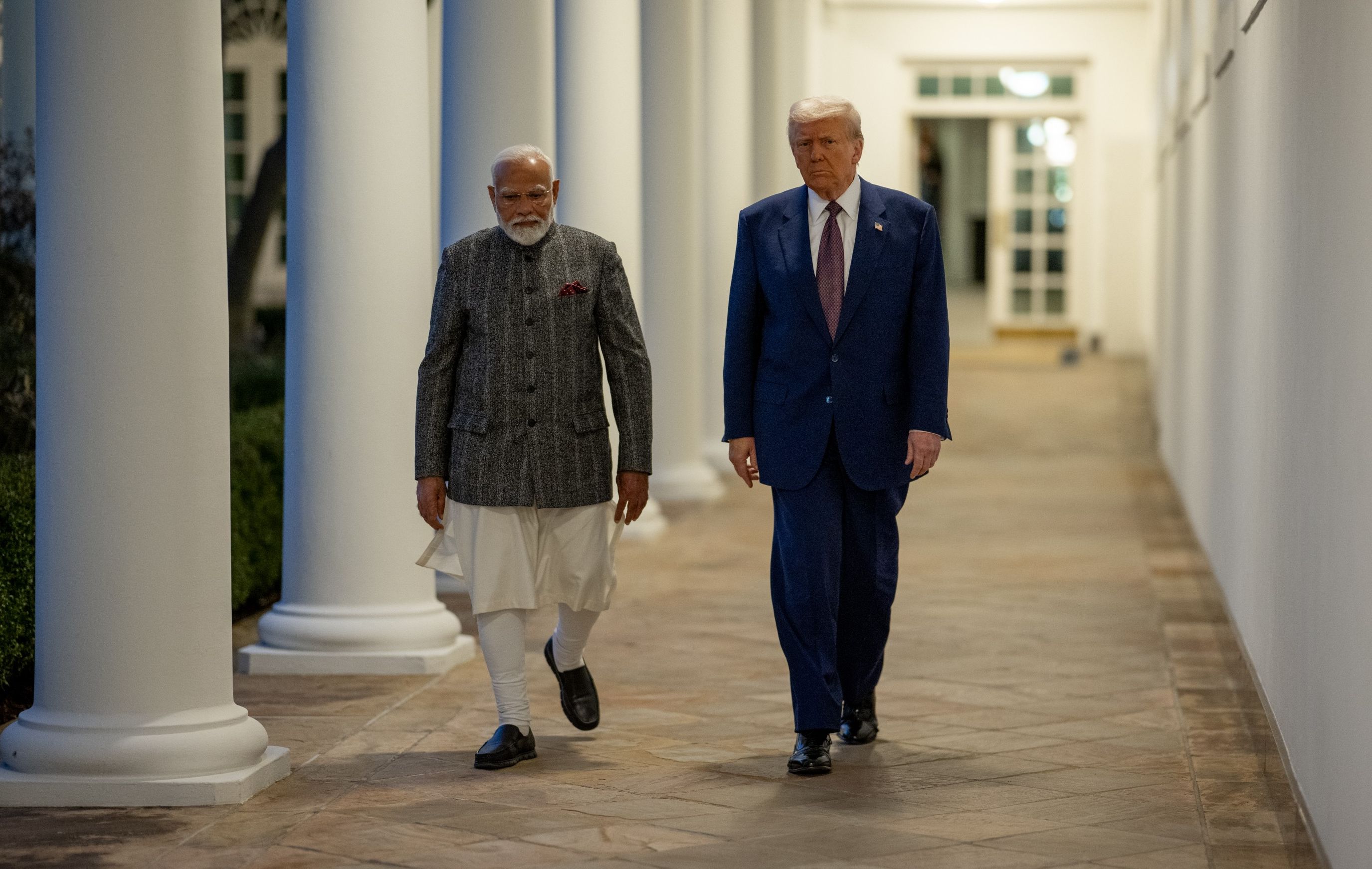
As President Trump’s second term kicked off, all signs pointed to a continued upswing in U.S.-India relations. At a White House press conference in February, Indian Prime Minister Narendra Modi spoke of his vision to “Make India Great Again” and how the United States under Trump would play a central role. “When it’s MAGA plus MIGA, it becomes a mega partnership for prosperity,” Modi said.
During Trump’s first term, the two populist leaders hosted rallies for each other in their respective countries and cultivated close personal ties. Aside from the Trump-Modi bromance, U.S.-Indian relations have been on a positive trajectory for over two decades, driven in part by mutual suspicion of China. But six months into his second term, Trump has taken several actions that have led to a dramatic downturn in U.S.-India relations, with India-China relations suddenly on the rise.
While the India-China thaw has received much hype, less attention has been paid to what this might mean for U.S. relations with the Global South and a more united BRICS bloc.
How did we get here?
Since the Obama era, India has played a central role in U.S. Indo-Pacific strategy. Both sides’ desire to balance against China and prevent its ascendancy as a regional hegemon has underpinned the relationship.
But as Trump ramped up efforts to resolve the Ukraine conflict, he slapped India with a 50% tariff for its Russian oil purchases, which a top U.S. official has said bankrolls Putin’s war machine. Indian officials immediately expressed outrage, with a Ministry of External Affairs statement calling the tariff “unfair, unjustified, and unreasonable.”
For India, this isn’t just about the steep tariff rate; it sees these moves as coercive meddling in Indian foreign policy and as hypocritical given Europe’s continued purchases of Russian energy. Washington’s warming ties with India’s archrival, Pakistan, and a disagreement between Trump and Modi over Trump’s role in mediating the recent India-Pakistan conflict, have also contributed to the U.S.-India rift.
India looks east
These developments have compelled India to rethink its relationships with the world’s two major powers. In rapid fashion, India has deepened a détente with China that began last year following five years of tensions stemming from a deadly 2020 border clash.
The very day that Trump announced 50% tariffs on India, Modi said he would travel to China for the first time in seven years to attend the late August summit of the China-led Shanghai Cooperation Organization. Shortly thereafter, India and China announced the resumption of direct flights between the two countries for the first time in five years.
Last week, Chinese foreign minister Wang Yi traveled to New Delhi, where he met with top Indian officials, including Modi. The two sides announced deals to address ongoing border concerns, lift curbs on Chinese exports of rare earths to India, and increase trade and investment flows.
Geopolitical implications
India and China still have many disputes that they won’t resolve overnight.
“No one in Beijing or New Delhi sees their re-energized diplomacy as a fundamental strategic shift,” Daniel Markey, a China and South Asia expert at the Stimson Center, told RS. “There’s still too much distrust.”
Still, progress in the India-China bilateral relationship will likely continue if U.S.-India estrangement drags on. However, the real realignment that this slide in U.S.-India relations could impel is almost certainly to take place among Global South countries.
India has long prized its strategic autonomy, walking a thin line as it maintains close ties with both Russia and the United States and participates in Chinese-led groups like BRICS and the Shanghai Cooperation Organization. The more Washington pressures India to make moves that New Delhi sees as against its national interest, the more India will find common cause with China and Russia, who are building Global South platforms like BRICS to resist U.S. pressure and coercion.
“Sustained U.S. pressure will indeed drive deeper [Indian] BRICS participation,” said Sushant Singh, a lecturer on South Asian studies at Yale University and a former Indian military officer. “India increasingly sees Chinese-led frameworks as necessary alternatives to unpredictable American coercion.”
BRICS was formed in the late 2000s, in part, to push back against U.S. sanctions and economic coercion. But the group has not been explicitly anti-Western, and divides between Russia and China, on the one hand, and India and Brazil, on the other, have limited BRICS cohesion. As Washington’s chief geopolitical rivals, it’s no surprise that Beijing and Moscow see BRICS as an important component of their efforts to subvert and ultimately replace the U.S.-led international order. India and Brazil, however, have shown more interest in BRICS as a mechanism to reform and democratize the international system.
“BRICS cooperation has evolved despite the China-India conflict,” but “rising U.S.-India frictions are now shifting the boundaries of what India is prepared to pursue with China and within BRICS,” said Mihaela Papa, who leads the BRICS lab at MIT’s Center for International Studies.
Washington’s treatment of a close partner like India reinforces the concerns of many Global South countries, who see the international system as a rigged game, where the United States uses economic coercion and hypocrisy to pursue American interests to their detriment. Although Trump’s bullying has been blunter amid his tariff war, U.S. peremptory behavior is a longstanding concern.
After all, BRICS saw its first real expansion during the Biden administration, when many Global South countries pointed out Western double standards over the Ukraine and Gaza wars. BRICS membership has expanded dramatically in recent years, with the bloc now accounting for 56% of the world’s population and 44% of global GDP.
If the first six months of the Trump administration are any sign of what’s to come in the years ahead, we can expect increasing Global South solidarity. Trump has also hit Brazil with 50% tariffs in response to the prosecution of Trump ally Jair Bolsonaro. Moreover, the U.S. president has threatened an additional 10% tariff for participation in BRICS, which he says is “anti-American.” The irony, of course, is that actions like these could be the catalyst for BRICS to take a more explicitly anti-American posture.
As a new multipolar world takes shape, U.S influence will necessarily diminish. But BRICS isn’t going to usher in the United States’ imminent decline on the world stage. Still, that doesn’t mean Washington shouldn’t consider how to address its declining influence in the Global South or those countries’ desire to find alternatives to a global economic and financial system that the United States often weaponizes against them. As Ernest Hemingway once described the descent into bankruptcy, the United States’ global influence can diminish gradually, and then suddenly.
Bullying close partners like India with no regard for its national interests is sure to hasten that decline and limit the United States’ ability to address major transnational threats — like climate change, terrorism, and the challenges posed by AI. The United States could be left behind as BRICS and other Global South coalitions see Washington as nothing more than an erratic bully.
- A China-India warming trend? Not so fast. ›
- Why the US is ill-suited to mediate India-China border dispute ›
- Can Trump-brokered Pakistan-India ceasefire hold? ›
- Major Shanghai summit of US 'adversaries' sends clear message | Responsible Statecraft ›
- The Iran war looms large as BRICS leaders gather in New Delhi | Responsible Statecraft ›