

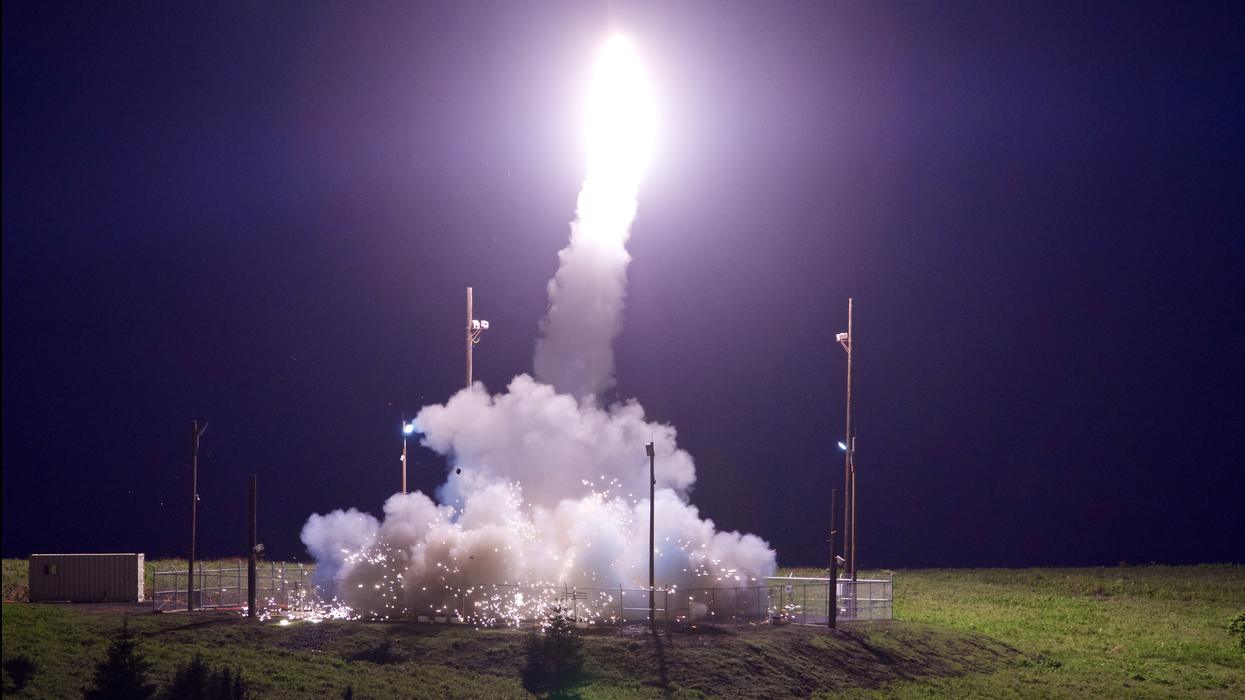
A new report finds the U.S. has fired at least 45% of its critical Patriot missile interceptors, and over 53% of its THAAD interceptors during its war on Iran.
The report, released by the Center for Strategic and International Studies (CSIS) Tuesday, finds the U.S. has blown through a number of key stockpiles, including more than 45% of its Precision Strike Missiles (PrSMs).
And these are conservative estimates of how much the U.S. has used. At most, CSIS finds the U.S. could have blown through up to 290 of its estimated 360 THAAD interceptors — more than 80%.
Altogether, the report asserts the U.S. has enough critical munitions to continue its war on Iran “under any plausible scenario.” It also finds many U.S. munitions have acceptable inventories.
However, because munitions take years to replace, massive weapons expenditures during the Iran war might mean the U.S. would not be fully prepared for another conflict in the near future.
“The diminished munitions stockpiles have created a near-term risk. A war against a capable peer competitor like China will consume munitions at greater rates than in this war,” the report notes. “Prewar inventories were already insufficient; the levels today will constrain U.S. operations should a future conflict arise.”
The White House is looking to boost production through a potential supplemental bill for the Iran war, slated to cost around $80 to $100 billion. In the DoD’s FY 2027 defense budget request the Army has asked for more than $20 billion to buy more replacement THAADs and Patriot missile interceptors. The Trump administration has also repeatedly consulted with weapons contractors to double or even quadruple their munitions production rates.
Beyond traditional defense contractors, the DoD has approached automakers and other civilian companies, like GM, Ford, and Oshkosh, to ask them to consider making weapons.
Leading up to the current war which began on Feb. 28, the U.S. expended many of its munitions in other wars in the Middle East and Ukraine, at rates faster than replacement levels.- By the numbers: US missile capacity depleting fast ›
- Iran wipes out US-Israeli radars & sensors, changing course of war ›
- Iran killed any delusions of US military domination over China | Responsible Statecraft ›
- Ukraine wants to make its own Patriot missiles. That's a bad idea. | Responsible Statecraft ›