

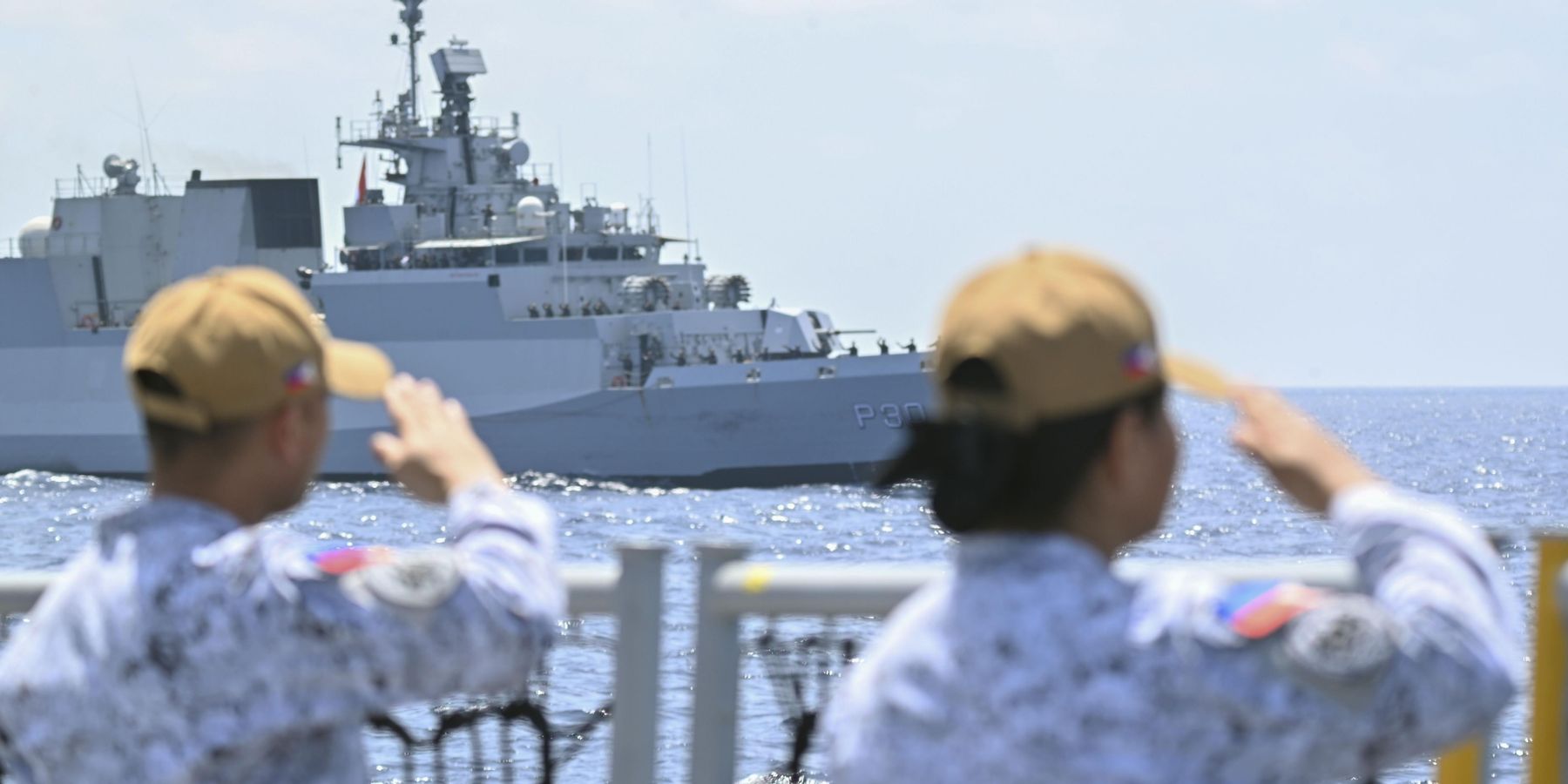
After calming down a little during the early part of this year, the South China Sea is on the boil again. Two serious incidents have brought home the fact that the situation is becoming critical, and a Philippines-China military crisis could happen anytime, potentially pulling the United States in.
On August 11, two Chinese vessels, one of which was a Chinese navy craft, collided while chasing a Philippine ship off Scarborough Shoal. The collision was serious, and several Chinese coast guard personnel possibly died in the collision. Any Chinese deaths would mark the first loss of life in the China-Philippine tussles in years.
Soon thereafter, there was a swarming incident in the second hotpot in the South China Sea, Second Thomas Shoal, where an aging Philippine ship, the Sierra Madre, with a handful of troops has been berthed since 1999. Though there were no injuries, Chinese craft came within 50 meters of Philippine military positions on the shoal.
The concern in Manila now is that China may respond to the acute embarrassment and losses it suffered in the collision by trying to forcibly seize or dislodge the Sierra Madre or take another similar aggressive action. The head of the Philippine military,General Romeo Brawner, has asked his troops to defend the post at Second Thomas Shoal “at all costs” and reiterated the “red line” of the death of even a single Filipino in contested waters.
The crossing of this line, General Brawner said, could invoke the Mutual Defense Treaty with the United States. The same red line was first articulated by Philippine president Ferdinand Marcos Jr. himself during the 2024 Shangri La Dialogue in Singapore.
China’s nine/ten-dash lines were ruled illegal in 2016 in a ruling at The Hague by an international tribunal constituted under the UN Convention on the Law of the Sea. China is unquestionably violating international law and interfering with Philippine sovereign rights and maritime jurisdiction through its intrusive activities.
However, the United States is far from helping. As laid out in a Quincy Institute brief in February 2025 (“Defending Not Provoking: The United States and the Philippines in the South China Sea”), Washington has expanded its military sites and exercises in the main Philippine island of Luzon northward, far from the South China Sea, and provocatively close to the Taiwan theater. Taiwan is the reddest of red lines from Beijing’s perspective.
The United States has also deployed advanced missile platforms to Luzon, which have little utility in countering Chinese gray zone tactics in the South China Sea. Moreover, Freedom of Navigation Operations (FONOPs) by the U.S. Navy, like the one conducted just two days after the serious August 11 collision, will not deter, but only further destabilize the situation. There was no pressing need to conduct this FONOP, certainly not so soon after the collision incident, when Chinese nerves were on the edge.
Calls are already being made in the United States for a direct U.S. naval role in Philippine resupply missions to Second Thomas and Scarborough shoals. In the coming days, these calls will doubtlessly multiply. But such escorts can only heighten the risk of a U.S.-China war over specks in the ocean that are an American interest, but far from a vital one.
A military crisis in the South China Sea must be avoided. All sides need to pull back and let temperatures cool down at this fraught moment. Otherwise, the summer may turn out to be a long hot one in Asia.- US policies pushing China, Philippines to brink of conflict ›
- China, Philippines both plant flag on reef, escalating Maritime tussle ›
- New US Army force deployed to Philippines ›