

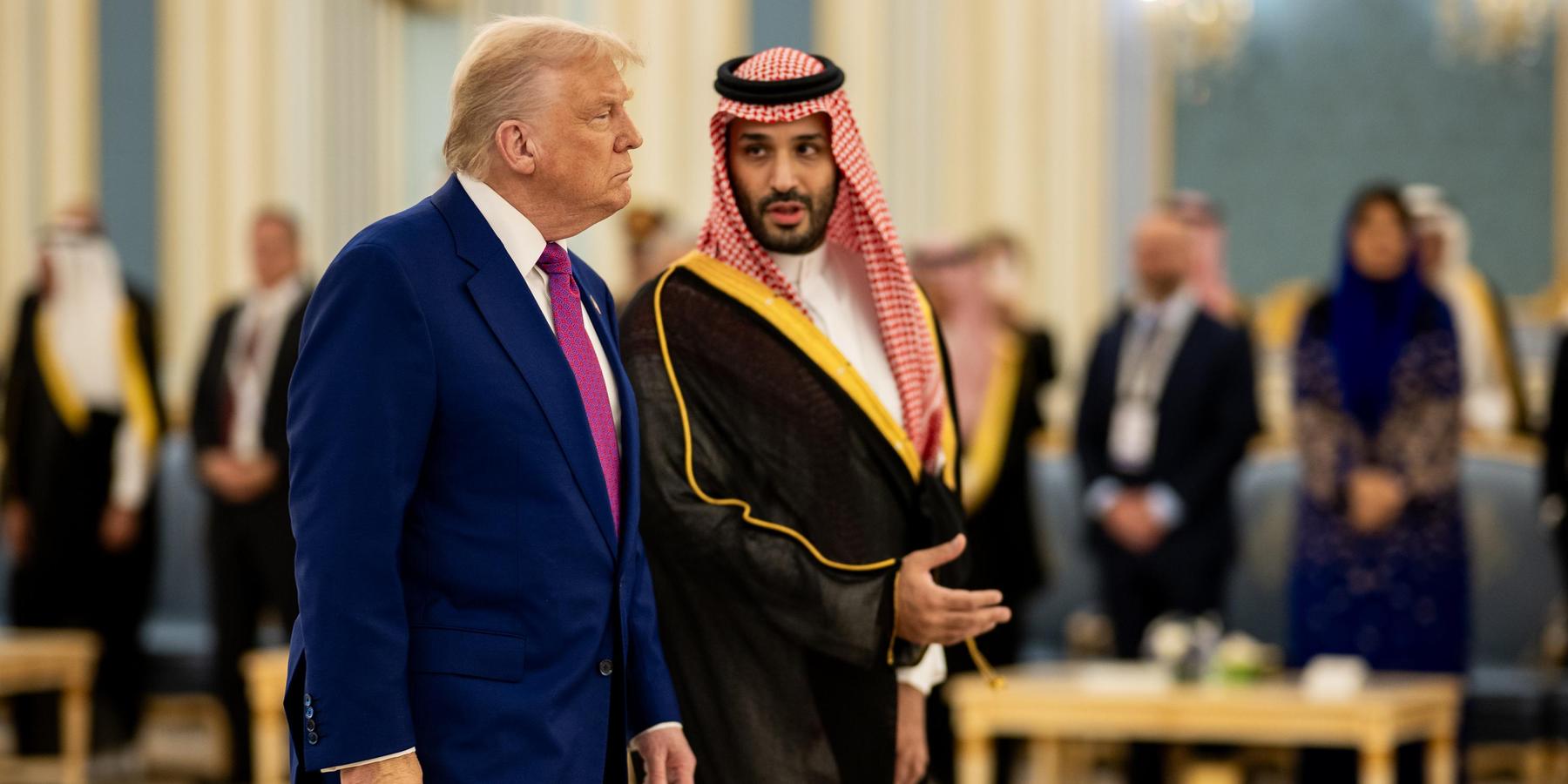
Just as the U.S. and Israel launched a war in Iran over the weekend in part due to concerns about Iran's nuclear program, Congress is waiting to receive a civil nuclear agreement with Saudi Arabia from the president, which could allow Riyadh to develop a nuclear program of its own.
President Donald Trump told Congress last fall that he is pursuing a civil nuclear deal with Saudi Arabia — a deal that lacks standard guardrails that would prevent the Middle Eastern nation from building a nuclear bomb.
The deal in itself is not an unusual development considering the dozens of other so-called “123 agreements” that the U.S. has forged with foreign governments. But the reason why this agreement is raising red flags is that it lacks some of the safeguards that have become commonplace in other agreements.
Arms control groups, many Democrats, and some leading Republicans, including Secretary of State Marco Rubio when he was a senator, have long insisted that the only safe nuclear agreements are the ones that come with guardrails, which can include prohibitions on enriching uranium or reprocessing nuclear fuel.
But according to Trump’s initial report to Congress, which was viewed by Reuters, the forthcoming agreement does not include non-proliferation safeguards that are intended to ensure Saudi Arabia does not develop nuclear weapons.
For one, the agreement is not expected to include the Additional Protocol. Originally created to address safety gaps that arose after Iraq and North Korea illicitly pursued nuclear weapons programs in the 1990s, the Additional Protocol grants the United Nations’ International Atomic Energy Agency broad oversight of a country’s nuclear activities.
The new agreement reportedly won’t include the “Gold Standard,” as it’s come to be known, which is a pledge not to enrich uranium or reprocess spent fuel. Further, the agreement involves an unprecedented focus on U.S. technology, aiming to place U.S. industry at the center of the Saudi nuclear program.
“The message is essentially that there are bilateral safeguards in place and that there is no need to worry,” Andrew Leber, assistant professor of Political Science and Middle East and North African Studies at Tulane University, told Responsible Statecraft. However, “given that these are sensitive and technical matters, that does raise questions about how far one would want to trust the administration on that.”
In its initial November report — which was required because of the absence of the Additional Protocol — the Trump administration assured lawmakers that the agreement as proposed would be sufficient to ensure that Riyadh could not militarize its nuclear program. But concerns remain.
“Even with stringent limitations, monitoring, and possible U.S. involvement, there's going to be an increased risk that the enrichment program is misused,” Kelsey Davenport, Director for Nonproliferation Policy at the Arms Control Association, told RS. “There's going to be an increased risk that if Saudi Arabia's strategic calculus shifts, it could try to nationalize any enrichment program and use it for weapons development purposes.”
Chief among the widespread concerns is that the less stringent agreement sets a dangerous precedent for future nuclear deals. “One immediately starts to think about who would be next,” Leber said. “Other countries in the region would likely think that they should try to secure their own nuclear energy agreement, especially if the United States appears willing to make such agreements without these safeguards.”
And with tensions already fraught in the Middle East — especially after weekend airstrikes in Iran by the U.S. and Israel — it’s been made clear that if one country were to develop a nuclear weapon, regional rivals might be quick to follow suit. Crown Prince Mohammed bin Salman, the de facto ruler of Saudi Arabia, has already stated that if Iran developed a nuclear weapon, Saudi Arabia would be forced to as well. Pakistan has established that its nuclear program can be made available to Saudi Arabia under their defense pact.
"If they get one, we have to get one," he told Fox News in 2023, saying a weapon would be necessary "for security reasons, and for balancing power in the Middle East, but we don't want to see that.”
This precarious line of dominoes could set off a nuclear arms race if any country were to move forward with developing a nuclear weapon, Annelle Sheline, Research Fellow in the Middle East Program at the Quincy Institute, told RS.
“The process of developing a nuclear weapon, when a new country comes online with one, is often seen as the moment of instability, where other countries are also trying to reestablish deterrence, either through a nuclear weapon or through some other form of deterrence,” Sheline said. “But nothing is quite as strong as nuclear deterrence.”
Historically and still, there has been strong bipartisan support for the Additional Protocol and gold standard to be included in any nuclear cooperation agreements.
“We can’t hand Saudi Arabia the keys to nuclear tech while ignoring its desire for nuclear weapons," Senator Ed Markey, a Democrat, recently told Reuters. "I’m urging the Trump administration to insist on the gold standard safeguards — enrichment bans and full inspections — before any deal."
With geopolitical relationships in the region already tense, Davenport said now is not the time for support of these guardrails among policymakers to wane.
“The precedent this could set for how states engage with the United States on future nuclear cooperation agreements could be profound, and the U.S. is facing a new age of proliferation risks,” Davenport said. “Washington needs to be careful about how it pursues nuclear cooperation agreements.”
Feb. 22 was the first day that the Trump administration could send the Saudi Arabia 123 Agreement of Congress — about 90 days after the initial report was sent. Now, it could come at any time. And unless both the Senate and the House pass resolutions opposing the Agreement within 90 days of receiving that proposal, it could take effect.
- Amid Gaza war, a beefed up Saudi nuke program is still on the table ›
- No Joke: US considering nuclear power for Saudi in grand bargain ›