

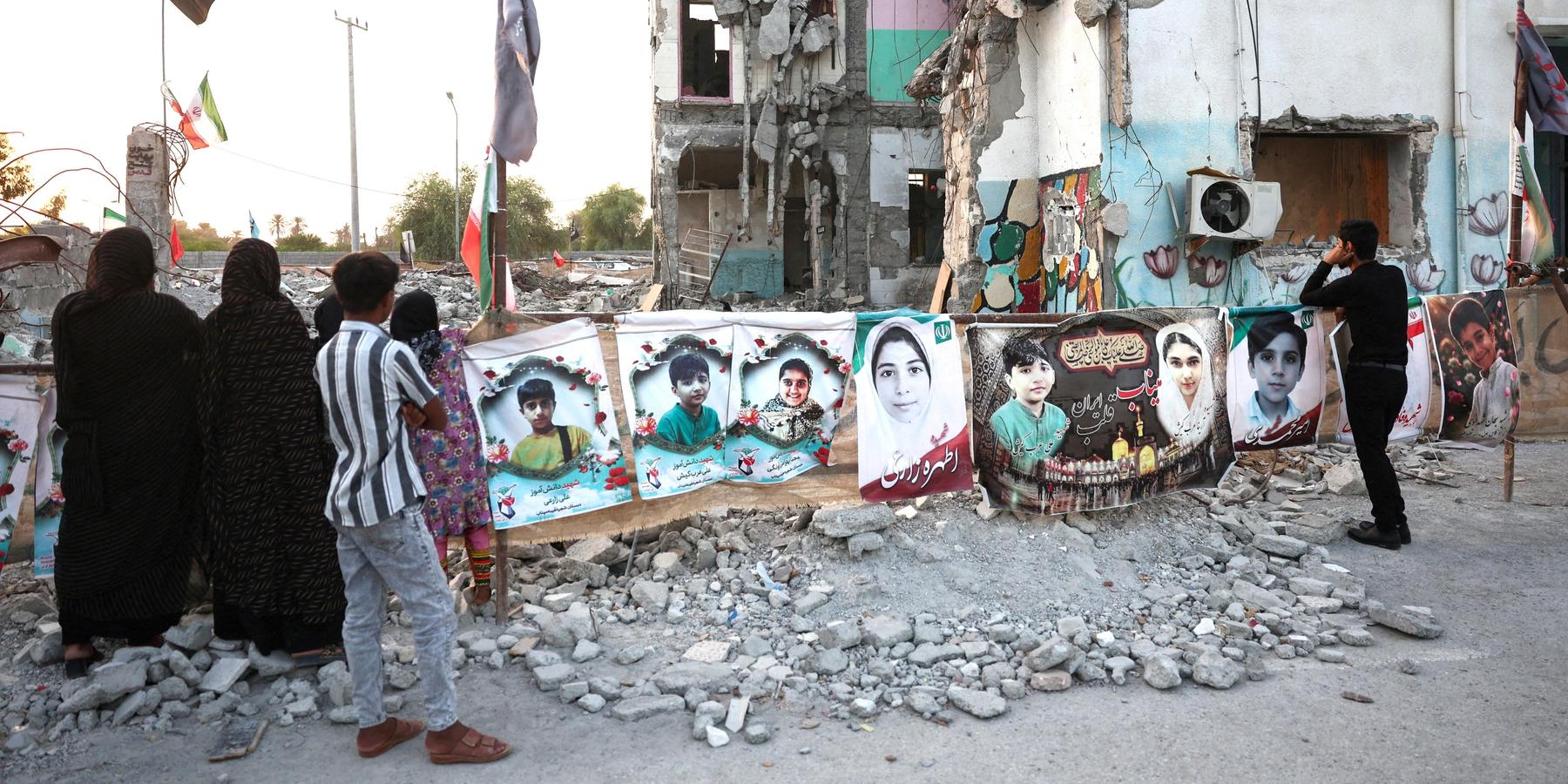
When the U.S.-Israeli war on Iran ultimately ends, it will be remembered for its bloody onset.
On the same day airstrikes killed the Supreme Leader Ayatollah Ali Khamenei in Tehran, a U.S. missile incinerated an elementary school in Minab, killing 123 children and dozens of others. Some 250 miles away, U.S. missiles fell on a residential area of Lamerd, killing 21 civilians, including five children.
Neither the White House nor Pentagon has publicly admitted responsibility in either incident, although an internal review reportedly determined Minab was hit by a U.S. missile. An independent, international fact-finding mission found “reasonable grounds to believe that the United States committed a war crime by launching indiscriminate attacks that killed or injured civilians or damaged civilian objects.”
Mistaken attacks and official denials have become a norm in the “global war on terrorism,” fought with “precision weapons” by remote military personnel often using faulty intelligence. In Iran, the Trump administration also conducted “dual-use” targeting and “double-tap” airstrikes, further endangering civilians and wrecking civilian infrastructure.
Although there are no official totals, the Human Rights Activists News Agency said in April that it had documented 1,701 civilian fatalities due to "airstrikes and impact damage on hospitals, emergency medical facilities, primary schools, universities, water desalination plants, power plants, civilian airports, places of worship, UNESCO World Heritage Sites, and countless densely populated residential areas."
To understand why the innocent continue to die under U.S. bombs, I spoke to The New York Times journalist Azmat Khan, whose Pulitzer Prize-winning work revealed deadly patterns of failure and a system of opacity and impunity in America’s air wars. Our conversation has been edited for length and clarity.
Martin Di Caro: During the most intense period of the U.S. bombing of Iran, did you notice the same problems that you uncovered in your past investigative work?
Azmat Khan: Yes, I saw the same problems over and over. One of the biggest was the misidentification of civilians. The distinction between civilians and combatants is supposed to be one of the pillars of targeting.
On the very first day, the United States hit the girls’ school in Iran. Early reports suggested the military used poor or outdated intelligence, didn’t bother to look at open-source evidence, and failed to detect the presence of civilians. These are all things that I saw over and over again which the military was unaware of. So, for example, in their own data, they found that misidentification occurred in about 4 percent of civilian casualty cases. When I analyzed them, I found that misidentification caused about one-third of the civilian casualties.
Just this month, on September 1, the U.S. hit a wedding gathering when the intended target may have been something nearby. I’ve seen that happen again and again, and often it was the result of confirmation bias, being predisposed to believing that everything is a target, even an ordinary action. For example, someone opening a gate will be seen as an ISIS tactic.
In my previous reporting I found that [targeters] didn't have enough drone surveillance video because they were working at such an intense pace. The Iran war exceeded previous bombing campaigns in its pace, scale, and intensity. So, of course you’re going to have the same problems endemic to the targeting system, but at a greater rate with far less accountability.
Di Caro: What about an overreliance on AI?
Khan: To use AI in any form of targeting means utilizing an already flawed data set, even if you have a human vetting it. The result is a system of impunity with a lack of accountability. And unless you're on the ground and investigating the target sites yourself, unless you're putting in the resources, time, and effort to understand what went wrong and why, you're never going to catch these kinds of mistakes. And can you really call these “mistakes” when they are repeated over and over, and go unaddressed? Can they be war crimes? This is something Oona Hathaway and I question in a law review article called “‘Mistakes’ in War.”
Di Caro: On the subject of transparency and accountability, what do you make of Secretary of Defense Hegseth’s decision to eliminate the Pentagon’s Civilian Harm Mitigation office?
Khan: Of course it’s contributing to the problem. That office was helping review civilian casualty assessments, largely because the rest of the Pentagon was so understaffed. So even after it had been gutted, the office was still helping with this. Even before the Iran war, during the bombing of Yemen in 2025, the U.S. stopped releasing strike-tracking data that is normally disseminated to the public. So there is less transparency, along with fewer people qualified and trained in assessing civilian harm.
Di Caro: Let’s talk about the use of new weapons. For instance, on the same day the Minab school girls were killed, PrSM missiles killed 21 civilians in Lamerd, Iran, according to a report you co-wrote in The New York Times. That weapon had never been used in combat.
The Pentagon always says it does not target civilians. But a missile that explodes above the target and sprays 1,800 tungsten pellets in all directions seems to be designed to kill as many people as possible.
Khan: Precision Strike Missile (PrSM) is an ironic name, because it pushes out the tungsten pellets. Sometimes weapons are given intentionally misleading names, things designed to give you certainty, clarity, or comfort when using them.
This missile is new to combat. We know [what happened in Lamerd] because there happened to be CCTV footage from the top of one of the buildings that showed the missile landing, which is rare. What were they trying to target and what went wrong? We don't have those answers. The Pentagon has not released its investigation. In fact, when The Times’ visual investigations team identified it as a U.S. missile, the military tried to suggest Iran was responsible. That was not true. It was a deliberate lie. And there is no transparency about using an untested weapon that, according to my sources, has a high fail rate. The U.S. Army just awarded Lockheed Martin a $1.2 billion contract that includes more Precision Strike Missiles.
Di Caro: The Pentagon has admitted to targeting civilian infrastructure in Iran, but under the rubric of “dual use,” meaning the facility might also have some military function.
Khan: Under the laws of war and civilian protection, civilian objects like hospitals or critical infrastructure are off limits. Dual-use targeting emerged during the Gulf War. It was invented by the United States and propagated by Israel. Both countries have really advanced dual-use targeting, and in a densely-populated urban environment the dual-use doctrine can be used against almost anything because non-state actors are known to embed themselves in civilian populations. This is a real crisis.
If it were applied against the United States the way the United States applies it in the world, a tower that houses businesses that do work for the U.S. government would be targetable — not with all the people in it, but the structure itself. So there are questions about the evidence used to prove that a target is used by the enemy’s military. You know, to what extent does the enemy need to use it?
Di Caro: It seems like an excuse to destroy as much civilian infrastructure as possible.
Khan: Well, the president of the United States openly said the intent was to destroy Iran, which is not even meeting the pretense of the dual-use doctrine.
Di Caro: An investigation by New Lines Magazine found that the United States also conducted “double-tap strikes” in Iran. They also seemed designed to harm civilians.
Khan: Double-tap strikes often happen when rescuers are trying to get to the wounded from the initial airstrike. I've seen them in every war I've investigated. You will hear two main justifications for them. [The military] did not consider the people running toward the bombing site rescuers. They were militants coming to aid their brethren.
[The other justification is] the military claims the target was obscured — that there was a cloud of smoke — so they hit it twice because it didn't appear that the target was damaged the first time. They couldn’t see rescuers or relatives rushing to the scene.
There are so many cases in which [the striking forces] classified people attempting to make their way to the scene to rescue others as combatants. If the Pentagon has already misidentified the target, then the military won’t suddenly realize that those people are locals who live nearby. It got to the point where locals would tell others not to try to rescue the wounded. I know a young man who wanted to reach his father and was held back. He watched his father burn to death because he would have been killed too.
Di Caro: Where was that?
Khan: In Mosul, Iraq. There’ve been many cases where the official claim that someone was a member of ISIS or belonged to Hamas felt quite disingenuous after I looked at the surveillance footage. I’ve seen videos of double-tap strikes in Gaza, for example, where you can clearly see a child who's been injured, people coming to help that child, and then another airstrike.
Di Caro: As you’ve reported, a supposed benefit of relying on so-called precision air strikes is that the U.S. can eliminate its enemies without deploying boots on the ground. But the promise of fighting clean, sanitized wars was a lie, wasn’t it? It’s not clean and sanitized for the people on the receiving end of U.S. airstrikes.
Khan: It's a good thing when fewer American soldiers are dying but the U.S. has shifted the costs, the human costs of its wars, to either partner forces on the ground or to the local population. For some in the United States, especially policymakers, they might view that as convenient because the political costs of war have gone down.
Historically speaking, American soldier deaths are one of the driving forces of anti-war movements and accountability… But I would argue that things are changing especially among the younger generations in the United States. Younger people that see foreign civilians being killed, maimed, murdered, slaughtered, and child amputees at the highest rates in the world [in Gaza] — they don't think of them as just some foreign other. They think of them as humans just like you and me. That's different, and it’s a political constraint. It has resulted in organizing, activism, and broad discontent among the American public about not just the wars the U.S. wages, but the countries to which the U.S. sells weapons and enables to wage these wars. The cost to foreign civilians is not something you can hide.
- Will we finally accept that 'precision airstrikes' don't exist? ›
- Why did mainstream media slow-walk coverage of school attack? ›