

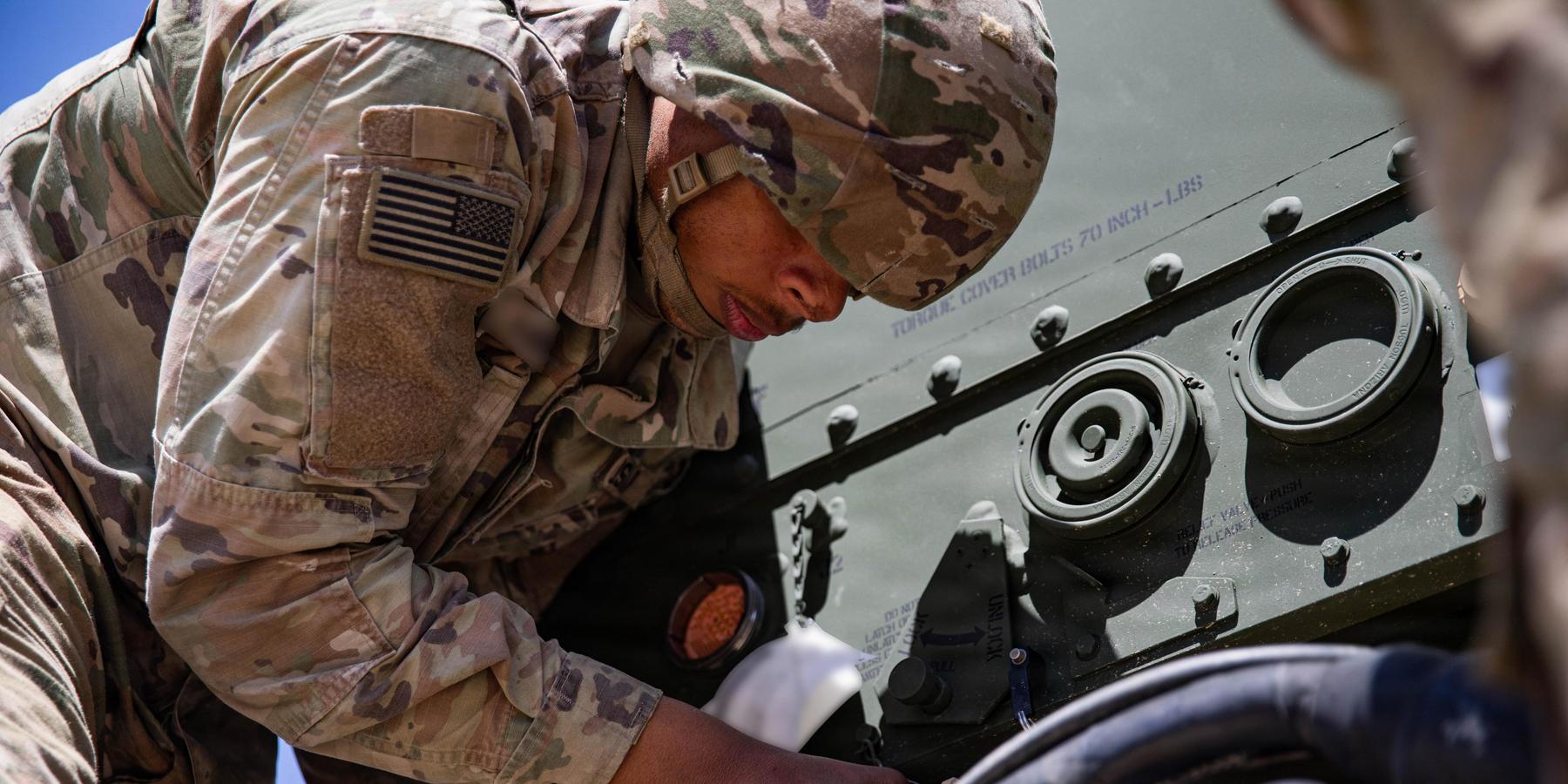
A plurality of active-duty service members oppose the military being used in the U.S.-Israel war with Iran, according to a poll conducted by Change Research for the advocacy group Common Defense
The poll surveyed 156 people currently serving in the military, 431 veterans, and 144 immediate family members of active-duty service members between September 15 and 28.
Common Defense is a veteran-led group that advocates for progressive policies and endorses Democratic candidates, though a 47% plurality of respondents to their September poll are self-identified Republicans. Nearly 20% identified as “pure independents,” while 35% said they were Democrats.
Though Republicans surveyed backed Operation Epic Fury at a rate of 77% to 16%, overwhelming opposition among Democrats and independents left respondents opposed to the war overall, 49% to 44%. Veterans were by far the most supportive of the ongoing conflict, with 53% in support and 44% opposing, while active-duty service members opposed it by a 16-point margin and military families by 38 points.
During a CBS News town hall that aired over the weekend, Vice President JD Vance faced questions from the grieving husband of Nicole Amor, one of six U.S. soldiers killed in an Iranian strike on a military base in Kuwait during the war’s opening days, about the “fundamental failures” that led to her death.
“There's a failure in leadership. And I want to know how this administration is gonna start holding those leaders accountable for the actions and the deaths of the soldiers that we honor and that we love,” Joey Amor told Vance.
The vice president responded that it was “literally the first time” he’d heard of these failures and pledged to “figure out what exactly happened and what exactly we can do better."
In the Common Defense poll, 55% of those surveyed named “the length of deployments and troops' health, safety, and welfare during the war with Iran” as one of the top issues Congress should investigate — the second-most commonly given answer, following Chinese access to the U.S. supply chain.
Besides the Iran war, a plurality of respondents opposed using the military for domestic policing and for assisting Israel’s military in regional wars. Overall, respondents opposed the U.S. military being deployed to assist Israel’s military aims in Gaza and Lebanon” by 53%-38%. A majority of respondents supported the use of the military for strikes on drug-smuggling boats in the Caribbean and for border deployments.
Some of the more explicitly political questions, including approval ratings for President Donald Trump and Secretary of Defense Pete Hegseth, were fairly split, but almost 80% of respondents agreed that “veterans and military families are being left behind by politicians and society.” A mere 15% disagreed.
"For too long, politicians have used veterans as a backdrop for their speeches instead of listening to what we actually have to say," Naveed Shah, U.S. Army veteran and the political director at Common Defense, said in a statement. "Even in a sample that leans older, whiter, and more conservative than the country, two-thirds of military voters say the decisions affecting our troops are about politics, not readiness.”
Recent polling has shown that among the general public, the war in Iran is among voters’ top concerns as midterms approach.
- The US kill count in Iran makes the phrase ‘precision strikes’ absurd ›
- Voters more worried about Iran war than immigration or crime: polls ›
- The Iran war is the most unpopular major conflict in US history ›