

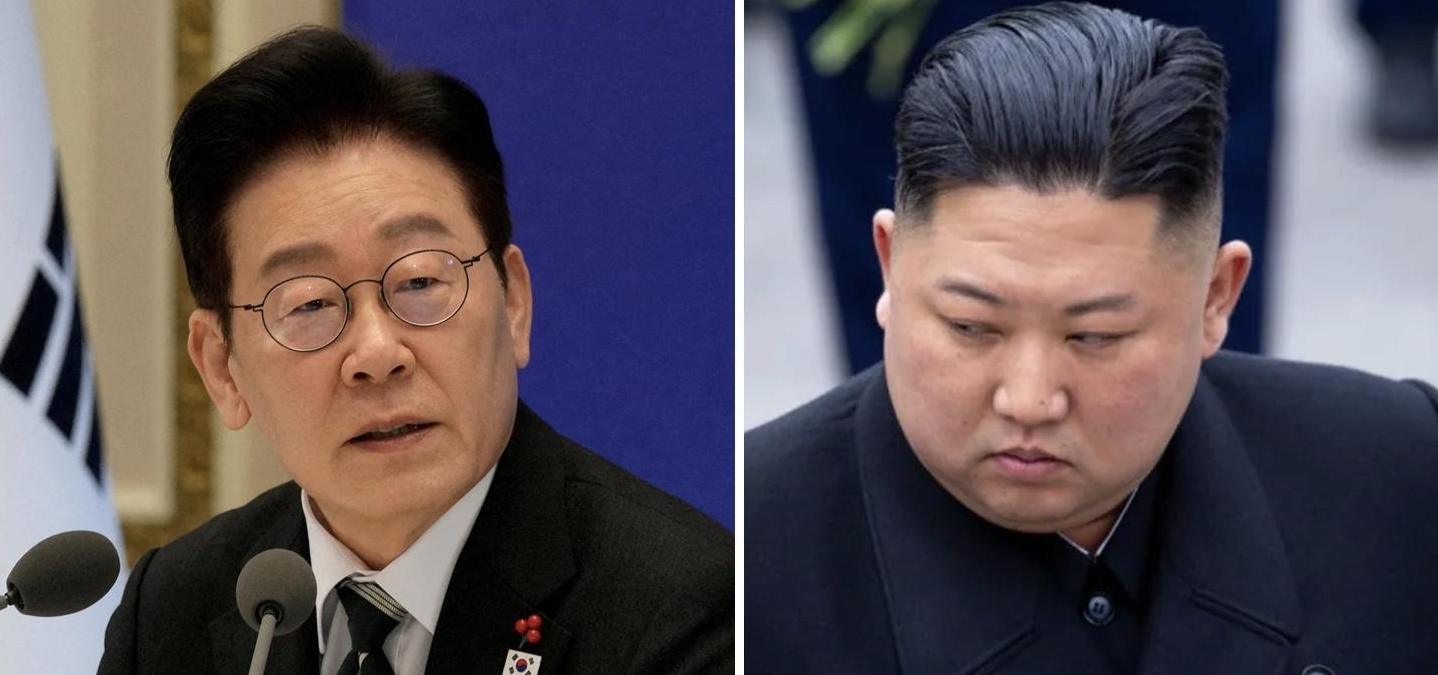
Earlier this week, North Korea sent a rare warm message to South Korea in response to South Korean President Lee Jae-myung’s public apology over civilian drone incursions from the South into the North, calling the apology “sincere and bold.” Seoul issued a statement describing the North Korean response as a sign of thaw, only for Pyongyang to quickly dismiss this claim, warning against “wishful interpretation.”
Indeed, this is hardly any progress. As North Korean leader Kim Jong Un reiterated on March 23, North Korea views South Korea as the “most hostile state” and does not intend to seek detente.
It is hard to deny that former South Korean President Yoon Suk-yeol’s imprudent hawkishness toward North Korea — culminating in an attempt to spark an armed clash with the North to justify his martial law, which ended in his impeachment — contributed to Pyongyang’s heightened hostility toward Seoul in recent years. Acknowledging the policy misjudgment on South Korea's part, Lee began his term in June 2025 with a pledge to break the deadlock on the Korean Peninsula through dialogue and engagement.
Under Lee, South Korea has taken several proactive steps to mitigate tensions and create an environment more conducive to diplomacy. Seoul has adopted a much more prudent and diplomatic rhetoric toward Pyongyang, removed the loudspeakers that the Yoon administration installed to broadcast propaganda into North Korea, banned civic groups from launching anti-North leaflets across the border, and ended the Yoon-era practice of “tit-for-tat” response to every North Korean missile provocation.
Pyongyang has reciprocated Seoul’s diplomatic overtures in some ways — for example, by withdrawing its own propaganda loudspeakers and reducing missile provocations. But it has remained firm in its commitment to continued disengagement with South Korea, refusing dialogue and maintaining an overall hostile, dismissive stance.
From Pyongyang’s perspective, engagement with Seoul has little strategic value. One takeaway Kim may have drawn from his failed 2018-19 negotiations with U.S. President Donald Trump — mediated by South Korea — is that Seoul lacks either the diplomatic leverage to move U.S. policy or the agency to advance inter-Korean relations without U.S. consent. In practice, Washington exerts decisive influence over key issues of concern to Pyongyang, including potential nuclear talks, U.S.-South Korea joint military drills, sanctions, and a permanent end to the Korean War.
Furthermore, Kim may now view Seoul as a legitimate barrier to reaching a deal with Trump. In 2019, Seoul worked with Pyongyang to advance a deal premised on partial, incremental denuclearization. But their interests have diverged. While Pyongyang has completely ruled out denuclearization, the Lee administration has maintained denuclearization as a goal and has sought to ensure that U.S. officials remain committed to it.
Nevertheless, the Trump administration’s “commitment” to North Korean denuclearization does not necessarily represent Trump’s own fixed position. Pyongyang likely understands that and has kept the door open to talks with Trump. Under these circumstances, Pyongyang sees even more reason to continue rejecting talks with Seoul and, ideally, to exclude Seoul from any diplomatic progress with Washington.
The reality that any South Korean diplomatic initiative toward North Korea cannot bypass policy coordination with the United States continues to limit the prospects for inter-Korean engagement independent of U.S.-North Korea diplomacy. But more fundamentally, North Korea cannot trust South Korea’s benign intent. The inherent challenge for the Lee administration is that the longstanding South Korean core interests of denuclearization and unification are antithetical to its goal of promoting “peaceful coexistence.”
For North Korea, agreeing to denuclearization means giving up its only real security guarantee — an intolerable option in the face of a far stronger U.S.-South Korean military, especially given the U.S. track record of using force against small and vulnerable adversaries. South Korea’s constitutional commitment to achieving a “peaceful unification based on the basic free and democratic order” may be benign in intent. But from North Korea’s perspective, it is tantamount to a hostile pursuit of unification by absorption.
Reassuring Pyongyang of Seoul’s intention of peaceful coexistence will remain extremely challenging. It will likely require much more than demonstrations of goodwill. Seoul may have to fundamentally rethink both denuclearization and unification policies. Domestic debate on these issues will be highly controversial. Both issues have long remained taboo in South Korea, and there are constitutional hurdles too. But Lee seems politically strong enough to handle such a debate, and the South Korean public also appears increasingly ready for it: the vast majority of South Koreans now believe North Korean denuclearization is impossible, and many also view unification as unnecessary.
The idea of dropping either denuclearization or unification as a South Korean national objective might be radical. However, by avoiding this question, South Korea could well damage its own security in the long term.
In the near term, “the Trump factor” should prompt the Lee administration to prepare for U.S.-North Korea negotiations that exclude denuclearization from the agenda and focus instead on arms control. Trump’s disregard for allies, his unilateral decision-making style, and his inclination to take risky gambles for “big wins,” along with his personal friendship with Kim, all make it possible that he would accommodate Kim to strike a deal. And, after a legacy-threatening war in Iran, Trump may see this as an opportunity for a high-profile diplomatic achievement.
An inflexible, non-negotiable South Korean stance on denuclearization increases Pyongyang’s incentive to sideline Seoul from even arms control conversations between Trump and Kim. Therefore, it is in Seoul’s interest to accept arms control diplomacy as a serious scenario and to signal greater flexibility to Pyongyang on the denuclearization issue.
Reassessing the goals of denuclearization and unification is also necessary as part of South Korea’s long-term policy planning toward North Korea.
The continuation of the hostile status quo, with no communication channels and guardrails, will make maintaining deterrence, let alone pursuing diplomacy, increasingly more challenging. The looming question for South Korea is whether the status quo is sustainable, particularly as the United States struggles to prioritize multiple security commitments simultaneously.
This dilemma has been vividly demonstrated in the ongoing U.S.-Iran war, with key U.S. strategic assets being redeployed from South Korea to the Middle East. Deterring an increasingly nuclear-capable North Korea will require a long-term, high-level strategic commitment. But it remains unclear whether future U.S. administrations will be able or willing to do that, given Washington’s chronic habit of military intervention in the Middle East, its obsession with confronting China, and its continually far-outstretched security commitments around the world.
North Korea no longer seems to be a U.S. priority, as both the National Security Strategy and the National Defense Strategy of the Trump administration suggest. Seoul would be naive to hope that the Trump administration’s position — that South Korea take the primary responsibility in deterring North Korea, only with critical U.S. support — is just temporary, and things will go back to business as usual after Trump. Future U.S. administrations may well see this direction as an inevitable realignment of priorities driven by scarce readiness and resources.
In the end, diplomacy with North Korea may be the only path to moderate what will be a long-term, sharply hostile and destabilizing arms race on the Korean Peninsula into a more manageable mutual deterrence relationship. If the pursuit of denuclearization and unification blocks that path, reassessing these goals might be a must, not a matter of preference, for South Korea’s long-term policy planning.
- It’s time to rethink US military ties with South Korea ›
- Are North Korea's latest threats rhetorical or real? ›