


During an April Senate hearing dominated by debate over the Iran war, Defense Secretary Pete Hegseth batted down criticisms from skeptical members of Congress, saying “I believe we do have the support of the American people” in this conflict.
Hegseth, it turns out, was wrong. Two months later, we can now confidently say that the Iran conflict is the most unpopular war in U.S. history.
When I compared public opinion on the Iran War to previous major U.S. conflicts in May, it hadn’t quite reached the Vietnam War’s level of unpopularity. But polling from June shows that the Iran War has now sunk to negative 32% net support — below the negative 31% recorded in the final poll during Vietnam.
This means that 32 percentage points more people oppose the Iran War than support it. (Net support is the percent of people who support the war minus the percent opposed.)
But that alone doesn’t quite capture how historically unpopular the Iran War is. Based on my updated analysis of 153 public opinion surveys across 7 major U.S. conflicts, the Iran War is the most unpopular U.S. war in history in at least three ways:
1. The Iran War started with lower public support than any other U.S. war. At negative 13%, it’s the first to begin with negative net support.
2. The Iran War currently has lower public support than any other U.S. war. At negative 32%, it trails even the infamous Vietnam War in popularity.
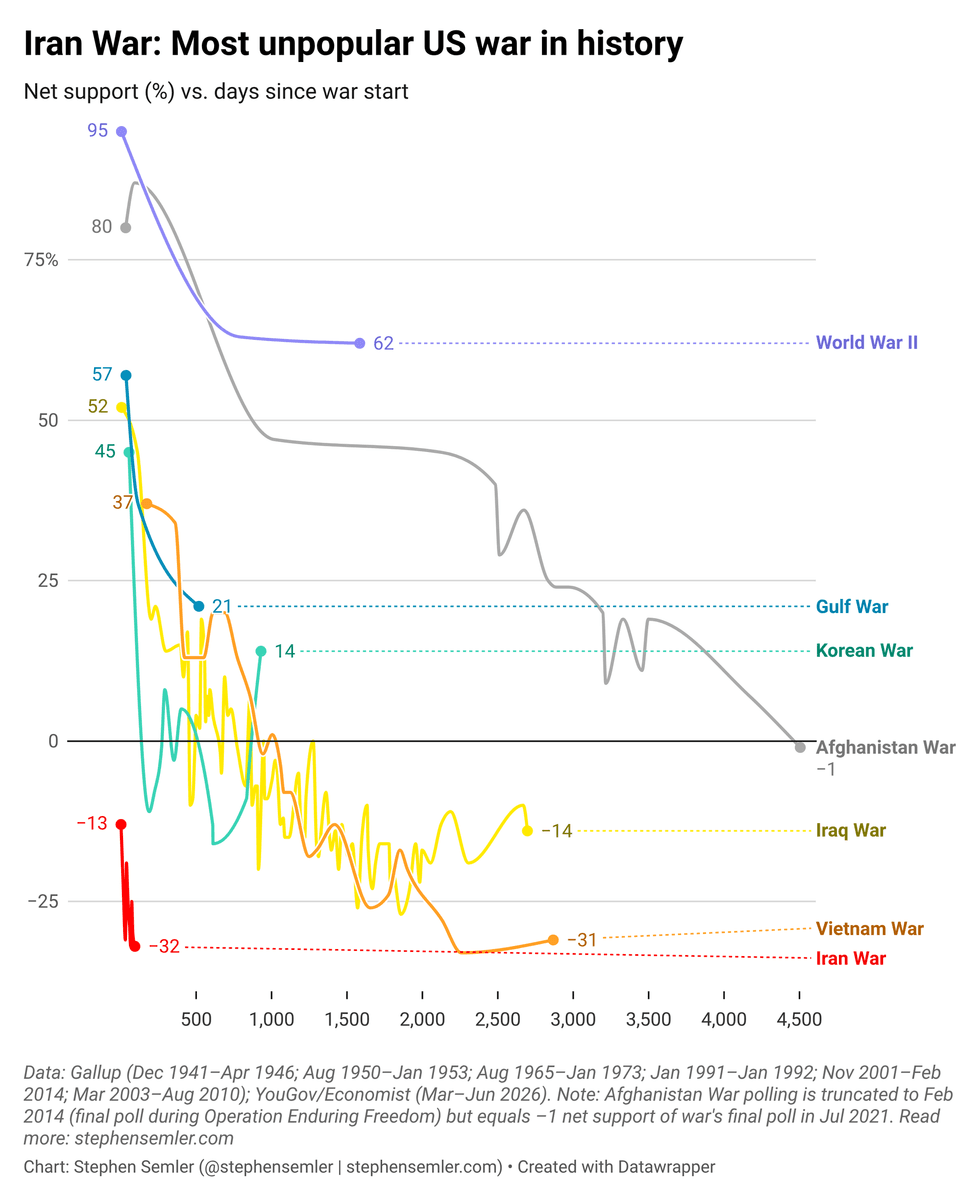
3. At no point have more Americans supported the Iran War than opposed it. In terms of net public support, it’s the first U.S. war to be fought entirely under water.
The first graph below covers the first two findings, while the second covers the third.
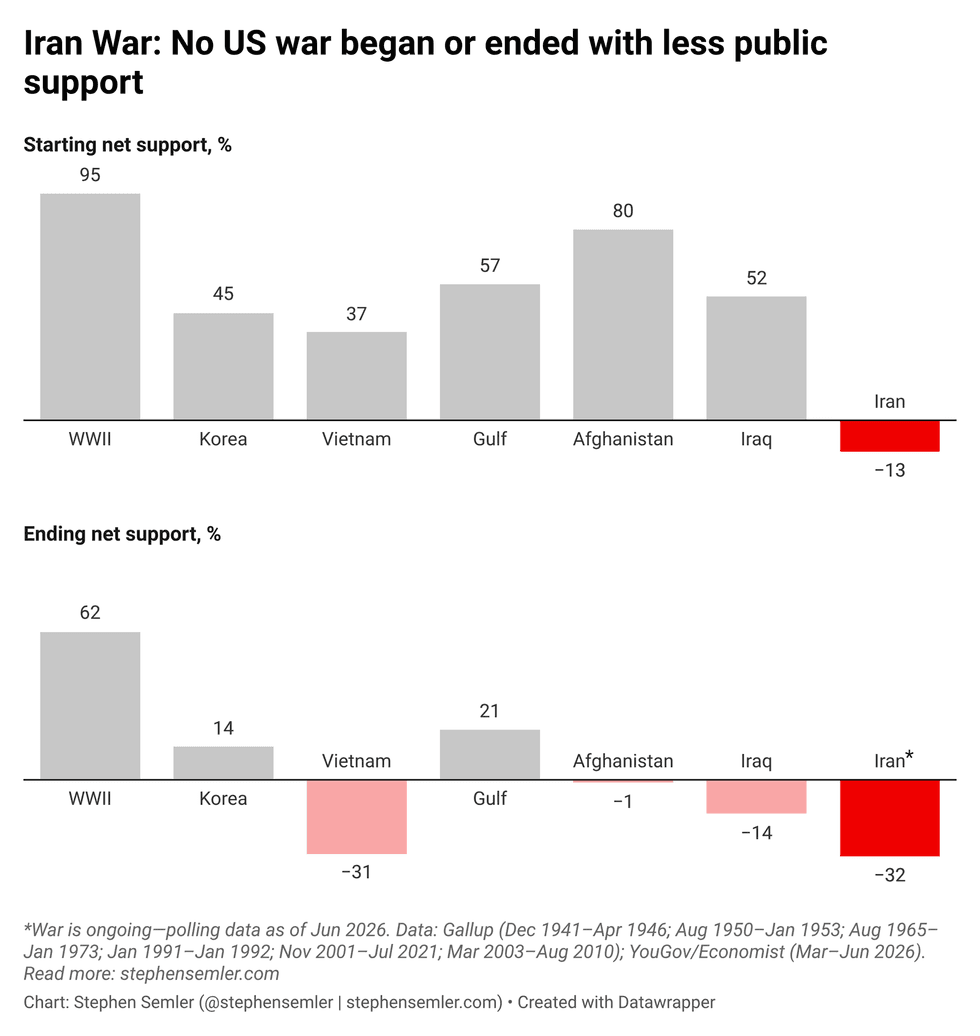
Polling for each war includes the first survey after the war began, the last survey before the war ended — or in the Iran War’s case, the most recent one — and (for the second graph) all the surveys conducted in between. (The full methodology is available here.)
Data for the first six wars came from Gallup, which for unclear reasons decided not to consistently poll this war. The Economist/YouGov partnership has produced the best surveys on the Iran War in terms of frequency, question wording, and continuity with the historical data.
Gallup asked respondents whether they thought a given war was or was not a mistake. The Economist/YouGov polls asked whether respondents support or oppose the war. Both question formats can yield more forgiving readings of war support than actually exist. Compare, for example, the responses to two Economist/YouGov questions asked this month.
When respondents were asked if they supported or opposed the war, 28% said they supported it and 60% said they opposed it. The numbers flipped for Republicans, 67% of whom expressed support and 20% of whom expressed opposition.
But, when the same survey asked if the U.S. “should make a deal to end the war in Iran as quickly as possible,” Republicans were more in line with the general public, with 54% calling for a rapid deal compared to 65% of all Americans.
So, among Republicans, support for the Iran War is at +47%, but support for prolonging the war — not ending it as soon as possible — is at negative 28%. A significant portion of the U.S. adult population is effectively saying, “Yes, I support fighting this war; yes, I want to stop fighting it ASAP.”
Among all Americans, net support for prolonging the Iran War — as opposed to ending it ASAP — stands at negative 52%.
This article has been adapted from an analysis in Polygraph.