

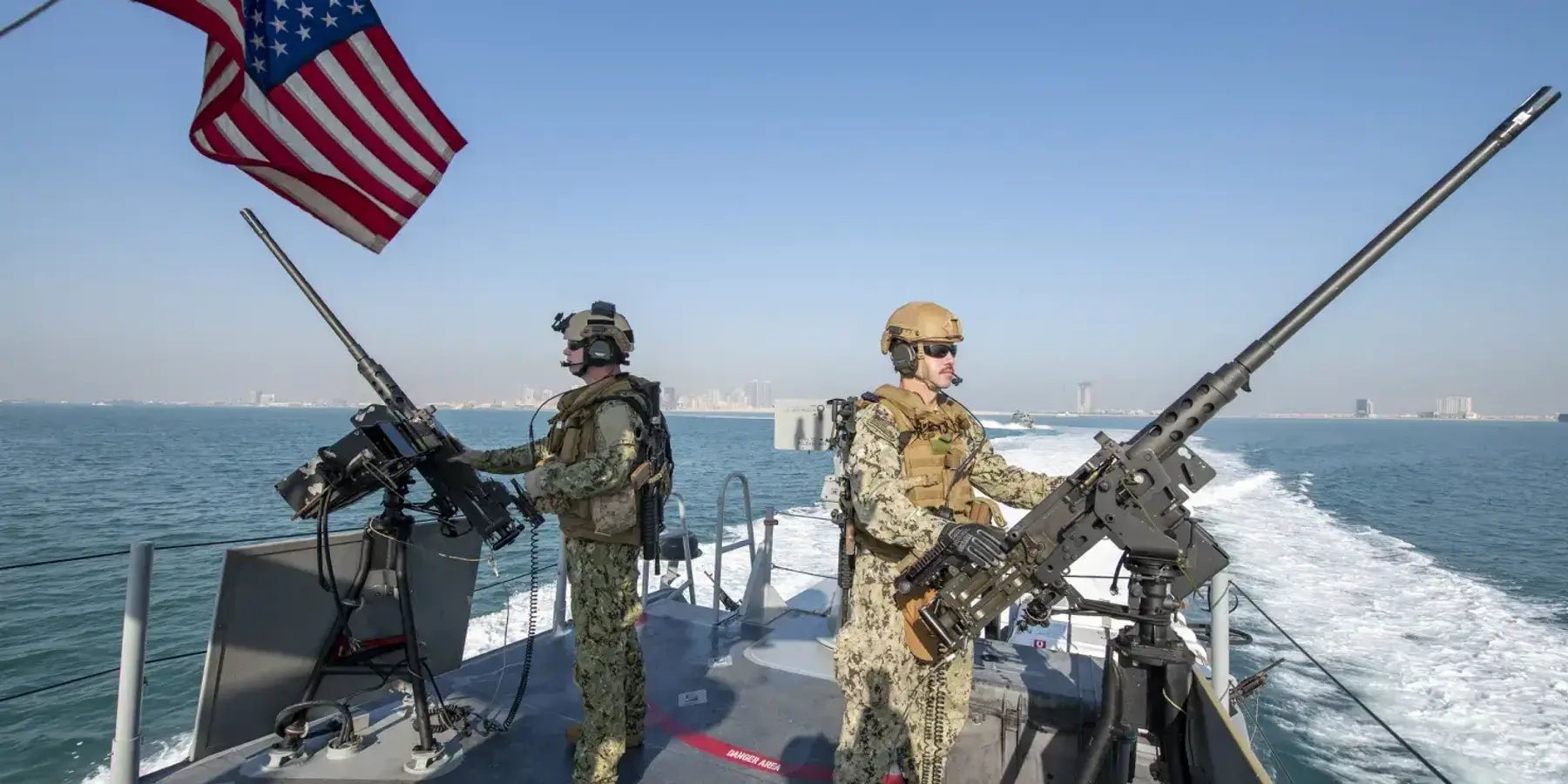
The latest U.S. strategy in the Middle East is defined as one of “maximum pressure,” combining military containment and economic sanctions in an attempt to compel Iran to accept a deal. But it lacks clearly defined, civilian-led outcomes, illustrating the persistent misalignment between military means and political ends.
Military pressure can set conditions, signal resolve, and buy time for civilian action. It cannot determine political outcomes. When a civilian-led strategy rooted in clear end states is not determined ahead of sending military forces, those deployments turn into continuous rotations; it is how ‘forever wars’ get started.
This essay is not an argument against the use of force. It is at times necessary, and even realist restraint doctrine says so. Instead, this essay is an argument that force is but one of many instruments of national security; when the other instruments of national security, like diplomacy, aren’t employed equally or greater than the military, it is service members who pay the greatest price.
An earlier article laid the framework for this argument; this article shows what the habit of overreliance on the military looks like in practice. It is about what happens when whole-of-government strategic planning doesn’t take place before the first bullet is fired – leading to strategic failure even if the military objective is achieved.
On March 4, 2026, U.S. Army Vice Chief of Staff General LaNeve testified that more than 108,000 U.S. Army soldiers only (not counting military forces from the other services) were deployed or forwardly postured across 160 countries. Many, more than 50,000 personnel from all the services, are deployed to the U.S. Central Command area of interest in the Middle East. They include sailors still at sea aboard the USS Abraham Lincoln. These forces have frequently been deployed to display U.S. resolve or apply “pressure” but have remained overseas longer than they or others anticipated.
Legendary deterrence theorist Thomas Schelling described a difference between using force to physically destroy an adversary's capability and using force as a threat to change an adversary's behavior. The former is a military task; the latter is a political strategy, effective only if a settlement is feasible. According to Schelling, "the power to hurt is bargaining power." But when pressure is applied without the possibility of a political settlement, force is all that remains.
In the 1991 Gulf War, the U.S. military stopped after liberating Kuwait and declined to advance to Baghdad. The political and military leadership (of President George H.W. Bush and Gens. Colin Powell and Norman Schwarzkopf, Jr.) agreed that continuing to Baghdad would trade a decisive military victory for an open-ended occupation for which the country wasn’t prepared. That was a wise political decision made before forces were committed.
Twelve years later, the U.S. political leadership ordered an invasion of Iraq without first answering the question of who would pick up the pieces after the military had done its job. While postwar civilian authorities were established, they were deployed too late, and post-conflict planning failed to assign civilian responsibilities and resources for security beyond military control. What was missing was the whole-of-government strategy on the who, what, where, when, and how the desired political outcome was to be achieved.
"You are going to be the proud owner of 25 million people,” then-Secretary of State Powell warned President George W. Bush before the invasion. “You will own all their hopes, aspirations, and problems. You'll own it all.” His warning, later dubbed the Pottery Barn rule — “if you break it, you own it” — underlined the importance of allocating responsibility for planning for the “day after” the use of force. The answer must always be America’s elected civilian leadership, not the uniformed members of the military; answers to the “who, what, where” questions must be known before forces are committed, not afterwards.
In Afghanistan, the military removed the regime and won on the battlefield. But multiple U.S. administrations failed to answer what specific, achievable, and time-bound political outcomes the fighting was designed to achieve. Instead, drawdown plans were based on optimistic assumptions and insufficient preparation for a full withdrawal. So when the political decision was finally made to bring the troops home and abandon Kabul in 2021, it was done in a hurried and improvisational manner, turning the operation into an evacuation, on the fly and under fire.
The 2026 Iran war has followed a similar pattern. On February 28, U.S. and Israeli aircraft struck Iran, opening the current phase of the conflict. While the military achieved its tactical objectives, there was no clearly defined civilian-led strategy to achieve the publicly stated political goal of overthrowing the Iranian regime, or at least forcing it to make significant concessions. An interim agreement established a 60-day negotiating period for a final agreement and temporarily paused military operations, but, without a clear political strategy, this had little hope of succeeding.
The result has been a return to violence as both sides claim to control, or even own, the Strait of Hormuz. U.S. forces are once again deployed to the Middle East with no end in sight. What started as a military pressure campaign to first destroy nuclear-related infrastructure and then remove the regime — something pressure alone (particularly air pressure only) can never achieve — has turned into the longest ever deployment of a U.S. aircraft carrier at sea without a port call and another “forever” conflict.
Ordering the deployment of forces is easy, but disengagement and redeployment are hard work. Powell used eight questions, and former Defense Secretary Casper Weinberger set down six criteria, including requirements that combat be a last resort and objectives be clearly defined before commitment. Which model used doesn’t matter so much as adhering to a model. It’s the discipline to not get into a fight without an exit strategy.
This touches on one reason the military is repeatedly asked to accomplish strategic outcomes beyond its mandate. Unlike other government institutions, the military teaches strategy and planning, and at scale. It has dedicated masters degree-granting institutions and dedicated career fields, such as the U.S. Army’s Functional Area 59 (Strategist). In contrast, the Department of State has genuine expertise, and its foreign service officers execute complex diplomatic missions every day, but it lacks a year-long, in-residence, career-gated strategist program; so does every other major agency that make up the other elements of national security.
The fix is for the president and Congress to build civilian capacity, tied to career advancement, to the same degrees the military currently possesses. Then, when national leadership convenes the government’s national security experts to consider the use of force, it is the civilian strategist who must be heard in at least equal measure as the military planner.
Unfortunately, when the government equates military pressure to strategy, it asks military forces to do the work that would be far more appropriately assigned to their political, diplomatic, or development counterparts. Military forces are designed to close with and destroy the enemy, not negotiate or oversee political settlements.
Deploying teams into high-risk environments and getting them home safely is common operational preparation. Every unit that deploys does it. Every combatant command does it. What is missing is the same preparation at the level above the uniform, from the civilian political leadership appointed over the military. Before you send them, know how, and when, you bring them back. Anything less is not strategy. It is the beginning of another long deployment.
- Four scenarios for war — and peace — with Iran ›
- Deterrence or creep? US forces quietly surge back to Middle East ›
- Turns out having nukes provided the US very little leverage | Responsible Statecraft ›
- US strikes on Iran risk resuming a war Trump wants to freeze ›
- Why 'D-Day' was destined to be a dud | Responsible Statecraft ›
- Somali piracy was under control. Then came the Iran war. | Responsible Statecraft ›