

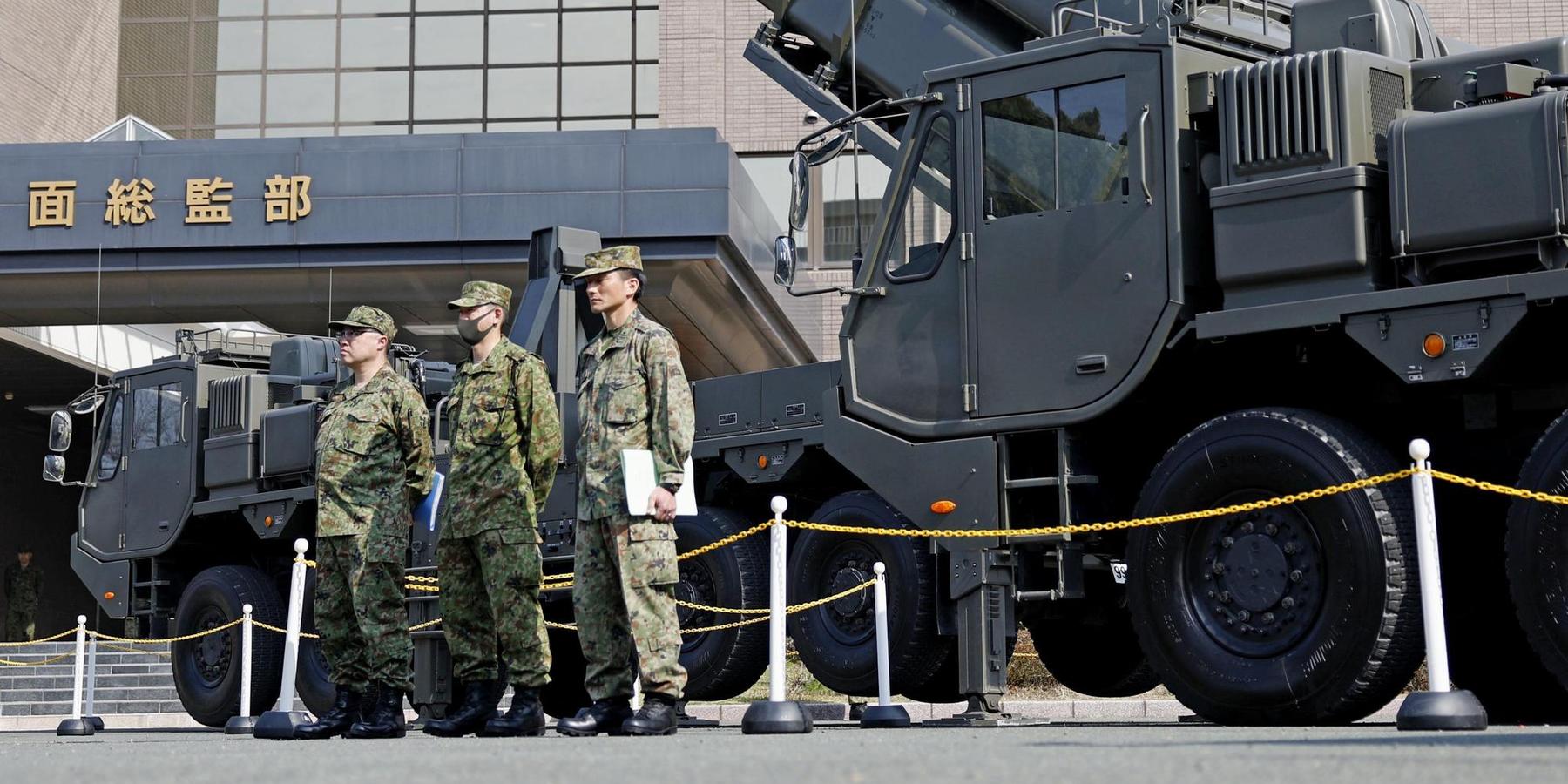
In the lead-up to the most consequential U.S.-China summit in years, Japan’s deployment of new long-range missiles is provoking China and raising the risk that the U.S. will get pulled into a cycle of escalation in East Asia.
On March 31, Japan deployed its first domestically developed long-range missile, the Type 25, to Camp Kengun in Kumamoto Prefecture, right by the East China Sea. With a range of about 600 miles (up from the 120- mile range of the earlier Type 12 missile), the Type 25 is capable of hitting Shanghai. If Japan deploys more of these to the Ryukyu Islands, the entire east coast of China would be within range.
That same day, Japan also deployed the Hyper Velocity Gliding Projectile (HVGP), its first hypersonic weapon, at Camp Fuji, a U.S. base near Tokyo. A week earlier, the State Department approved a $340 million equipment sale to Japan to support the HVGP program.
Japan is planning additional deployments of both weapon systems over the coming years and preparing to arm its destroyers with American-made Tomahawk missiles. The combined effect is that Japan’s long-range strike posture is growing, and the U.S. is materially supporting that expansion.
As President Donald Trump prepares to travel to Beijing next month for his summit with Chinese President Xi Jinping, the White House should be assessing: are these moves making East Asia safer or intensifying a security dilemma that could drag the U.S. into an unintended escalation?
Japan-China tensions
Defense Minister Shinjiro Koizumi told reporters these deployments strengthen Japan’s deterrence in what Tokyo sees as “the most severe and complex security environment in the postwar era.”
However, from Beijing’s perspective, a missile that can reach the Chinese mainland looks more like a first-strike offensive option. China’s Ministry of Foreign Affairs says Japan’s long-range missiles “go far beyond the scope of self-defense” and warns that Japan’s “neo-militarism is casting a long shadow over regional peace and stability.”
For decades after World War II, Japan’s security posture was shaped by a constitutional commitment to pacifism and an “exclusively defense-oriented” military structure. That peace-oriented tradition was abandoned in 2022, when Japan’s National Security Strategy called for developing “counterstrike capabilities” and for doubling defense spending to 2% of GDP.
Critics in Japan argue that reinterpreting the constitution without putting forward a formal amendment sidesteps the democratic process. On April 8, tens of thousands of protesters gathered in Tokyo, with parallel rallies at over 130 locations across Japan, to protest the Iran War and what they see as the dismantling of Japan's pacifist constitution. But Prime Minister Sanae Takaichi remains determined to pursue this shift in the country’s strategic posture.
Japan and China are still in the middle of a diplomatic crisis after Takaichi said that a Chinese blockade of Taiwan could lead to a Japanese military intervention. This breaks with decades of Japanese restraint on the Taiwan issue.
Chinese Foreign Minister Wang Yi said Japan had “crossed a red line.” China’s Ministry of Defense warned that Japan would suffer a “crushing defeat” if it intervened.
Takaichi has also signaled a willingness to abandon Japan’s 1967 pledge not to produce, possess or host nuclear weapons. Chinese officials argue that, if Japan were to abandon its vow never to arm itself with nuclear weapons, the global buffer against nuclear proliferation would be critically weakened. They are right to worry, and so should Washington.
At the same time, Japan is uneasy about its security amid an uptick in Chinese warship activity near Japan’s islands. Last December, Chinese fighters locked Japanese jets with fire-control radar near Okinawa, a move that signals the pilot is preparing to attack.
Defense Minister Shinjiro Koizumi described Chinese and Russian military exercises near the Sea of Japan later that month as “clearly intended as a show of force against our nation, which is a serious concern for our national security.”
This is a classic security dilemma. Japan points to Chinese activities near its islands; China points to Japanese missile deployments and statements on Taiwan and nuclear weapons. Each side’s defensive rationale reinforces the other’s threat perception.
Japan’s new long-range strike capability only raises the odds of something going wrong. With new counterstrike capabilities, Japan might feel compelled to preemptively strike if it suspects an attack is on the horizon. All it takes is a miscalculation of China’s moves, and suddenly Japan launches, instantly dragging in the U.S., which is committed by treaty to Japan’s defense.A better deterrence framework
As the U.S. supports Japan’s advanced missile capabilities, Washington is becoming more involved in the region’s escalation dynamics. The U.S. should not demand a halt to Japan’s defense modernization. But it is in the American interest to prudently shape Japan’s shifting posture to reduce the risk of escalation.
It would be smarter for the U.S. to encourage Japan to shift its focus to conventional denial. The distinction here is between capabilities that deny Chinese aggression near Japanese waters and capabilities that threaten the Chinese mainland. The former deters, while the latter provokes.
To bolster a denial posture, Japan could harden its bases to survive a first strike, expand its air defense systems, and build out its undersea warfare capabilities. Washington should encourage such efforts, rather than supporting Japan’s long-range strike posture.
This strategic logic lines up with what American defense officials like Elbridge Colby recommend for the region: the U.S. and allies like Japan should make it too costly for China to try seizing disputed territory instead of threatening to hit mainland China itself.
The upcoming Trump-Xi summit is also an opportunity. Trump’s summit agenda should include a conversation on preventing an accidental clash between Japanese and Chinese forces that draws the U.S. into war.
The lead-up to the summit is the right time to encourage military-to-military dialogue between Japan and China. This could include reviving the Japan-China hotline established in 2023, which was only used once for a ceremonial call. Dialogue channels help defuse incidents, like when warships or fighters get too close, and prevent events from spiraling out of control.
Japan arming itself with long-range missiles heightens the risk that the U.S. will get pulled deeper into regional brinkmanship. Direct talks between Japan and China — and a smarter approach to Japan’s defense — would do a lot to ease tensions.
- First female Japan PM takes hawkish position on China, Taiwan ›
- The shortsighted US-Japan-South Korea military pact ›
- Japan debuts as a weapons exporter ›