

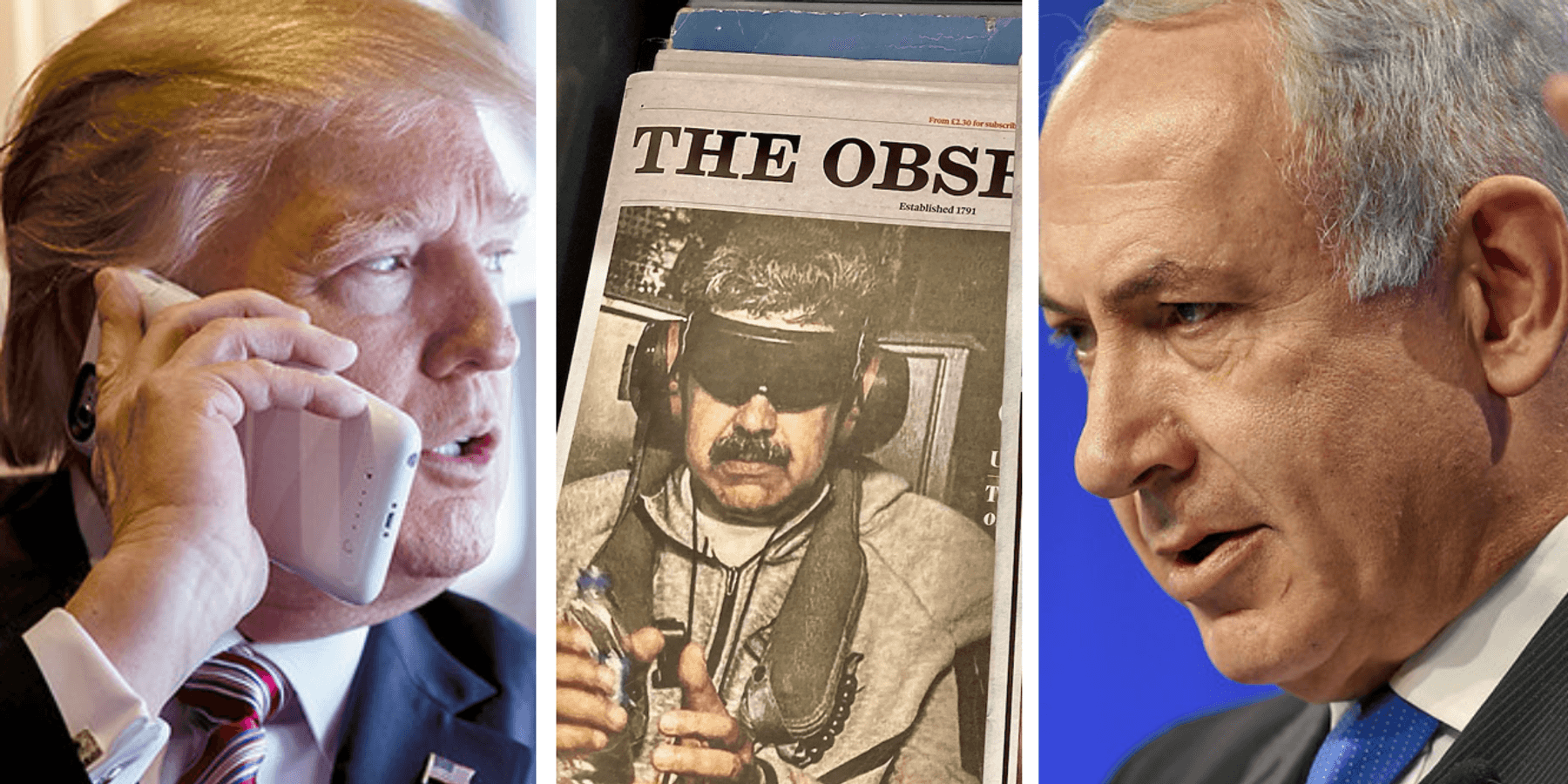
When the news broke that a U.S. military operation had kidnapped Venezuelan President Nicolás Maduro in Caracas and transported him to New York to face trial, among the most enthusiastic and immediate cheers came from Israel.
Prime Minister Benjamin Netanyahu congratulated President Donald Trump on his “bold and historic” action. For the casual observer, this might seem puzzling. Why would a Middle Eastern nation invest its political capital in celebrating a coup d'état in a South American country thousands of kilometres away?
One could argue that the Venezuela coup was a precondition to the expansion of Israel’s own multi-front war against Iran. Last week, with Venezuelan oil secured under a directed government in Caracas, the U.S., Israel, and other partners launched the regime change campaign the Israeli right-wing and its supporters in Washington had been planning for decades, directly against Tehran.
The Israeli government has long viewed Venezuela as a strategic satellite of the Islamic Republic of Iran. As Israeli Foreign Minister Gideon Sa'ar put it, Israel welcomed the removal of “the dictator who led a network of drugs and terror,” adding that “South America deserves a future free from the axis of terror and drugs.”
“Iran and Venezuela have been deep partners for the last 20 years,” noted U.S. Ambassador to Israel Mike Huckabee following the operation, echoing a sentiment pushed by pro-Israel lobbying groups.
The narrative, amplified by neoconservatives housed at think tanks like the Foundation for the Defense of Democracies, the Washington Institute for Near East Policy, the Heritage Foundation, and the American Enterprise Institute, paints a picture of a continent under siege by Iran and its proxies.
Israeli security officials have long argued that Venezuela provided an operational foothold for Hezbollah and the Islamic Revolutionary Guard Corps, Iran’s global paramilitary organization, pointing to the presence of Iranian drones in Venezuelan military parades and Iran-Venezuela ghost flights, including the infamous 2022 incident of a Venezuelan-owned cargo plane detained in Argentina carrying Iranian crew members. Others say these claims are exaggerated and the relationship between Venezuela and Hezbollah has been more symbolic than practical.
Israeli hardliners have alleged that Maduro’s Venezuela was a launchpad for terrorism and antisemitism in the Western Hemisphere, used to attack Jews, Israelis, and other critical interests. That claim has been repeated by various Israeli politicians, including former Defense Minister Benny Gantz.
The late Hugo Chávez was a fierce critic of Israeli policy, breaking off diplomatic relations in 2009 during Operation Cast Lead in Gaza. The Chavismo ideology supports Palestinian liberation, aligning itself with other self-avowedly pro-Palestine US adversary states like Cuba.
This position made Venezuela a thorn in the side of Israel and a prime target for regime change advocates in Washington and Jerusalem long before the recent military operation.
The coup against Venezuela was, according to Israel, a significant blow to Iran’s revenue, arms, terror, and training networks. Helping destabilize Iran’s resources, in turn, meant a weaker regime, one that would be easier to then topple.
But while the threat of Hezbollah operatives is a useful talking point, we have to look at the bigger picture. Venezuela sits on the largest oil reserves in the world. In the current geopolitical climate, where the U.S. has moved 40 to 50 percent of its total firepower to strike Iran, controlling global oil supply chains in the event of a cut-off is paramount.
As predicted, Iran has threatened ships seeking to use the Strait of Hormuz, which has halted traffic since Saturday.
Global oil supplies are now potentially choked off. In that exact scenario, a U.S.-run Venezuela becomes an economic lifeline (Trump himself has already boasted about taking 80 million barrels of oil, managing them himself from a bank account in Qatar). Much of Venezuela’s reserves may be inaccessible for now, given the damaged state of its oil infrastructure, but a new extraction and foreign investment law may increase access for American companies. The coup in Caracas was, therefore, an insurance payment on a war with Tehran.
Furthermore, the allegations of a “Cartel de los Soles” run by Venezuela’s government and armed forces, and Hezbollah's drug empire in South America, must be viewed with skepticism. While there is evidence of corrupt military officials and others engaging in narcotrafficking in Venezuela, the narrative of a state-run terror-for-drugs pipeline originates almost exclusively from think tanks like the Heritage Foundation and the FDD, which have spent decades advocating for regime change in both Caracas and Tehran.
Joseph Humire, now Assistant Secretary of Defense for Hemispheric Affairs, who helped organize the U.S. Southern Command’s recent visit to Venezuela, was the first promulgator of this story in the press and government. Deeper investigative reporting has often shown the “Iran-Venezuela criminal nexus” to be more complicated, and often more exaggerated, than the picture painted by Washington hawks.
Of course, lectures about the evils of “narcoterrorism” require a significant suspension of historical disbelief. The United States has indirectly funded Colombian paramilitaries through Plan Colombia, groups like the United Self-Defense Forces of Colombia, or AUC, designated by Washington itself as narcoterrorists, in its fight against leftist guerrillas and drug cartels. Ironically, the AUC are now one of the largest drug traffickers in South America, and the country’s largest purveyor of violence. The AUC’s lawyer, with connections to the MAGA right, might become the next Colombian president.
Interestingly, Venezuelan hardline opposition leader María Corina Machado has been unequivocal in her support for Israel, pledging to move Venezuela's embassy to Jerusalem if she comes to power.
In 2018, Machado sent a letter to Netanyahu directly requesting foreign intervention to “dismantle” the Maduro government. Meanwhile, her predecessor, Juan Guaidó, whose “interim government” was immediately recognized by Israel in 2019, promptly announced plans to move Venezuela's embassy to Jerusalem.
The rise of far-right leaders across Latin America has reshaped the region in favor of Israel’s interests. Argentina's Javier Milei, Chile's José Antonio Kast, El Salvador's Nayib Bukele (despite his Palestinian ancestry), and Brazil's Jair Bolsonaro have all positioned themselves as staunch allies of Israel.
They view alignment with Netanyahu and Trump as a cultural and political counterweight to the leftist, pro-liberation movements that have historically led the region. For Israel, the fall of Maduro represents the fall of one of the last major anti-Zionist dominoes in the Americas. It strengthens Israel’s influence in the region at a time when at least two-thirds of Latin Americans and most political leaders recognize Palestine.
In Israel’s calculus, the overthrow of Maduro was a blow to Iran, a safeguard for U.S. oil interests, and one more step in building out a pro-American, pro-Israel bloc in Latin America.
Netanyahu finally got his wish, but it took American might and oil guarantees in Venezuela to make it sellable to Americans, despite an overwhelming majority of Americans opposing this war.
- Craven Europeans give US and Israel a blank check for illegal war ›
- Did the US only attack Iran because of Israel? ›