

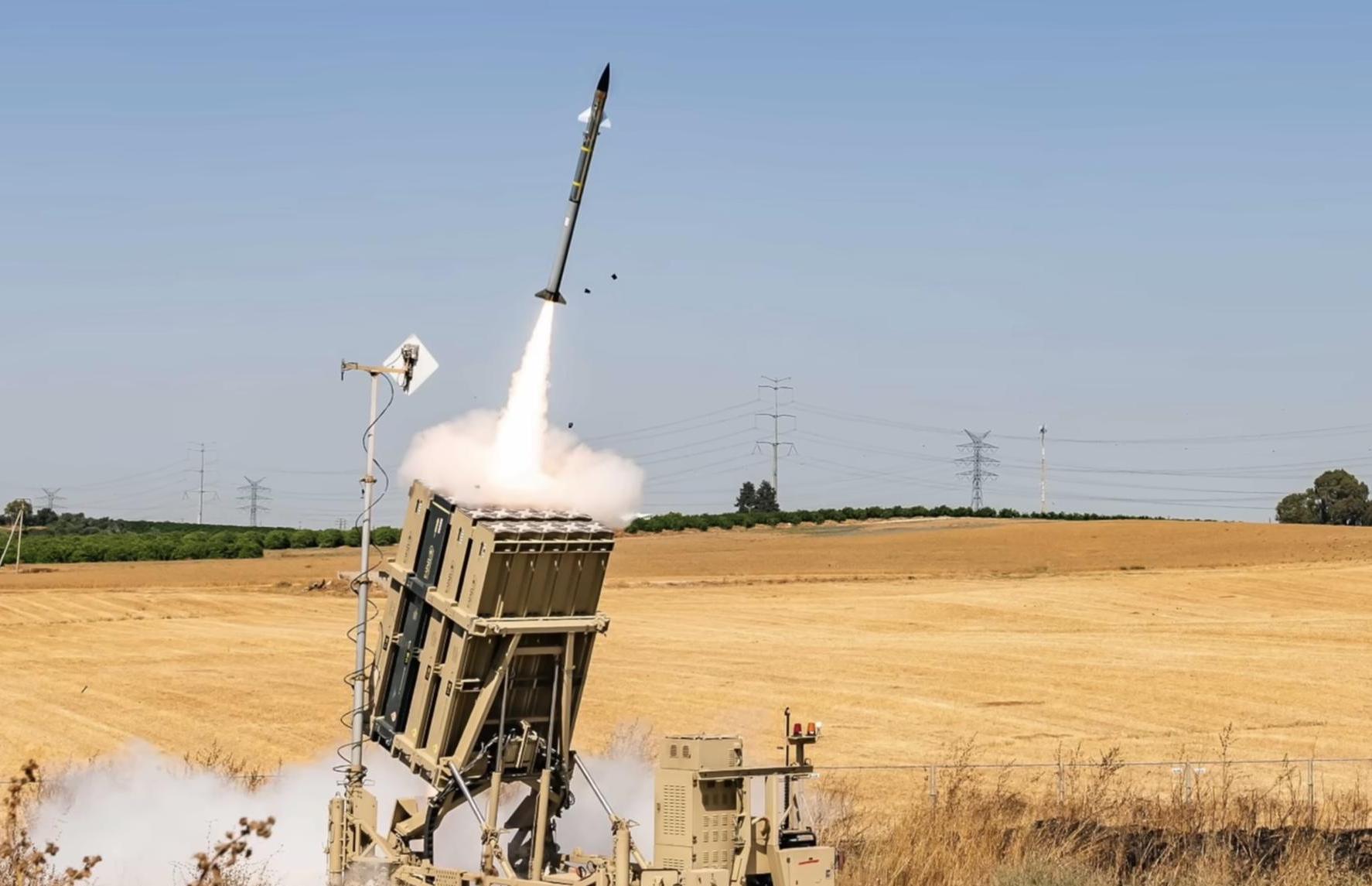
Even as frustrations mount over Israeli military campaigns across the Middle East, governments keep buying weapons from Israel — making it one of the world's largest arms exporters.
As experts tell Responsible Statecraft, Tel Aviv uses these weapons sales to lock countries into long-term, strategic relationships that make recipients less likely to hold Israel accountable for their behavior in Gaza and Lebanon or in its West Bank policies. They stress that sustained U.S. support, including billions in military grant aid each year and the co-development of many Israeli weapons systems, helps make this all possible.
A weapons exports boom
Following October 7, Israel’s defense industry has exploded: the number of startups there nearly doubled, from 160 in July 2024 to 312 in April 2025. Its arms exports, which account for 75% to 80% of all Israeli weapons production, have grown in tandem. According to Stockholm International Peace Research Institute (SIPRI) data published in March, Israel was the world's seventh-largest arms exporter between 2021 and 2025, surpassing the United Kingdom.
Tel Aviv raked in a record $19.2 billion from arms exports in 2025, a jump up from the $14.8 billion it made the previous year.
Arms sales as political leverage
As Seth Binder of the American Committee for Middle East Rights (ACMER) told RS, “arms deals are expensive and often create a long tail to negotiate, complete, and fulfill over the life of [a given] contract.”
Over time, these contracts provide Israel a way to build relationships that other governments have strong incentives to preserve. Exports can “entrench relationships that constrain others' ability to hold [Israel] accountable,” Daniel Levy, the president of the U.S./Middle East Project (USMEP), said.
A growing global demand for weapons is playing to Israel’s advantage. A case in point is Europe. Spurred by fears of Russia and U.S. pressure to increase defense spending, some European countries are buying Israeli weapons to supplement their fraught rearmament efforts. The purchases continue despite disquiet across the continent over Israel’s actions in the Middle East, which have led some European Union countries to pursue arms embargoes or suspend export licenses to Israel.
Germany signed multi-billion euro deals for the Israeli-made Arrow-3 missile defense system, Heron drones, and Spike anti-tank missiles last year. Greece spent about $740 million on 36 Precise & Universal Launching System (PULS) rocket artillery systems in December. Romania signed a deal worth about $2.3 billion for Spyder air defense systems earlier this week and is now set to acquire its own version of Israel’s Iron Dome air defense system.
Outside the EU, the value of U.K. arms- and ammunition-related imports from Israel skyrocketed from just $508,343 in 2020 to nearly $7.97 million in 2025 — a nearly 1,500% increase. A senior Israeli defense official told Reuters in early June that European countries are expected to order more air and missile defense systems soon.
But depending on Israel for critical defense needs may prove risky. “A government that might otherwise respond to public demands for sanctions or arms embargoes [against Israel] now faces the prospect of degrading its own air defense…if it does so,” Levy told RS.
Similar dynamics are playing out among Abraham Accords nations; Israeli exports to those countries jumped fivefold between 2023 and 2025.
“No one has any illusions that Israel is popular right now in [the Abraham Accords] countries,” an Israeli diplomat told The Economist last fall. “But their governments have made long-term investments in their defense ties with Israel, and they’re not about to change course.”
More broadly, continued prospects for arms sales turn Israel’s controversial military actions — in which Israeli defense technologies are being used against civilians — into a commercial selling point. As Omar Shakir, the executive director of DAWN, told AP last month, Israeli defense and technology companies have been “able to parlay the use of their products in Gaza to attract more business.”
Israel's arms exports blitz: fueled by Washington
Israel's weapons industry is booming in part because “the U.S. has long subsidized it,” Binder told RS.
Israel receives Foreign Military Financing from Washington, which provides funds for acquiring American weapons equipment, training, and adjacent services. The support is even more direct through what is called Off-Shore Procurement (OSP), which Binder said allows Israel to “use a portion of its Foreign Military Financing provided by the United States to pay for [its own] arms.”
Although OSP is set to phase out by 2028, Binder told RS that “Israel's arms industry has arguably established itself as a competitor” to America’s weapons sector through the program.
Meanwhile, Israeli firms have gained a competitive edge, thanks to what former State Department official Josh Paul calls a “larcenous” approach toward U.S. intellectual property. “Many technologies developed by U.S. industry are [simply] re-developed and re-packaged by Israeli companies,” he told RS.
American support is often evident in the export deals themselves, where, for example, the Arrow-3 system Germany bought from Israel was co-developed with the U.S., which helped fund its development. Because of Washington's role in the program, U.S. approval was required before the initial sale could proceed.
Altogether, the International Trade Administration observed that U.S. assistance has “turned the Israeli military industry and technology sector into one of the largest exporters of military capabilities worldwide.”
Currently, a series of congressional proposals under consideration — including one that Israeli Prime Minister Benjamin Netanyahu has endorsed as his “personal plan” — stands to give Israel’s defense sector a deeper foothold in the U.S. market.
Indeed, section 219 (previously section 224) of the National Defense Authorization Act (NDAA) for FY 2027 would move to more closely integrate the U.S. and Israeli militaries. The provision would further incorporate Israeli technologies and companies into U.S. supply chains, likely creating more opportunities to sell its weapons.
As Paul told RS, Israel being positioned “to become a supplier to the U.S. military is just a further example of [it] using [its arms] sector as a tool of influence.”
- Israelis don't pay for the weapons we 'sell' to them — US taxpayers do ›
- Massie moves to strike $3.3B in Israel military aid from the budget ›
- Pro-Israel hawks lash out after most House Dems vote to cut aid ›
- Britain banned settlement imports. Will Europe finally follow suit? | Responsible Statecraft ›