

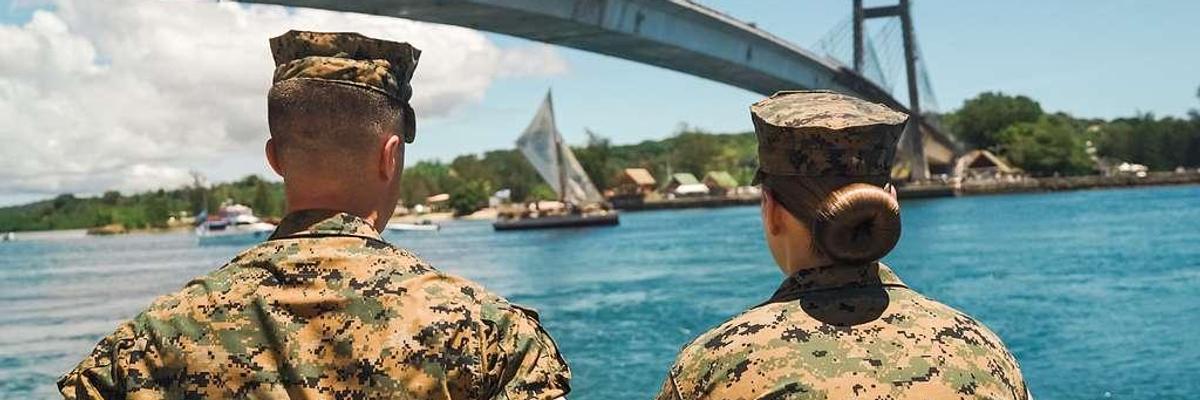
The United States is quietly working to reassert its control over the compact states, three island states in the central Pacific Ocean.
Last month, witnesses at a congressional hearing revealed that the Trump administration is expanding military and intelligence operations in Palau, the Marshall Islands, and the Federated States of Micronesia. Witnesses told lawmakers that the three countries occupy an area critical to U.S. power projection and pivotal for geopolitical competition with China.
“This is a region that is increasingly central to United States security and global stability,” State Department official Tony Greubel said. “And as geopolitical competition intensifies, the Pacific strategic sea lanes, abundant resources, and vibrant communities, they’re more important than ever to the United States and our allies and partners.”
Some congressional leaders criticized the Trump administration’s imperial ambitions in other parts of the world, with Representative Jared Huffman (D-CA) warning about “a colonial conquest binge” affecting Greenland, but they exhibited the same kind of imperial mindset for the Pacific. Lawmakers from both parties called on the Trump administration to preserve U.S. military controls in the compact states.
“If we lose the foothold there, we are never going to get it back,” Representative Addison McDowell (R-NC) said.
The president may continue to insist that the United States should annex other lands and countries, but U.S. lawmakers know that the United States can maintain control over the compact states through other means, just as it has been doing for decades. Rallying behind their own vision of empire, they are working to ensure that the Trump administration remains supportive of the longstanding system of compact colonialism.
“We should not let this administration drop the ball and risk losing our military dominance in such a critical region,” Representative Huffman (D-CA) said.
Compact Colonialism
For decades, the United States has ruled over the compact states, which are also known as the Freely Associated States (FAS). Through a special arrangement with each country called a compact of free association (COFA), the United States has exercised exclusive military controls while claiming special privileges in a vast oceanic area that is comparable in size to the continental United States.
U.S. powers severely limit the sovereignty of the compact states. With the “defense veto,” the United States can prevent the compact states from creating their own security arrangements with other countries. The power of “strategic denial” enables the United States to prohibit military forces from other countries from accessing the compact states’ lands, waters, and airspace.
“With the exclusive military rights, with exclusive military access, every country’s military, before they stop to refuel like aircraft or ships in the Freely Associated States, they have to ask for permission,” State Department official Tony Greubel told Congress, referring to U.S. military controls over the compact states.
Although the compact states have chafed at the limits to their sovereignty, they have repeatedly renewed the compacts, in part because the United States provides them with economic assistance and grants islanders visa-free access to the United States. Under the terms of the compacts, which were renewed in 2024, the compact states are receiving $7.1 billion in U.S. funding over the next 20 years.
U.S. leaders often boast about U.S. dominance of the region, but they exaggerate the scope of their powers. Rather than acknowledging that the UN Convention on the Law of the Sea limits strategic denial to the 12-mile territorial waters around the compact states, as confirmed by a 2002 report by the General Accounting Office, U.S. leaders routinely lay claim to the much larger 200-mile exclusive economic zones of each country. Some have gone so far as to suggest that compacts provide the United States with control over a vast oceanic highway that crosses the Pacific Ocean.
“Through the compacts, the U.S. military secures exclusive access across the Pacific beyond Hawaii all the way to Palau,” Representative Teresa Leger Fernández (D-NM) falsely claimed at the congressional hearing in January.
Representative McDowell (R-NC), who spoke of maintaining a foothold in the region, also made exaggerated claims about U.S. powers, falsely asserting that “the United States has exclusive defense and security rights across millions of square miles of the Pacific.”
Challenges
U.S. lawmakers may have evaded legal challenges to their grand imperial claims by refusing to ratify the UN Convention on the Law of the Sea, a sign they share Trump’s disdain for international law, but they remain concerned about challenges to U.S. power.
On Capitol Hill, lawmakers often warn about China. The United States and China, they say, are engaged in great-power competition. Some argue that there is a battle underway for control of the compact states.
China is “trying to push the United States out of its own backyard and rewrite the balance of power in the Pacific,” Representative McDowell (R-NC) said.
Many U.S. leaders fear that China is trying to establish a direct presence in the compact states. Officials in Washington are tracking people from China who live on the islands, especially those who are leasing tracts of land near U.S. military locations.
A related concern in Washington is compact migration. Officials increasingly worry about the depopulation of the compact states, as many islanders are leaving their homelands, largely due to poor living conditions and a lack of economic opportunities.
“The most significant threat in that region is depopulation of the communities,” Insular Affairs official Angel Demapan told Congress. “Depopulation is premised on the lack of available services and opportunities.”
Although officials in Washington remain focused on geopolitical developments, the compact states face a far more urgent threat. As leaders of the Pacific Islands have been warning for years, the single greatest threat to their region is climate change.
After President Trump delivered an inflammatory speech at the United Nations last year in which he dismissed climate change as “the greatest con job ever perpetrated on the world,” leaders of the Pacific Islands responded with a united front in which they rejected his claim and warned that climate change remains an existential threat to their homelands. They reminded the world of its legal obligation to stop global warming from rising beyond 1.5 degrees Celsius.
“The climate crisis is not up for debate,” Wesley Simina, president of the Federated States of Micronesia, said in a speech. “The only question now is whether we as leaders will act with the urgency it demands.”
Actions
Officials in Washington understand that the compact states are facing an existential threat from climate change, especially given that U.S. military locations are being affected, but they remain focused on their imperial ambitions. Viewing the region through the lens of great-power competition, they are prioritizing their goal of maintaining a foothold.
The Trump administration is working to strengthen the U.S. military presence in all three compact states. It is directing the construction of radar stations and airstrips in Palau, the testing of hypersonic missiles and interceptors at a military base in the Marshall Islands, and the expansion of seaport and airport projects in the Federated States of Micronesia.
“The United States currently maintains, or is planning to build, improve, or expand defense sites,” Insular Affairs official Angel Demapan acknowledged.
At the same time, the Trump administration is trying to reduce Chinese influence. In contrast to the many islanders who welcome Chinese assistance, viewing it as beneficial to their countries, U.S. officials are seeing tests of U.S. power and a battle for influence. They are going so far as to get people from China expelled from the islands.
A major effort is underway in Palau, where U.S. diplomats are warning that Chinese individuals and organizations are engaging in criminal activity, including operations to influence Palauan leaders. Last year, the U.S. embassy distributed intelligence reports that warned about corruption in the Palauan government.
Some Palauan officials have welcomed U.S. involvement, even requesting assistance from the Central Intelligence Agency (CIA).
“We have asked the United States, especially, you know, the CIA, to assist us,” Hersey Kyota, Palau’s ambassador to the United States, told Congress. “They have identified those illegal companies or illegal individuals that are tied with CCP,” meaning the Chinese Communist Party. “Our president has identified them… and we send them back.”
Oceanic Empire
The leaders of the United States insist that their operations are helping the compact states. They defend their actions by claiming that they are safeguarding the region from Chinese influence and trying to maintain a free and open Indo-Pacific.
“Through these compact agreements, the United States advances economic growth, promotes self-sufficiency in the FAS, and reinforces partnerships that support a free and open Indo-Pacific,” Insular Affairs official Angel Demapan said in a written statement to Congress.
While U.S. leaders speak of growth and freedom, however, they often contradict themselves. They criticize islanders who want to improve relations with China, even standing in the way of the self-determination of the compact states. They boast about having the power to close off a vast area of the central Pacific Ocean to other countries, a claim at odds with the idea of a free and open Indo-Pacific.
“Under the COFA agreements, the United States has full authority and responsibility for security and defense matters with respect to the FAS, including the ability to establish defense sites and to strategically deny foreign military access to the lands, waters, and airspace of the FAS,” Demapan insisted.
U.S. lawmakers often take the same contradictory positions. They are highly critical of any efforts by the compact states to develop closer relations with China. At the same time that they call for a free and open Indo-Pacific, they insist upon maintaining the power to deny foreign militaries access to the compact states.
“Strategic denial alone is worth far more than what we spend on these agreements,” Representative McDowell (R-NC) said.
Even as some lawmakers criticize the Trump administration’s imperial ambitions, particularly the president’s calls for annexing other lands and countries, they display a comparable imperial mindset. Believing that the compact states remain critical to U.S. imperial power, they are supporting the administration’s moves to strengthen U.S. controls over the islands, including its ongoing military and intelligence operations.
What U.S. leaders are doing, in short, is spreading fears about China while trying to maintain a vast oceanic empire in the central Pacific Ocean. Instead of pursuing a really existing free and open Indo-Pacific, which would include respect for the rights and freedoms of all peoples, they are forging ahead with a decades-long neocolonial binge in the compact states.
This article was republished with permission from Foreign Policy in Focus.
- US Military tells Singapore to take its F-15s anywhere but Guam ›
- US maintains military grip over ‘sovereign’ Pacific island states ›