

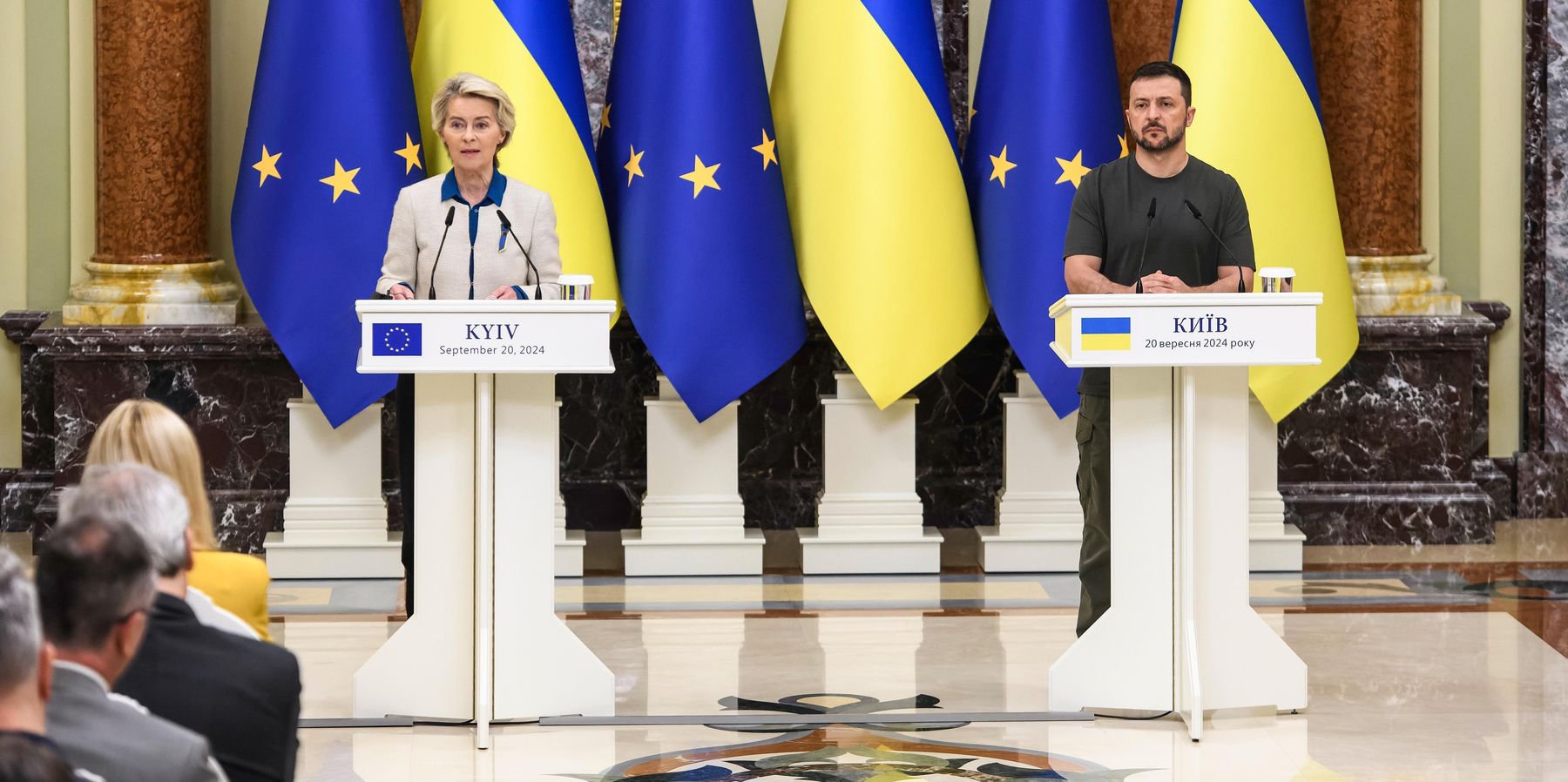
Angela Merkel, the eternal pragmatist, has chosen her moment. In a recent interview to Hungarian media, the former German chancellor pointed a finger at Baltic and Polish leaders for their alleged role in “undermining” a potential EU-Russia dialogue before the war.
Whatever one thinks of her legacy, Merkel has an unmatched sense of political timing. Her statement is not a historical aside; it is the opening salvo in Europe’s looming blame game for the impending defeat in Ukraine.
Her comments land at the precise moment the foundational assumptions of Europe’s Ukraine policy are collapsing. On the battlefield, Russian forces are now grinding out slow, but steady gains. In the United States, Donald Trump keeps insisting that this is “Biden’s war,” not his, and that it should end.
While Trump no longer appears to be cajoling Ukraine’s President Volodymyr Zelensky into accepting some of Russia Vladimir Putin’s terms, his current position — selling arms to Ukraine funded by Europe — does not satisfy the Europeans as they face increasing economic and fiscal difficulties. Europe finds itself holding a bill it cannot pay and for a war it cannot win — and a war whose strategic direction is being dictated from Washington, not Brussels.
This transatlantic shift is starkly evident in the recent flurry of activity between Trump and Zelensky. Their key topic is the potential provision of U.S. "Tomahawk" cruise missiles to Ukraine. This is a quintessential Trumpian gambit — escalation as a tool for deal-making — but Trump himself does not appear to have decided on the deliveries as he acknowledges this would represent a major escalation. Europe, meanwhile, is left entirely to lobby Trump to make “Biden’s war” his own which highlights the ultimate failure of its own policies.
Consider the plan to seize frozen Russian assets to help Ukraine. While theoretically a massive windfall, estimated at €183 billion of Russian sovereign funds, it is faltering precisely where it matters: in Belgium, where most of those assets are held. Brussels is raising red flags over the legal precedent that would undermine its credibility as a global financial hub and the terrifying prospect of Russian retaliatory strikes on Belgian interests worldwide.
While the European Commission is trying to find a formula that would allow to use the funds while protecting Belgium’s interests, the Belgian government is not yet convinced. Privately, diplomats admit that legal concerns are compounded by Kyiv’s own corruption challenges, highlighted by Zelensky’s recent attempt to abolish an independent anti-corruption body — hardly a confidence-building measure for handing over hundreds of billions.
The EU’s other grand gestures are equally hollow. The attempt to fast-track Ukrainian EU membership collapsed. A scheme championed by the Council President Antonio Costa at the informal EU summit in Copenhagen a few weeks ago to switch to qualified majority voting on enlargement instead of the unanimity rule was blocked by Hungary’s Prime Minister Viktor Orbán.
Orbán provides the public “no” vote, but he merely gives political cover for a chorus of objections to Ukraine’s membership across the bloc, including from the new government in the Czech Republic. Addressing the issue, the winner of the elections, Andrej Babis, said Ukraine “was not ready for the EU, and the war had to end first.”
The “drone wall” proposed by the Commission in response to Russia’s repeated alleged violations of EU airspace is mired in the inter-member state scramble that has always limited EU defense integration: the countries in Europe’s south, which do not share the Nordic, Baltic and Polish perceptions of Russia as an existential threat, resent the fact that the proposed “wall” is to be funded by all member states but almost entirely centered on the north’s priorities.
This policy paralysis is mirrored by a crisis of leadership and a crumbling political center. A discontent with the EU’s high representative for foreign affairs, Kaja Kallas, is becoming widespread, even among her allies. Once applauded for her staunch stance on Russia, she is now perceived by many in Brussels and other European capitals as diplomatically inept and monomaniacally hawkish, needlessly undermining the EU’s relations with key players, such as the United States, India and China.
Meanwhile, the domestic foundations of the pro-Ukraine consensus are giving way. France has had four prime ministers in two years, with President Emmanuel Macron deeply unpopular and unable to command a parliamentary majority. A resurgent anti-war bloc spans from the left-wing France Unbowed to the right-wing National Rally, both of which oppose further support to Ukraine. The popularity of each of these parties dwarfs that of Macron’s faction.
In Germany, the Ukraine-skeptic and occasionally openly pro-Russia Alternative for Germany (AfD) is polling at record highs — and according to some surveys, at the same level as Chancellor Friedrich Merz’s Christian Democratic Union. The new Czech government was elected on a platform explicitly questioning the blank-check approach to Kyiv.
Yet, despite the overwhelming sense of a dead-end, the machinery of European policy grinds on, with a 19th sanctions package against Russia in the works. This is the power of political and bureaucratic inertia — reinforced by Russia’s own reckless escalations consisting in refusal to halt strikes on Ukraine and violations of the EU airspace.
Yet Europe has painted itself into a corner, hoping for a magic wand to alter these dynamics. The latest such fantasy has shifted to American Tomahawk missiles. It is uncertain whether they will even be delivered, and more uncertain still if they would change the military reality. What is certain, as the Kremlin has ominously stated, is that they would dramatically raise the stakes increasing the risk of a direct confrontation between NATO and Russia, with a prospect of a nuclear weapon use.
By refusing to pursue its own diplomatic solutions while simultaneously lobbying Washington for escalatory gambits like Tomahawks, Europe is effectively outsourcing its fate. It is a policy driven by the slogan of supporting the maximalist goals in Ukraine “for as long as it takes,” not strategic foresight. The continent has made itself an active party to a confrontation whose catastrophic consequences it would bear firsthand. When the reckoning comes, the blame game that Angela Merkel has just begun will remain the only policy in full swing.