

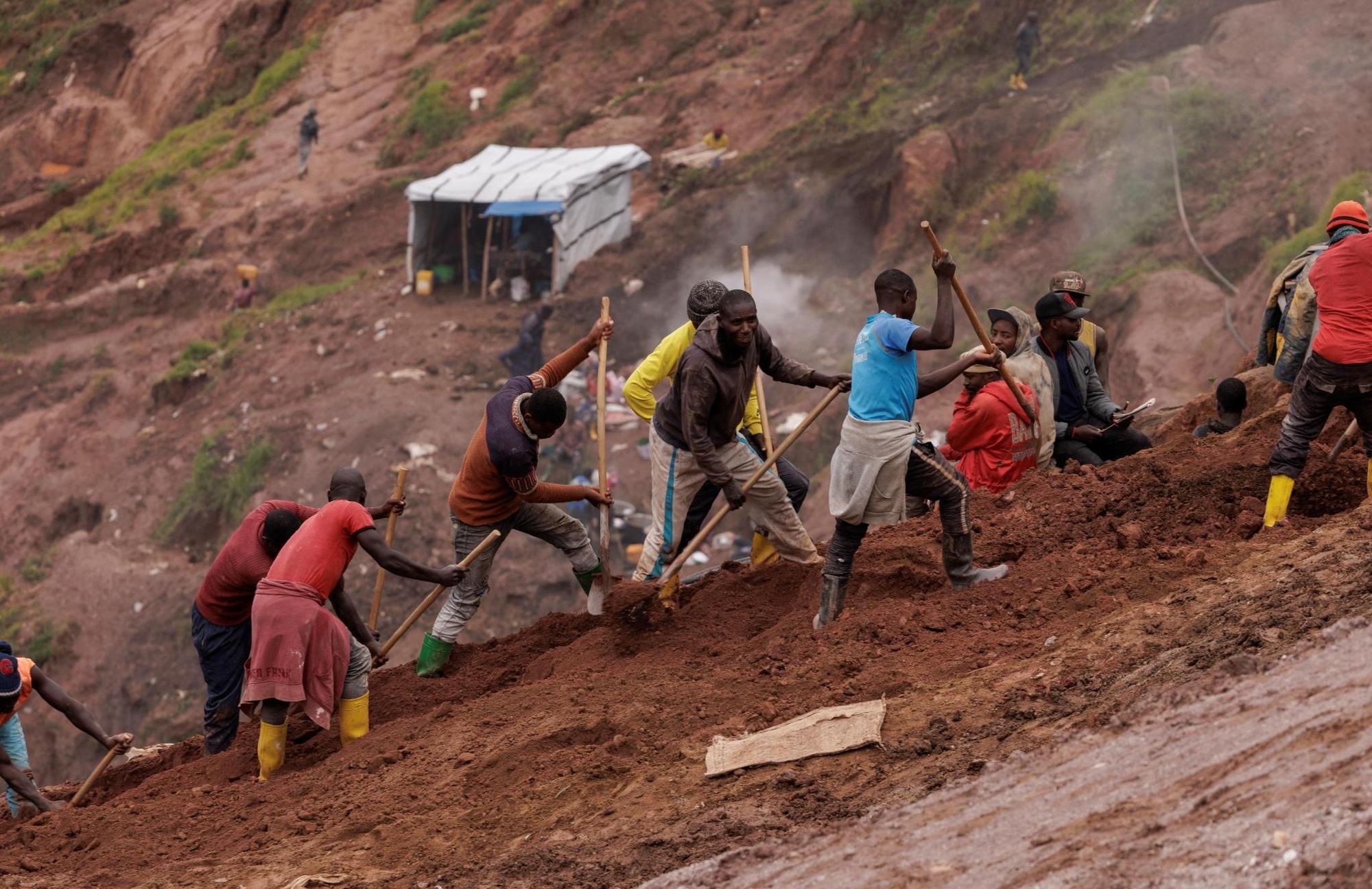
Donald Trump is trying to make it easier for American businesses to access critical minerals and other resources across the Global South, particularly in the Democratic Republic of the Congo (DRC) and Venezuela. But widespread armed group violence on the ground in these countries threatens the safety and security of American firms looking to do business there, which risks counterbalancing Trump’s effort to deepen American economic engagement with the DRC and Venezuela.
Both countries are filled with some of the world’s most important critical minerals and other resources that are vital to fueling the technological and infrastructure advances required to sustain modern economies. And America’s economic competition with China — the United States’ primary economic and technological rival — has served to jolt the U.S. government into finding ways to increase access to these minerals for American companies.
But Trump’s ambition to improve access for American firms looking to mine critical minerals across the Global South is running up against a hard reality on the ground. Intense fighting by armed groups threatens the safety and security of those working in and around many of the most valuable mines in both countries, and complicates the U.S. government’s efforts at commercial diplomacy.
In December, the DRC and the U.S. signed a Strategic Partnership Agreement (SPA) , that gave preferential access to American firms looking to mine in the DRC, a country rich with critical minerals, such as gold, cobalt, coltan, and copper. This deal followed a June 2025 agreement, in which Washington brokered a peace deal between the DRC and Rwanda in their decades-long war.
The SPA aims to facilitate “greater investment by U.S. persons and aligned persons in order to diversify the Democratic Republic of the Congo’s mining sector.”
To promote this economic engagement, the agreement grants American companies preferential access to the critical minerals and other resources in the DRC by creating a strategic asset reserve (SAR). The SAR is a list of critical minerals and other assets to which American companies receive priority when submitting bids.
But mining in the Congo is a complicated pursuit. Joshua Walker, Director of Programs for the Congo Research Group at NYU’s Center on International Cooperation, told Responsible Statecraft that though minerals aren’t the cause of the most recent iteration of the conflict, they have helped to fuel it. According to Walker, “as the M23 has taken more and more territory (…) we’ve also seen, for instance, a massive increase over the last several years in Rwandan gold exports. The assumption is that a lot of that gold is illicitly mined gold [by the M23] coming from the eastern Congo”.
As it relates to the SAR, Walker said that though most of the sites are “not located in the M23-controlled zone,” one major mine — the Rubaya coltan — is controlled by the M23 rebels.. It is likely that the Congolese included this site as part of the SAR “as a way of trying to draw the United States more closely into engaging in … political processes to bring about” some sort of peace in the area surrounding the mine, according to Walker. Essentially, the idea is that if American interest in the mine is high enough, Washington would be willing to pressure Rwanda to demand the M23 pull away from the mine.
This wouldn’t be the first time the Trump administration has taken such action. In March 2025, the Bisie mine in eastern Congo — which was operated by the partially American-owned Alphamin Corporation — was threatened by the advance of the Rwanda-supported M23 rebel group. In response to the security threats, Alphamin halted its mining activity. In order to protect the company’s operations, Trump’s Africa advisor, Massad Boulos, successfully pressured Rwanda to force the M23 group to pull back from the site, which allowed Alphamin to restart operations.
But, in a clear case showing the complexity involved with mining in the region, within a few months of the deal, the U.S. stake in Alphamin was sold to an Emirati holding company, ending American equity in the firm.
Armed groups have made it similarly difficult to tap into the mining sector on the other side of the planet, in Venezuela, where Trump has also feverishly sought access to critical minerals. These vital resources, Trump hopes, will boost the United States’ geopolitical leverage in a region across which he seeks to expand American influence and curb the influence of strategic rivals.
This is particularly true now that diplomatic relations have been restored and U.S. oil sanctions are being lifted following the January 3 bombing of Caracas and kidnapping of President Nicolas Maduro.
Last week, Interior Secretary Doug Burgum visited Caracas to promote joint ventures in the mining sector, just weeks after Energy Secretary Chris Wright traveled to the country to expand U.S. investment and production in the country’s vast oil and natural gas reserves.,
But swooping into Venezuela’s precious metals and critical minerals in the country’s southern Orinoco Mining Arc — particularly gold, diamonds, coltan, bauxite, tungsten and gallium — may not be as easy as Trump thinks.
As the Wall Street Journal recently reported, armed actors in Colombia’s six-decade-old ELN and FARC guerrilla groups operate openly in Venezuela’s mining region, taxing illegal operations and enforcing strict rules in communities that subsist on the trade. Colombian president Gustavo Petro’s efforts to bring those groups to the negotiating table and establish state control in the border regions with Venezuela have largely fallen flat, and the Trump administration has put pressure on Colombian and Venezuelan authorities to drive Colombian guerrillas out of the territory, with limited success thus far.
“An estimated 90% of gold exported from Venezuela is of illicit or criminal origin. These groups exert significant operational and financial control of mining regions,” Julia Yansura, program director for environmental crime and illicit finance at the Washington-based FACT Coalition, told RS. “We’ve documented children as young as nine operating in illegal mines, miners getting their hands chopped off by irregular groups if they’re unwilling to pay the extortive 10-20% tax, systematic extrajudicial killings and clandestine graves.”
Moreover, Venezuela’s mineral resources are largely unexplored and undeveloped; state security forces are often complicit in illicit mineral trafficking; and the sector is plagued by weak rule of law, lackluster infrastructure, insecurity, and informality. Serious environmental degradation from makeshift open pit mining, widespread disease, and mercury-related health ailments make the prospects for swift U.S. involvement in Venezuela’s mining industry even more precarious.
But perhaps the biggest challenge to tapping Venezuela’s critical mineral wealth is ongoing political uncertainty. Broad financial sanctions against the country’s main mining (Minerven) and metals (CVG) conglomerates, an opposition questioning the Rodríguez government’s authority, and a fickle Trump administration have undermined investor confidence, even for those willing to tolerate elevated political risk.
Ultimately, Trump’s efforts to expand American mining interests in both the DRC and Venezuela will require continued efforts by the U.S. government to contend with the threats to mining companies’ interests without risking getting bogged down in the quagmire of decades-long local guerrilla conflicts.