

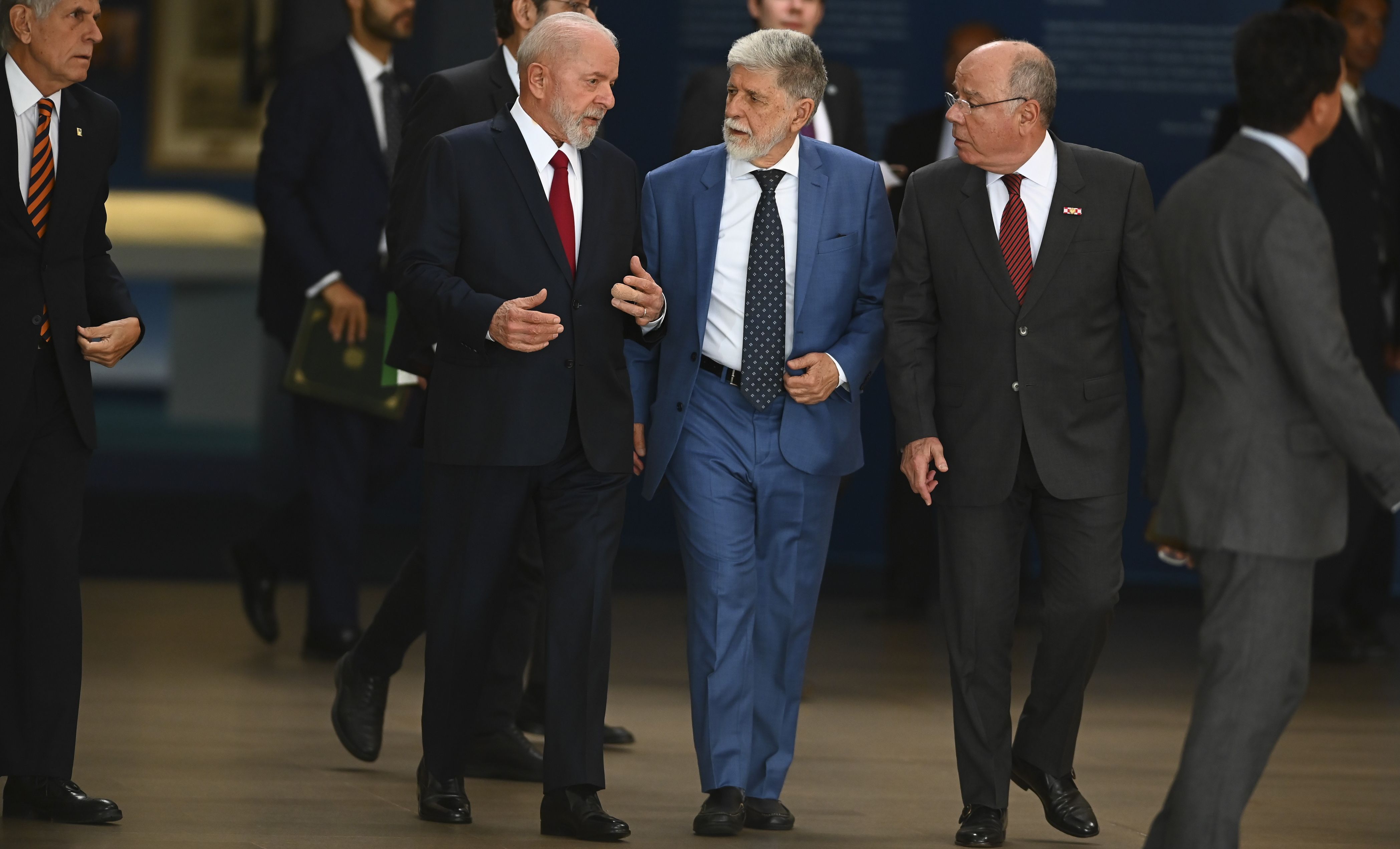
Three months into the Trump administration, there has been a conspicuous lack of confrontation with Brazil’s Luiz Inácio Lula da Silva. The president of Latin America’s largest nation is an elder statesman of the global left and made clear his preference for the Democratic nominee in last year’s presidential race.
He has also hammered Elon Musk for the explicit way he has sought to undermine Brazilian law as it relates to Twitter/X operations in his country, insisting last September that “the world is not obliged to put up with Musk’s extreme right-wing anything goes just because he’s rich.”
Now, of course, Musk is perhaps the central policy player in Trump’s government. Yet compared to Gustavo Petro of Colombia, who forcefully and very publicly challenged Trump’s deportation policies as they concerned his country, Lula’s government has been restrained, opting for a behind-the-scenes engagement strategy that emphasizes the preservation of open diplomatic channels.
This approach does not merely reflect Brazil’s hope of avoiding Trump’s wrath; in fact, Lula will almost certainly sharpen his critiques of Trump during next year’s presidential campaign. Rather, the move to deliberately avoid provoking Trump more likely stems from the conclusion that the type of disruption he represents may offer novel opportunities for Brazil to deepen the foreign policy orientation Lula has embraced since his first stint in office from 2003-2011. The architect of that strategy, which prioritizes Brazilian leadership in a strong, unified South America and a dogged independence on the world stage, is Celso Amorim.
Amorim was Lula’s foreign minister during the entirety of his first two terms and minister of defense under Lula’s hand-picked successor, President Dilma Rousseff, from 2011 to 2014. Currently, he is Lula’s most important foreign policy adviser. Amorim normally shies away from the public spotlight, but he recently offered a glimpse into his current thinking.
Amorim sees some potential positives in Trump’s geopolitical shakeup. For one thing, he clearly welcomes Washington’s efforts to reengage Russia.
“I think Trump looks at the vast expanse of Russia, a country that spans 12 time zones, and imagines the investment possibilities,” he said during a recent interview. “He doesn't want to be at odds with Russia.” He also referred to Secretary of State Marco Rubio’s comments that the U.S. doesn’t want to see Russia as “totally dependent on China” nor enemies with Beijing as a “surprisingly sensible statement.” ‘
Talks between Trump and Russian president Vladimir Putin should be welcomed in the name of peace, Amorim argues. After returning to power in January 2023, Lula eagerly sought to aid in negotiating an end to the war in Ukraine. Such efforts never gained the support of the Biden administration — National Security Council spokesman John Kirby accused Lula of “parroting Russian and Chinese propaganda” — and went nowhere. Now, however, the U.S. president is making points similar to what Lula was saying two years ago.
“In his conversation with [Ukrainian President Volodymyr] Zelensky [in early March at the White House], which was very crude,” Amorim observes, “Trump said something interesting: ‘He [Zelensky] wants victory. I want peace.’ And that's true too.”
Predictably, Amorim is now linking the latest developments on this front back to the long-held Brazilian aspiration for greater international influence. Eventually, he posits, “they will have to multilateralize the process,” referring to attempts to end the war in Ukraine, “not least to avoid the natural frictions that exist between Russia and the U.S. Let things evolve. At the right time, we will, yes, have a role to play.”
As the fourth-largest democracy in the world and the producer of much of the world’s food, Brazil is not easy overlooked. This is especially true, as Amorim often reminds his interlocutors, given Brazil’s central role in important international fora like BRICS. Noting Lula’s upcoming foreign travel, including trips to Russia and China, Amorim stressed in the interview both that Lula remains engaged and personally undeterred as he seeks to continue carving out a lasting foreign policy legacy and that Brazil is not just a regional heavyweight. Instead, he said, Brazil “is part of the global South, active, together with the two largest powers in the world besides the U.S. It does not mean that we want to fight with the U.S., but we are showing that we have options. And this helps us to have influence on other issues as well.”
Amorim made a similar point in a separate interview last month, saying there is no anti-Western hostility to BRICS, which expanded dramatically last year.
“Brazil is, above anything else, a country that wants to defend its position and that of the developing countries without any aggression,” he said, pointing to a history of productive relations with governments of varying ideologies. What BRICS hopes to accomplish — indeed, what it was founded to do, according to Amorim — is to support a more inclusive international system where developing countries have a more substantial role than has often been possible in the U.S.-led postwar order.
“This is very important because it has shown the big Western, capitalist countries that they cannot dictate the rules; they can present initiatives, but they will have to discuss them with us,” he said. “And I think this did not exist because before, the G7 would speak and the International Monetary Fund, the World Bank, the World Trade Organization would just follow. Now it is different.”
The strength of BRICS, Amorim believes, rests in its relative cohesion. Brazil seems less interested in BRICS as an alternative to the United Nations but as another body in which it can exert special influence while remaining deeply committed to eventually earning a permanent seat on the U.N. Security Council. For that reason, he argues BRICS should not keep adding new members.
“My message is that the BRICS is a group of developing countries that want prosperity, but also want peace,” he said. “I believe that the world in which we live today is mostly in search of peace. I think it was that Pope Paul VI who said, ‘development is the new name for peace.’ The BRICS is the new name for development.”
Amorim sees a United States under Trump denuded of the frequent hypocrisies of the postwar era. “Sometimes it [hypocrisy] is worth it because it is civilizing. When there are solutions compatible with the rules, the situation always improves,” he said. “The U.S. ended up accepting the rules. I don't see that happening with Trump.”
Yet Amorim, the consummate diplomat, notes that this posture is clarifying — it will be up to Brazil to find fresh opportunities and to strengthen BRICS as well as its own independent activity on the world stage.
While Amorim (and Lula) believe Brazil is simply too big and well-connected not to be involved in the major conversations shaping global politics, it is worth noting that not all Brazilian leaders agree.
Former President Jair Bolsonaro, for example, said in a recent interview that it’s wrong for a Brazilian president to consider himself an equal to an American one. “I knew my place when speaking with [Trump],” Bolsonaro said.
A high court in Brazil has barred Bolsonaro from seeking office until 2030 for his role in undermining the last election, but his position helps elucidate the political stakes of next year’s race in Brazil. The Bolsonaro family, in stark contrast to the independent geopolitical profile the current government has insisted upon, is actively soliciting U.S. intervention in the hope of forcing the former president back into contention. “Me not being on the ballot is a negation of democracy,” he said.
For their part, Amorim and Lula imagine a world after U.S. primacy. They are jointly contributing to the construction of a global order that will be more responsive to their insights, demands, and aspirations. “Our great challenge, in this division of the world,” Amorim said, “is to not be anyone's colony.”
This is the basic tenet of Lula’s foreign policy. It is sure to be vigorously proclaimed and contested at home in the year ahead.