

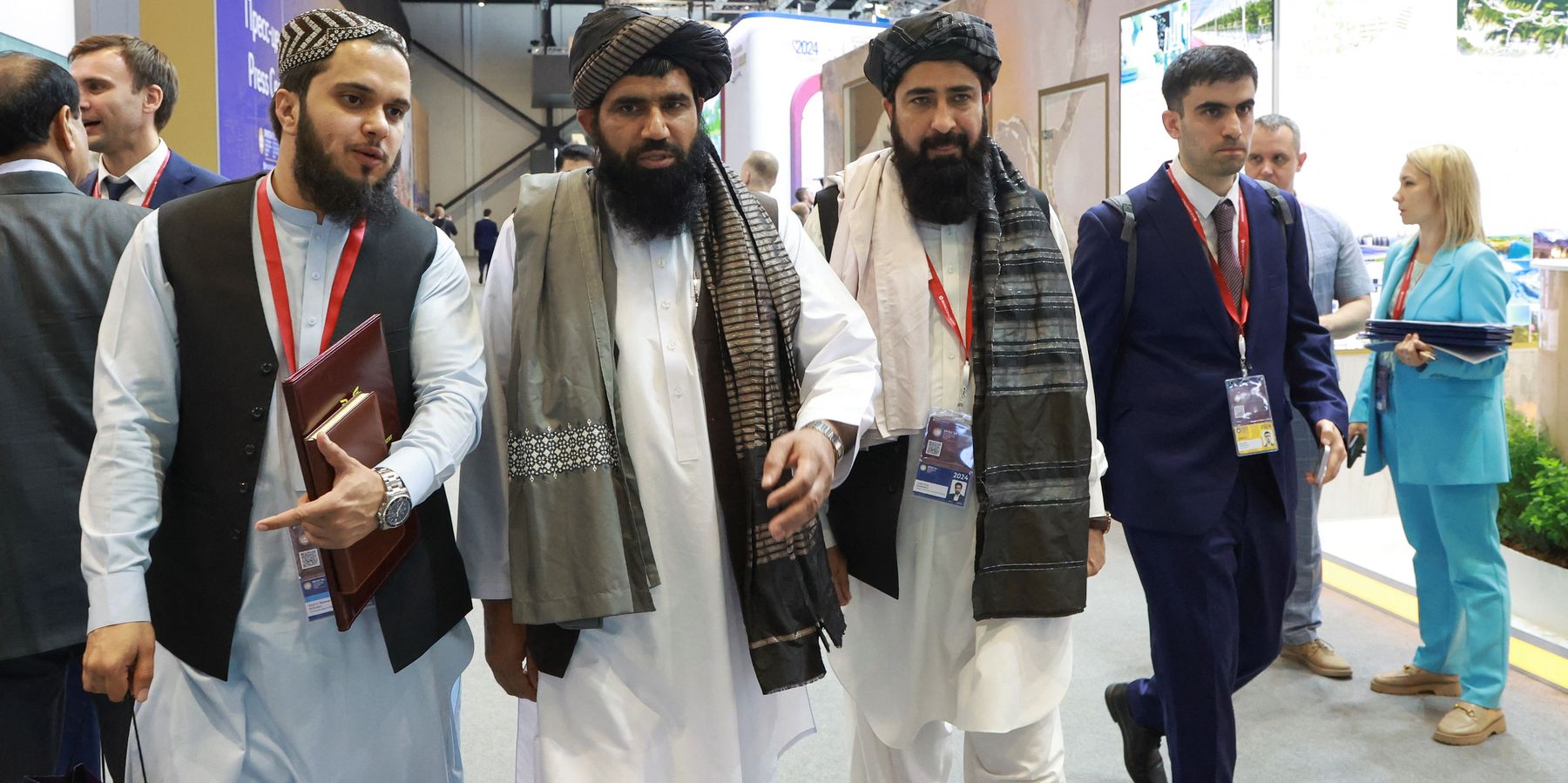
Late last month, roughly two dozen countries sent envoys to Qatar for a conference about international engagement with Afghanistan and for the first time the Taliban participated too.
Taliban representatives attended the latest round of the “Doha process” because, unlike the May 2023 gathering, activists were not in attendance this time around. This conference gave the Taliban the chance to call on the U.S. and other western governments to lift economic sanctions on Afghanistan and build deeper ties with the Islamist regime in Kabul.
That diplomats from these roughly two dozen countries and Taliban officials attended this recent conference speaks to the fact that more states are engaging the Islamic Emirate of Afghanistan (IEA), even if no government has officially recognized the Taliban since it reconquered the country in August 2021.
Most of Afghanistan’s immediate neighbors and a host of non-western, Muslim-majority countries along with China and Russia have essentially informally recognized the Taliban and stepped up outreach to the IEA to further their own economic, trade, and security interests.
Afghanistan’s Disastrous Economic Conditions
Against this backdrop of growing international engagement with the Taliban, Afghanistan’s economy is in horrible shape. As of March, 69% of Afghanistan’s population is “subsistence insecure” and “dramatic” water scarcity plagues many parts of the country, according to a UN official.
The Afghan economy has contracted by 27% since the Taliban’s return to power in August 2021. Unemployment has doubled, and only 40% of the Afghan population enjoys access to electricity, while the country’s financial sector has “basically collapsed.”
The Taliban’s governance and extreme policies that limit women’s rights have greatly contributed to these problems. But there is no denying that much of the blame for Afghanistan’s economic crises can be laid on Washington’s doorstep given the sanctions it has imposed on the country since the Taliban retook power almost three years ago.
U.S. Diplomacy Toward the Taliban
Despite waging financial warfare against post-occupation Afghanistan, the Biden administration has been engaged with the IEA diplomatically since before the U.S. withdrawal in 2021.
Since the Obama years, Doha has been the main venue for U.S.-Taliban dialogue and engagement. To this day, Qatar’s foreign ministry remains the chief interlocutor between Washington and the Taliban. To lesser degrees, the United Arab Emirates, Pakistan, Norway, and the United Nations serve bridging roles too.
Throughout the past roughly three years, the U.S. and Taliban have engaged on a host of issues such as the mutually perceived threat of Islamic State Khorasan Province (ISKP), the status of American citizens detained in Taliban-ruled Afghanistan, rights of women and girls, and humanitarian challenges in post-U.S. Afghanistan.
The extent to which such engagement with the de facto rulers of Kabul has advanced Washington’s interests is mixed. With respect to the status of Afghanistan’s women and girls, Washington’s diplomatic outreach to the Taliban has basically achieved nothing. At the same time, the Biden administration’s efforts to convince the Taliban to protect certain segments of the Afghan population from the IEA’s oppressive hand have proven futile.
“The U.S. has also failed to convince the Taliban not to target former Afghan government officials, former Afghan National Defense and Security Force members, and millions of those Afghans who were educated under the U.S. involvement in Afghanistan,” Ahmad Sayer Daudzai, the former Afghan ambassador to the United Arab Emirates, told RS.
“This is important for the U.S., as the U.S. considers this generation of Afghans as a long-term asset of the U.S. in Afghanistan. As the Taliban continue to target, arrest, assassinate and force this segment of Afghan society to emigrate from Afghanistan, the U.S. is losing their 20-year gains in Afghanistan,” he added.
But since August 2021, diplomacy has resulted in the release of four U.S. citizens who were held in the Taliban’s prison system. According to U.S. government sources, and it has also led to some productive counterterrorism coordination.
“There is cooperation between the U.S. and the Taliban’s Defense Minister Mullah Yaqoob, which has allegedly led to successful raids against ISKP in eastern Afghanistan. The details of this financial and intelligence cooperation were declassified [in June 2024] by a CIA veteran of Afghanistan named Sarah Adams,” explained Daudzai.
Russia, China, and Iran’s Influence
In the longer-term, great power competition is the key variable in the equation that incentivizes the Biden administration to engage the IEA through diplomacy.
Put simply, the White House understands that if the U.S. does not engage the Taliban at all, Washington’s foes and rivals — Russia, China, and Iran — will move to fill vacuums in post-occupation Afghanistan at the expense of America’s interests in West Asia. This dynamic helps explain in part the rationale behind the Biden administration’s outreach to the IEA despite the humiliation of doing so.
A concern for U.S. policymakers is that Moscow, Beijing, and Tehran could bring Taliban-governed Afghanistan increasingly into their orbits of influence. One example pertains to trade and sanctions. Currently, China’s over-land trade with Iran has to transit Tajikistan, Uzbekistan, and Turkmenistan. But, if there is greater stability in Afghanistan, such Sino-Iranian trade could go through one country (Afghanistan) rather than three Central Asian countries, serving to increase geo-economic connectivity between China and Iran.
Taliban Rule is Probably Here to Stay
The reality on the ground in Afghanistan is that no actor poses any credible challenge to the IEA’s rule. ISKP is the most serious threat to the Taliban government today, but this extremist group is unlikely to establish any statelet within Afghanistan (as other Islamic State franchises did in Libya, Iraq, and Syria) — let alone topple the IEA and take control of Afghanistan. Nor is the National Resistance Front in a position to take over.
Therefore, the Taliban’s control of the country is probably set to remain a fact of life for the foreseeable future. Washington not recognizing the Taliban while imposing sanctions on Afghanistan is unlikely to change that. Those in the U.S. who see the world through the lens of great power competition may find themselves challenging the wisdom of not recognizing the Taliban while Washington’s competitors make moves to establish deeper informal (and perhaps before long formal) relationships with the de facto regime in Kabul.
The U.S. recognizing the IEA would be the Taliban’s dream. But that’s a dream which probably would only come true in the distant future. Given Washington’s struggles in Afghanistan since 2001 and the way in which the IEA took power in 2021, any push for recognition of the Taliban would be extremely unpopular in Washington.
However, it would be worth having a serious debate about where Washington’s policy of non-recognition and economic sanctions is headed, and what U.S. interests can be realistically advanced through it.