
Follow us on social

Speaker McCarthy drops 'blank check' for 'full support' of Ukraine aid

Speaker McCarthy drops 'blank check' for 'full support' of Ukraine aid

The GOP leader gave a full throated endorsement for Russia 'pulling out,' too, signaling a shift in tone and away from dissenting colleagues.

Analysis | Europe

Speaker of the House Kevin McCarthy used his trip to Israel to cast his full-throated support behind security aid to Ukraine, months after insisting the country would not get a "blank check" from Congress.

“I vote for aid for Ukraine. I support aid for Ukraine,” McCarthy said, responding to a question from a Russian reporter.

“I do not support what your country has done to Ukraine, I do not support your killing of the children either,” McCarthy told a Russian reporter there, adding. “You should pull out.”

According to Politico, the speaker also vowed to continue giving weapons and military assistance" as long as I am Speaker" during his landmark speech to the Knesset (he's only the second Speaker to address Israel's legislative body since Newt Gingrich in 1998).

This is a bit of a shift in tone for the Republican leader, at least since October when his party was embroiled in a tight race for dominance in the 2022 elections and inflation was the hot topic. “I think people are gonna be sitting in a recession and they’re not going to write a blank check to Ukraine,” McCarthy told Punchbowl News at the time. “They just won’t do it. … It’s not a free blank check.”

He doubled down on the statement in March when he declined an invitation by Ukrainian president Zelensky to visit Kyiv.

“Let’s be very clear about what I said: no blank checks, OK? So, from that perspective, I don’t have to go to Ukraine to understand where there’s a blank check or not,” McCarthy said. “I will continue to get my briefings and others, but I don’t have to go to Ukraine or Kyiv to see it.”

McCarthy and Zelensky ultimately spoke on the phone.

But McCarthy's seeming shift comes two weeks after a group of 19 Republicans sent a letter to President Biden saying they would no longer support unconditional aid to Ukraine and that future packages would have to come with a clear strategy for ending the war.

According to Axios, the next aid package could come this summer, setting up a fight amid Republicans, though despite McCarthy's heavy-handed words back in October and March (and oversight efforts by Rep Matt Gaetz and Sen. J.D. Vance), "the issue has barely been on the House agenda."

While the latest polls definitely indicate Republican voters going one way on the subject (more skeptical of aid), it would seem the party establishment is not interested in rocking the boat, at least not yet.

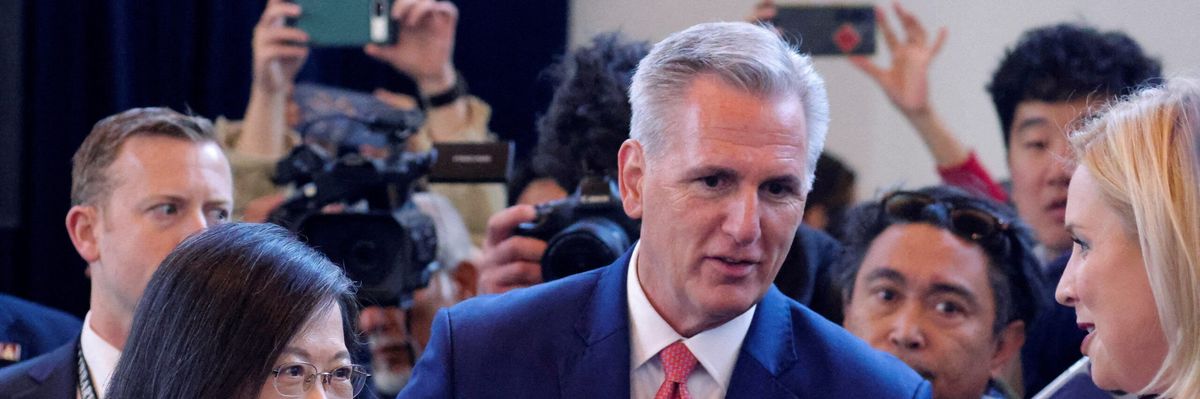
FILE PHOTO: Taiwan's President Tsai Ing-wen meets the U.S. Speaker of the House Kevin McCarthy at the Ronald Reagan Presidential Library in Simi Valley, California, U.S. April 5, 2023. REUTERS/David Swanson/File Photo|Taiwan's President Tsai Ing-wen gestures while speaking during an event with members of the Taiwanese community, in New York, U.S., in this handout picture released March 30, 2023. Taiwan Presidential Office/Handout via REUTERS ATTENTION EDITORS - THIS IMAGE WAS PROVIDED BY A THIRD PARTY. NO RESALES. NO ARCHIVES.
Analysis | Europe
Critics: US ultimatum to Israel a 'cynical' election ploy
@BarakRavid

Copy of post from Barak Ravid on X

Critics: US ultimatum to Israel a 'cynical' election ploy

QiOSK

The Biden administration says it is giving Israel 30 days to address concerns related to the humanitarian crisis in Gaza.

In a letter to two senior Israeli officials dated Oct. 13, Secretary of State Antony Blinken and Secretary of Defense Lloyd Austin said, “We are now writing to underscore the U.S. government’s deep concern over the deteriorating humanitarian situation in Gaza, and seek urgent and sustained actions by your government this month to reverse this trajectory.”

keep readingShow less
Biden sends US troops to Israel weeks ahead of election
Top photo credit: Israeli Prime Minister Benjamin Netanyahu and U.S. officials visit the Terminal Altitude Area Defense System site in IsraelU.S. Air Force (photo by Staff Sgt. Cory D. Payne)

Biden sends US troops to Israel weeks ahead of election

Middle East

The escalation of conflict in the Middle East will now apparently involve U.S. troops. President Biden has directed the deployment of the Terminal High Altitude Area Defense (THAAD) system to Israel, along with around 100 American soldiers needed to operate it. This is the first time that U.S. troops will have been sent to Israel since Hamas’ Oct. 7 assault.

This risk of further American involvement comes as the American public is increasingly against sending troops to fight Israel’s war. A survey conducted by the Chicago Council on Foreign Affairs released in August found that only about four in ten Americans supported sending troops to defend Israel if it were attacked by its neighbors, down from around 55% until 2021. This decision to deploy to Israel so close to the November election is made as general sympathies for Israel have slipped to a low of 33% amongst Americans polled in Sept. 2024.

keep readingShow less
Five ways Israel could strike Iran and what it would need to do it
Top photo credit: Shutterstock/Hamara

Five ways Israel could strike Iran and what it would need to do it

Middle East

As the U.S. sends THAAD, one of its most advanced anti-missile systems — along with 100 U.S. troops to crew it — to Israel, the signals are clearer than ever that Israel intends to strike back at Iran for its October 1 missile attack.

Whatever the Israeli response, their chosen target set may reveal whether their intent is retribution or something more. We may be able to discern Israeli strategic intent by classifying five general categories of targets in order of escalating magnitude. What they hit should tell us what they aim to do.

keep readingShow less

Election 2024

Latest

Newsletter

Subscribe now to our weekly round-up and don't miss a beat with your favorite RS contributors and reporters, as well as staff analysis, opinion, and news promoting a positive, non-partisan vision of U.S. foreign policy.