

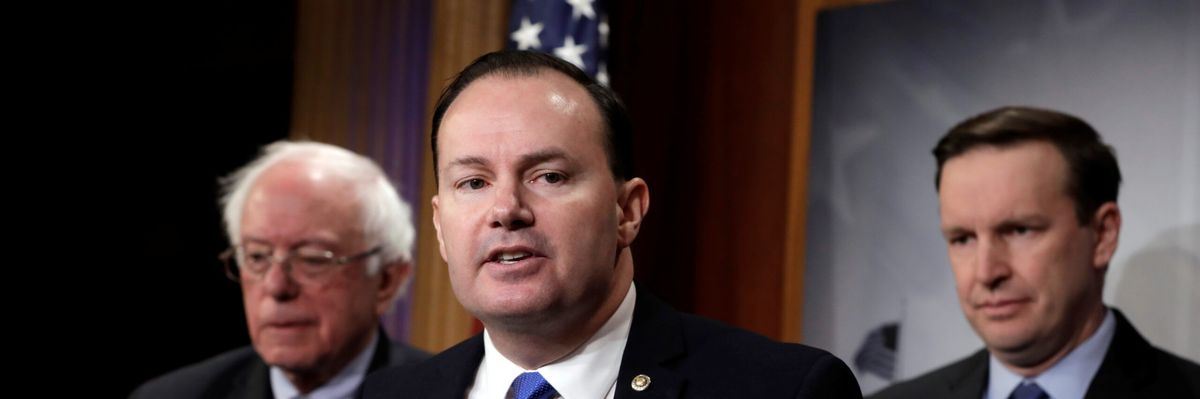
Sens. Bernie Sanders (I-Vt.), Mike Lee (R-Utah), and Chris Murphy (D-Conn.) have teamed up again to propose major legislation that would reform war powers, arms sales, and national emergencies.
The three Senate co-sponsors of the National Security Powers Act (NSPA) have worked closely together before to craft a resolution demanding an end to U.S. involvement in the Saudi coalition war on Yemen. Now they are building on that earlier work to replace the War Powers Act with more precise language to close the loopholes that presidents of both parties have exploited for the last fifty years.
The NSPA also addresses the serious problem of presidential overreach in the areas of selling weapons to other governments and of declaring phony national security emergencies to push through these arms sales and other items on their agenda that have nothing to do with the security of the United States.
The bill would create more stringent requirements for the arms sale approval process in Congress, and it would curtail the president’s ability to declare national security emergencies. The previous administration abused national security emergency provisions several times in an attempt to bypass Congress entirely, and the co-sponsors of this bill want to make sure that can’t happen again. The NSPA is a serious, constructive effort to reclaim Congress’ role in matters of war and national security after decades of acquiescing to executive power grabs.
One of the weaknesses of the existing War Powers Act is that it does not adequately define the meaning of the term “hostilities,” and that has allowed one administration after another to engage the military in unauthorized conflict while claiming that they are not doing so. During the Libyan intervention in 2011, for example, the Obama administration’s lawyers claimed to respect the War Powers Act while redefining hostilities in such a way that it supposedly excluded the ongoing air war against the Libyan government. The Obama administration position at the time was that U.S. forces couldn’t really be engaged in hostilities if the other side couldn’t shoot at them, and for that reason they didn’t need Congressional authorization.
The same strained denial of involvement in hostilities came up again under both Obama and Trump during the Yemen debate, as the Pentagon insisted that its support for the Saudi coalition, including mid-air refueling, did not constitute hostilities and was therefore none of Congress’s business. The new legislation seeks to clarify matters by setting a definition for hostilities that will cover these and other scenarios in which U.S. forces are clearly involved in a foreign conflict, and it would give the measure teeth by including an automatic funding cutoff if the president failed to meet its requirements. As the Post reported this week:
“It would define “hostilities” as any operation involving the use of force, remotely or directly — superseding the unofficial custom of administrations interpreting the law as applying only when there are combat troops on the ground. It also would shorten the time that presidents have to engage in those hostilities from 60 to 20 days and automatically terminate funding for an operation if a president fails to secure congressional support for the venture by that deadline.”
The new legislation makes several important improvements here. It not only significantly reduces the amount of time that the president has to withdraw forces to just a few weeks, but it also ensures that funding for an unauthorized operation will end without further Congressional action. This puts the onus back on the president to justify military operations, and that should go a long way towards restoring the Congressional role in matters of war. The bill would strike another blow for war powers reform by sunsetting all current authorizations for use of military force (AUMF), including the 2001 and 2002 AUMFs. Within six months of the NSPA’s enactment, all these authorizations would be repealed and there would be no automatic replacement for any of them.
The improvements to the regulation of arms exports and national emergencies are no less important. Currently, the executive has wide latitude in selling weapons to other states, and when an administration chooses to declare an emergency that allows the executive to circumvent Congress altogether. We saw how this happened with the Trump administration’s arms sales to Saudi Arabia and the United Arab Emirates in 2020 when then-Secretary Pompeo issued a bogus emergency declaration to expedite the sales and to avoid Congressional scrutiny and opposition.
Current law requires Congress too little time and forces them to jump through too many hoops to block an unwanted arms sale. As Sen. Murphy notes, “It should come as no surprise that Congress has never successfully stopped an arms sale through this process.” If the NSPA became law, Congress would assume a much more significant role in the process and would be able to provide the kind of serious oversight that these sales require.
Congress would have to approve arms sales before they could take effect. That means that the president could not present Congress with a fait accompli and then dare them to try to stop it. Instead of Congressional opponents needing a veto-proof supermajority, the president would have to win majority support for the sales he wanted. This change in the process would expose these sales to greater scrutiny and democratic accountability. In practice, that could make it more politically risky for the government to continue arming despotic and abusive clients to the teeth, and it would force members of Congress to take greater ownership of the sales of U.S.-made weapons and their consequences for the affected regions of the world.
Presidential declarations of emergencies would face similar constraints. Unless Congress approves of it, any emergency would be limited to 30 days, and even approved emergencies would last for one year with a total time limit of five years. This would not only prevent presidents from abusing national security exemptions written into existing laws, but it would ensure that the U.S. does not keep adding to a growing army of zombie national emergencies that are extended without serious consideration of whether they are still needed.
As Sen. Murphy mentioned in a recent column detailing the provisions of the legislation, “there are no fewer than 39 ongoing national “emergencies,” and these emergencies are routinely renewed and never seem to end. Emergency declarations grant the president broad powers to impose sanctions and tariffs. The emergency provisions were included on the assumption that they would be used responsibly, but clearly there need to be much stronger safeguards against abuse. The NSPA's new requirements provide some of those safeguards.
While final passage of the bill in its current form is unlikely, it represents important progress in forging a transpartisan coalition dedicated to reining in an unchecked executive and preventing more unauthorized wars in the future. Dedicated activists and elected representatives have changed the debate over war powers and presidential authority in just the last few years. Sens. Sanders, Lee, and Murphy are taking the next important step in advancing that work in Congress with the National Security Powers Act.