

The velocity at which President Trump’s war on Iran has spiraled out of control is unsurprising.
History neither repeats nor rhymes, but patterns flash like neon signs in the recent U.S. experience in the Greater Middle East. The combination of underestimating the enemy, overestimating one’s own power, and altogether ignoring the need for a clear definition of victory leads to escalation with no end in sight.
The president raced to the top of the escalatory ladder, threatening to destroy Iranian civilization on April 7. Mercifully, he backed down and offered a ceasefire, leading to a single day of peace talks in Pakistan. Already, however, Trump is ordering the U.S. Navy to blockade of the Strait of Hormuz and is reportedly weighing the resumption of limited air strikes.
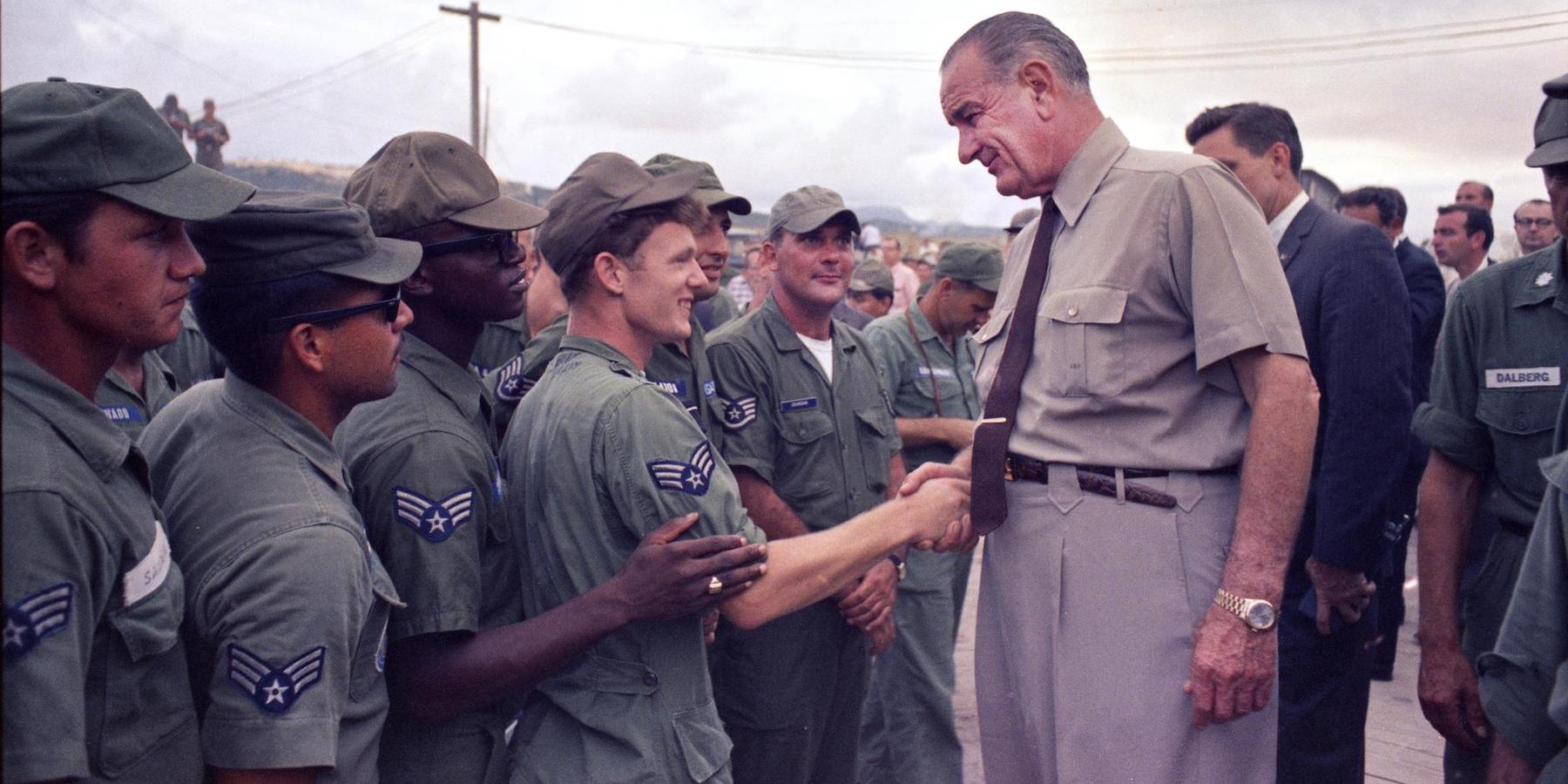
The United States was supposed to have learned these painful lessons after the long nightmare in Vietnam. Despite serious doubts in his own mind and among his chief advisers that victory was attainable, President Lyndon B. Johnson sank his legacy in the jungles of Southeast Asia.
To better understand the parallels between past and present, Responsible Statecraft spoke to the preeminent scholar of the Vietnam era, Fredrik Logevall, who teaches history at the John F. Kennedy School of Government at Harvard.
Logevall is the author of Choosing War, which chronicles the 18 months between Kennedy’s assassination and LBJ’s decision to send the Marines into Da Nang in March 1965. He also authored Embers of War, covering the French catastrophe in Vietnam, which won the Pulitzer Prize. Our conversation has been edited for length and clarity.
Responsible Statecraft: How do you define the logic of escalation or what is often called the escalation trap?
Logevall: It’s a concept often associated with Herman Kahn, although others have written about it, too. It's a conceptual framework with a self-reinforcing, step-by-step mechanism where one side misreads its early tactical successes. You expect to continue to achieve those successes, but when they don't materialize, you get frustrated, so you feel compelled to escalate further. What you often end up with, and this is what Kahn was really interested in, is the disconnect between the military effort and whatever political result you're seeking.
RS: The historian John Dower wrote in his book Cultures of War that “language and rhetoric themselves become a prison and the machinery of destruction has its own momentum.” There's more to any war than language and rhetoric. But I think we can already see that the Trump administration is being trapped by its own rhetoric.
Logevall: I couldn't agree more, and I think Dower is onto something hugely important. We also see this with respect to [the U.S. wars in] both Iraq and Afghanistan. We certainly see it with respect to Vietnam. U.S. leaders became, as Dower puts it, locked in a prison partly because of the language they've used, the vows that they've made, and the assertions they've made about the importance of the struggle.
RS: To call something a trap implies that there’s no way out. But we know from the Vietnam War, specifically about what you describe as the “long 1964” from Kennedy's assassination to Johnson's decision to send in the Marines to Da Nang in March 1965, that there were alternative choices. Policymakers and President Johnson himself weighed these choices.
Logevall: If it's a trap, it's one that you willingly enter. As the ‘long 1964’ comes to a close, Johnson believes himself to be in this trap. He may have believed it from the beginning, meaning soon after Kennedy's assassination in the early months of 1964. Johnson basically says to his wife Lady Bird, “I'm trapped on Vietnam. Whichever way I go, I'm going to be crucified.”
A key finding in my own research, including in Choosing War and also in some subsequent work, is that options existed and were articulated by people at the time. There were people in high places arguing with Johnson, ‘Don't do this. Don't escalate this war.’ Including the vice president of the United States, Hubert Humphrey, in a remarkable memorandum in mid-February 1965. He basically pleads with Johnson not to escalate the war.
Johnson himself had severe doubts about whether the war was winnable even with escalation, even with ground troops, even with air power. More disturbingly, Johnson even doubted that the conflict was worth waging. Already in May 1964, he says in a phone conversation with McGeorge Bundy, “I donʼt think itʼs worth fighting for and I donʼt think we can get out.”
RS: He said to McGeorge Bundy, “I don't think we can fight them 10,000 miles away from home and ever get anywhere in that area.” So, there are some important parallels to today's disaster as well as important differences. But when I was reviewing your book from 25 years ago, Choosing War, I was surprised at how many parallels jumped off the page. Here’s one: As in 1965, there was very little public enthusiasm for escalating the war or initiating a new war with Iran. Yet here we are.
Logevall: We tend to exaggerate in hindsight the degree to which the American public was enthusiastic about the war in Vietnam in 1964 and ‘65. The difference is that, when Johnson Americanized the conflict, majorities said, "Yes, this is the right thing to do." Not with a great deal of enthusiasm. I think you're absolutely right about that. But I do think Johnson could legitimately claim to have popular backing for preventing South Vietnam from falling to the communists.
With Iran, however, it seems pretty clear that most Americans do not back the war. Donald Trump is in a more tenuous position than we've seen perhaps with respect to any war that I can think of.
RS: You're right that most Americans believed in supporting South Vietnam, but short of sending in ground troops. When Johnson makes the decision in March 1965 to send in a small contingent of Marines, does he or anyone else expect it'll turn into 500,000 combat troops within three years? The warning here is obvious, as Americans today fear the potential for ground troops in the Persian Gulf.
Logevall: The American people were highly skeptical up through, let's say, March 1965. And then an interesting thing happens: the rally around the flag effect takes hold. So support for the war rises significantly and stays well above 50% for a considerable period of time.
If Donald Trump committed major ground forces to Iran, could we see something similar happen, that a sizable part of the American population decides, well, now that the troops are committed, we have to support this thing? I'm not sure. This is a fundamentally different scenario.
The other point to make in response to your astute observation, few really anticipated a long, drawn out struggle. But again, we should bear in mind Hubert Humphrey, who was long ago forgotten on this point. Humphrey did anticipate it. He did say in his memo, ‘Mr. President, if you escalate this war, you're going to divide the American people. You're going to be in there for a long time.’ You're going to worsen your chances for re-election in 1968. And, moreover, the Joint Chiefs of Staff said to Johnson as he was weighing the decision, [it would require] five years and 500,000 troops.
RS: That's what makes today's situation so maddening. We can see that if Trump and his Defense Secretary Pete Hegseth deploy even a small number of troops to the Strait of Hormuz or somewhere else in the Persian Gulf, they’ll be climbing the escalatory ladder. It'll be a matter of time before they have to send more troops to defend the ones initially deployed.
Logevall: That's my fear, and that's what my reading of the relatively recent and somewhat more distant past would say. We historians are loath to make predictions, but the scenario that you've just laid out is more likely than not.
RS: Johnson argued U.S. credibility was on the line in Vietnam. Allies responded by questioning our judgment, even our sanity. You can see the same thing happening today.
Logevall: Credibility has to be viewed in three dimensions. I call it credibility cubed. So it's credibility internationally vis-à-vis adversaries and allies. There's domestic political credibility. Would Johnson have credibility on Capitol Hill with Democrats and Republicans depending on which course he took? And then there's personal credibility, careerist credibility, if you will. All of these dimensions matter.
And I suspect they matter now. Trump is thinking about the markets. He's thinking about his domestic position. I think people around him, to the extent that he even gets or takes advice, are also thinking of credibility in these different dimensions.
RS: Another aspect of the current war that is maddening, and here we can find more parallels to Vietnam, is that it’s fairly apparent that the desired political outcomes are not going to be achieved no matter the military dominance.
Logevall: The early signs indicate that problem far sooner than was the case in Vietnam. There were serious doubts from the start about the political objectives, however you define them. It was a little more straightforward in the Vietnam case, unlike in Trump’s case where he can say different things depending on the minute or the hour. In Vietnam it was pretty clear that the U.S. wanted to preserve a non-communist independent South Vietnam for the indefinite future. But could that political objective be achieved even if we committed ground forces, even with our dominance in terms of air power? There were skeptics from the beginning.
RS: I appreciate your point about how Trump keeps changing his rationales. Regime change was there at the start. The parallel to South Vietnam is not perfect, but it's clear, based on all the reporting out there, that Donald Trump believed he'd have a more favorable regime in Tehran by now. He underestimated the enemy, just as Johnson did in Vietnam.
Logevall: We’re seeing graphic evidence of this… We're talking about a country with 93 million people, one-sixth the physical size of the United States. Its regime has been in power for a very long time, and has formidable assets that it can use in asymmetrical warfare.
RS: Only fools try to predict the future, but as of today, do you expect to see ground troops in the Persian Gulf again? I really don't know what to make of the president's thinking anymore.
Logevall: I don't either. If you put me on the spot, there could be a ground force commitment, as has been discussed, to take some of the islands in the Persian Gulf. It's arguably a relatively straightforward proposition to take them, but what happens after that could get tricky.
But the other point I'll make in terms of prediction is [that] it’s almost impossible, based on recent history, to win a war just by obliterating, to use Trump's own word, the enemy's military. The regime has survivors who have choices of their own. The enemy gets a say. Ultimately, what you get in most modern wars is a political settlement.
- JFK oversaw Vietnam decapitation. He didn't live to witness the rest. ›
- Veterans warn US landing could be 'more Gallipoli than Vietnam' ›