

As fears mount that U.S. strikes against so-called “narco-terrorists” in the Caribbean could escalate into full-scale war with Venezuela, weapons makers are well positioned to benefit from the unprecedented U.S. military build-up in the region, not seen on such a scale in decades, and continues unabated.
Currently, key naval vessels such as guided-missile destroyers equipped with the Aegis combat weapons command and control system — including the USS Gravely, USS Jason Dunham, and the USS Stockdale — the guided-missile cruiser USS Gettysburg, and the littoral combat ship USS Wichita, are deployed around the Caribbean. The USS Newport News (SSN-750), a nuclear-powered attack submarine which can launch Tomahawk missiles, is also present.
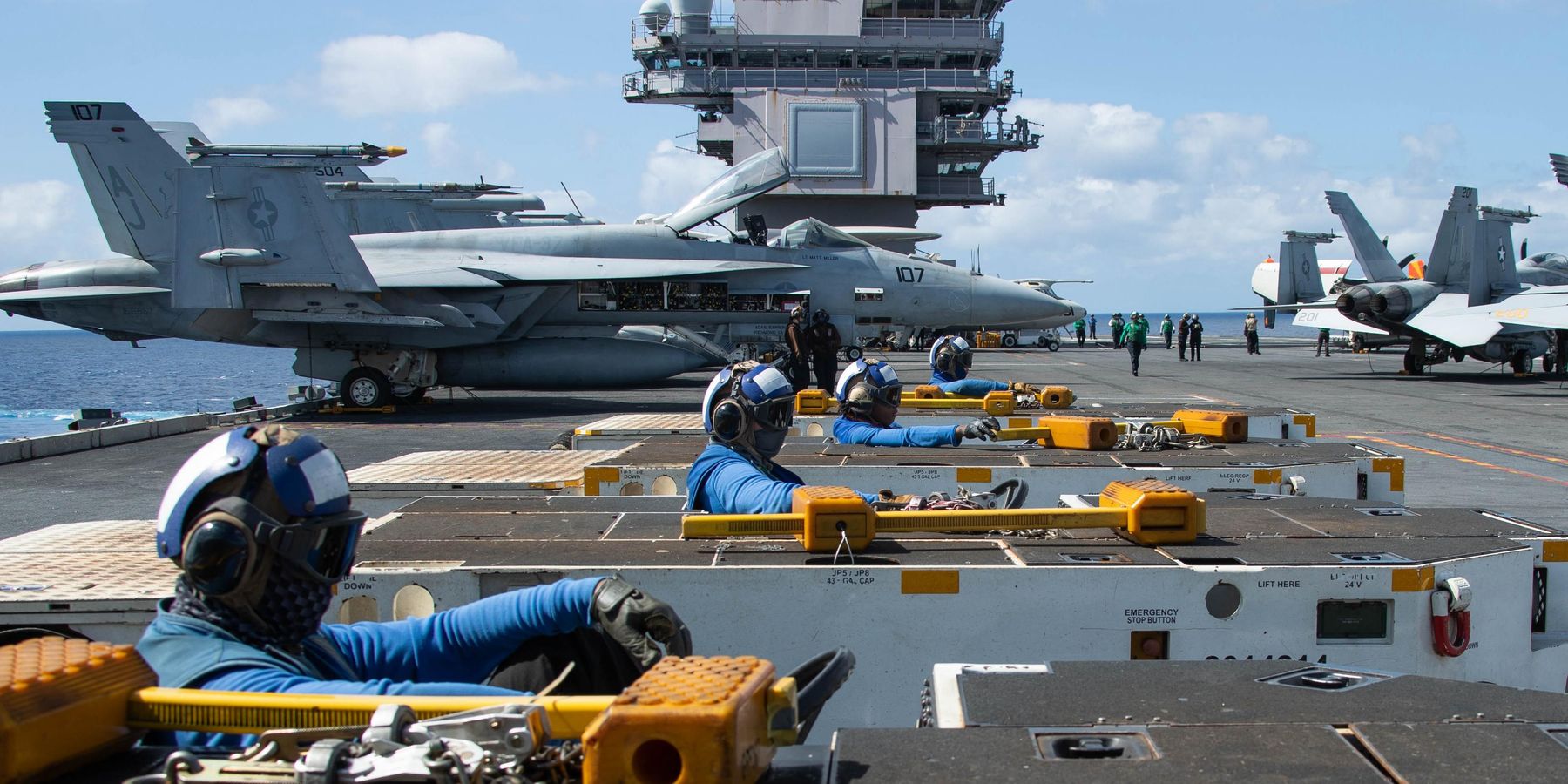
Moreover, Tuesday’s arrival of the Gerald S. Ford carrier strike group, the Navy’s newest, most technologically advanced aircraft carrier with escorts (USS Bainbridge, USS Mahan, and USS Winston Churchill), brings another 4,000 military personnel into the theater, on top of the estimated 10,000 already there.
Washington is also examining sites where it can send additional military assets to, and is building out new construction at its former naval base in Puerto Rico — suggesting what experts fear might be a larger, longer operation in the region.
If anyone benefits from all this, it is the weapons industry.
Indeed, many of the weapons systems and vessels involved in the buildup come with steep price tags. Arleigh-Burke class destroyers cost about $2.5 billion each just to procure. The AC-130J Ghostrider aerial gunship costs a staggering $165 million per unit; the P-8 Poseidon about $83 million per unit, and the Landing Craft Air Cushion (LCAC) hovercraft, which some of the warships are equipped with, cost about $90 million each.
While relevant procurement contracts for those deployed systems are already secured, contractors stand to gain from their maintenance costs and follow-up services while at sea, as sustainment costs account for about 70% of their lifetime cost.
To this end, contractor General Atomics quickly benefitted, receiving a $14.1 billion contract to support the procurement and sustainment of its MQ-9 Reaper Systems in mid-September — soon after the U.S. campaign against alleged drug traffickers in the region began early that month. Remotely-piloted drones known for their striking and reconnaissance capacities, MQ-9 Reaper Systems have been spotted around the Caribbean, carrying out most of the strikes against the boats.
Stephen Semler, journalist and co-founder of the Security Policy Reform Institute, told RS that the five established defense “primes,” including Lockheed Martin, Boeing, and RTX (formerly Raytheon), stand to benefit the most. Although this elite group has been challenged more recently by Silicon Valley defense-tech startups, the primes already receive about one-third of all military weapons contracts in existence.
Lockheed Martin products are especially well-represented in the ongoing military build-up. It’s the prime contractor for the F-35 fighter aircraft, a familiar sight in the region, as well as the AC-130J Ghostrider, which is also operating there. Lockheed Martin also produces the warships' Aegis combat systems, for which the company received a $3.1 billion contract to support this summer. It is also a primary manufacturer of the hellfire missiles likely used in ongoing strikes.
At the end of October, Lockheed also announced a $50 million investment in Saildrone, which has been operating unmanned surface vehicles in the Caribbean for the purposes of counter-narcotics surveillance since February.
Munitions-wise, many of the vessels present in the Caribbean — namely, the Arleigh-Burke class ships, the USS Lake Erie, and USS Newport News — can launch Tomahawk missiles, and are estimated to carry 115 of them. The destroyers escorting the Gerald Ford carrier group bring an estimated 70 more. The missiles, which the Pentagon purchased at an average of $1.3 million, could become an easy money maker for its producer — RTX — if and when the military needs to replenish. The Navy already wants more, authorizing a purchase of 837 RTX-made Maritime Strike Tomahawks, which are upgraded with additional sensing and processing capacities, early last month.
“Beyond the immediate beneficiaries, the entire arms industry is set to profit from the buildup and prospect of war,” Semler told RS. “Lobbying efforts will be built around the prospect of war with Venezuela, having the combined effect of driving up the Pentagon budget, thereby rewarding all military contractors.”
- US strikes are blowing up more than just boats in LatAm ›
- Spineless Congress outdoes itself on Caribbean strikes ›
- 'Reckless' US ops in Caribbean lead to near-miss with Jet Blue plane ›
- US weapons stocks booming, CEOs gloating after Maduro toppled ›
- DoD spent $4.7 billion for Venezeula, Caribbean operations: Report ›