

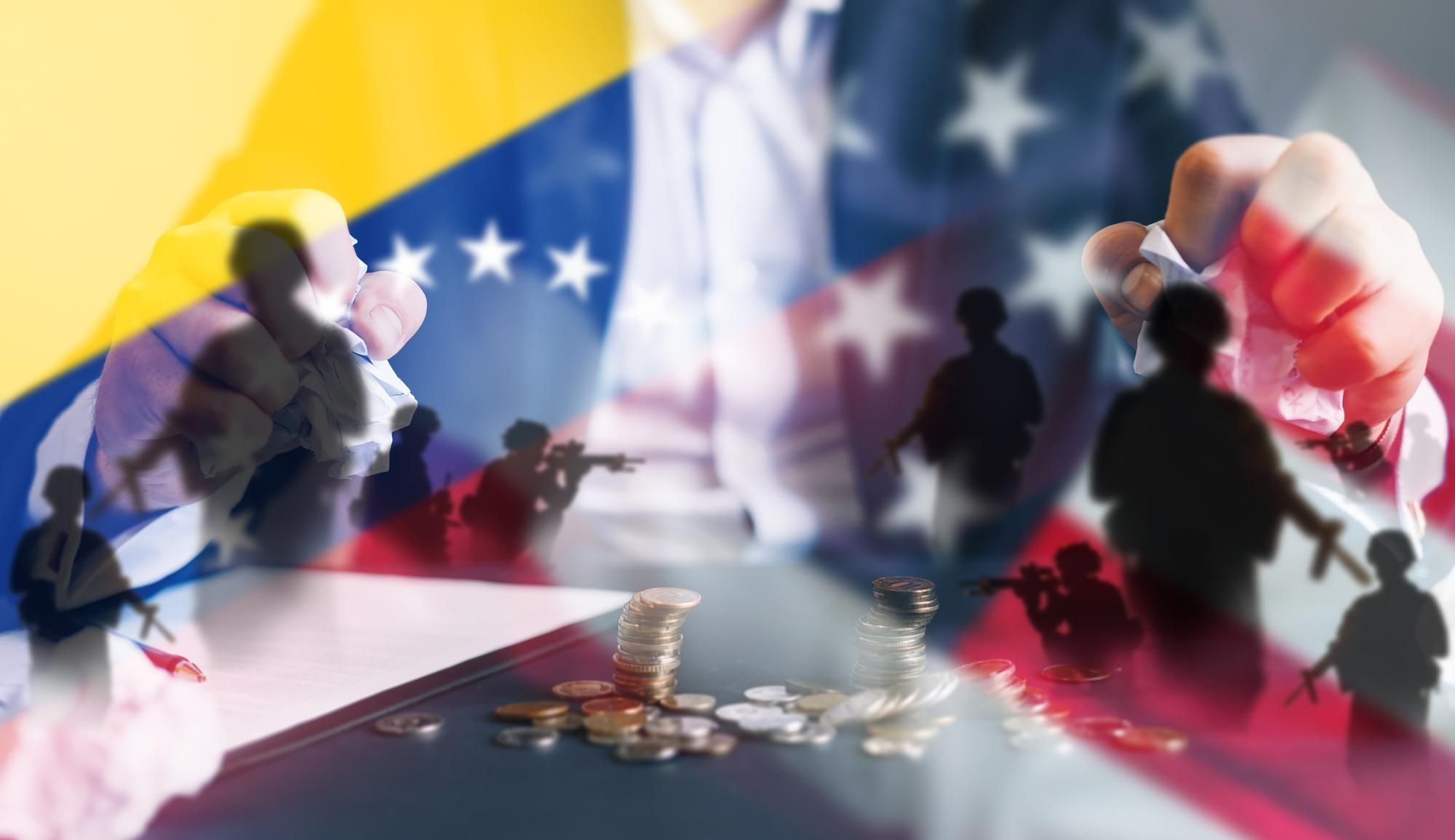
For months, foreign policy analysts have tried reading the tea leaves to understand the U.S. government’s rationale for menacing Venezuela. Trump didn’t leave much for the imagination during a press conference about the U.S. January 3 operation that captured Venezuelan President Nicolas Maduro.
“You know, they stole our oil. We built that whole industry there. And they just took it over like we were nothing. And we had a president that decided not to do anything about it. So we did something about it,” Trump said during a press conference about the operation on Saturday.
It’s not about the drugs —or democracy. In Trump’s telling — at least at that moment — this operation was about oil.
Even before the dust settles, some investors are already responding to this call for foreign investment in the oil industry. A former Chevron executive, Ali Moshiri, told the Financial Times that he is raising $2 billion for Venezuelan oil projects already. “I’ve had a dozen calls over the past 24 hours from potential investors. Interest in Venezuela has gone from zero to 99 per cent,” Moshiri told FT. His firm, Amos Global Energy Management, has already identified Venezuelan assets to invest in.
Charles Myers, chairman of consulting firm Signum Global Advisors, told the Wall Street Journal he is planning a trip to Venezuela in March along with some 20 other hedge funds and asset managers from the finance, energy, and defense sectors. “There is a huge amount of interest in Venezuela reconstruction opportunities,” said Myers.
Venezuela has the world’s largest oil reserves, though underinvestment and sanctions have left the energy infrastructure in poor condition. Plus, Venezuela's reserves are also mostly extra-heavy crude, making it an expensive endeavor to extract. Francisco Monaldi, director of Latin American energy policy at Rice University's Baker Institute for Public Policy, estimated it could require $10 billion per year over the next decade.
To incentivize interest, the Trump administration has been telling oil companies that they could be compensated by the U.S. government for their rigs, pipelines, and other seized properties, if they go back into Venezuela and invest. “A tremendous amount of money will have to be spent, and the oil companies will spend it, and then they’ll get reimbursed by us or through revenue,” Trump said during an NBC interview. U.S. Energy Secretary Chris Wright will meet with representatives of Chevron, ConocoPhillips, and Exxon later this week.
The companies eligible for reimbursement of seized assets could include Exxon and ConocoPhillips, which have long claimed they are owed billions of dollars in compensation from Venezuela over assets seized in 2007 by Maduro’s predecessor, Hugo Chavez. ConocoPhillips and Exxon are seeking $8 billion and $1.6 billion respectively, though Venezuela has consistently refused to pay. With Maduro gone, those companies may have a higher chance of recovering that money if they go back into Venezuela and renegotiate joint ventures with the government. Exxon and ConocoPhillips’ stocks both jumped more than 2% on Monday.
It’s not immediately clear what Delcy Rodriguez, the de facto new president, will do to facilitate American investment. “She's essentially willing to do what we think is necessary to make Venezuela great again,” Trump said to reporters. Rodriguez is credited with helping expand Venezuela’s oil production, impressing Trump administration officials along the way.
Rodriguez has a close relationship with private industry such as Chevron, the only major American company currently operating in Venezuela. Because Chevron is already on the ground and has a close relationship with Rodriguez, the Houston company’s stock is seen as an obvious winner. Chevron’s stock jumped 5% on Monday.
Refiners could also profit from the change in leadership, as more Venezuelan oil reaches American refineries. Marathon and Valero jumped 6% and 9% respectively on Monday.
But it’s Paul Singer, a major Trump donor, who is set to be one of the biggest winners. Singer’s investment firm, Elliot Investment Management, bought Citgo, a subsidiary of Venezuela’s state-run oil company for the bargain price of $5.9 billion. The sale of Citgo to Singer’s firm in November, amid the build-up of military forces in the South Caribbean, was forced by a Delaware court after Venezuela defaulted on its bond payments.
Singer is also a major Trump donor, having donated $5 million to Trump’s super PAC and $1 million to defeat one of Trump’s fiercest Republican critics, Rep. Thomas Massie (R-Ky.). Singer has been called a “vulture” for his tactic of buying up distressed assets, sometimes assisted by longtime ally Secretary of State Marco Rubio. In 2016, then-Senator Rubio pressured Argentina into a payment of $4.6 billion to Singer and other creditors to settle debt they had bought, according to journalist Greg Pallast.
Many oil companies and investors are no doubt concerned about Venezuela’s volatility, the daunting task of extracting heavy crude oil, and the high overhead costs of investment. But not everyone is deterred. Just days out from Maduro’s capture, others are already looking at Venezuela as a boon for their bottom line.