

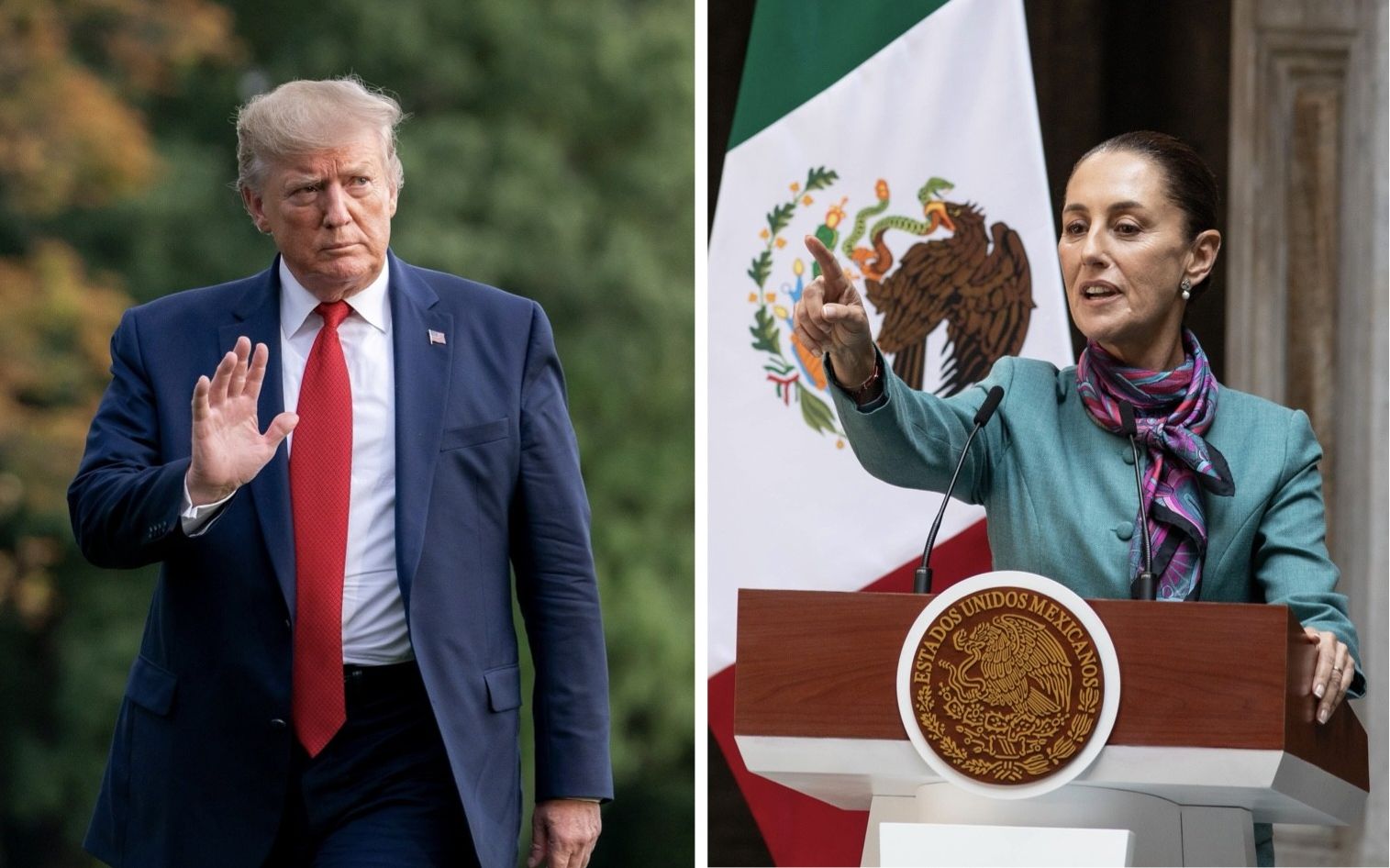
One of the more surprising developments of President Trump’s tenure in office thus far has been the relatively calm U.S. relationship with Mexico, despite expectations that his longstanding views on trade, immigration, and narcotics would lead to a dramatic deterioration.
Of course, Mexico has not escaped the administration’s tariff onslaught and there have been occasional diplomatic setbacks, but the tenor of ties between Trump and President Claudia Sheinbaum has been less fraught than many had anticipated. However, that thaw could be tested soon by economic disagreements as negotiations open on a scheduled review of the U.S.-Mexico-Canada trade agreement (USMCA).State of play
Both the U.S. and Mexico appear to have found a way to cooperate on the key bilateral security issues — like immigration and organized crime — allowing them to compartmentalize these subjects from negotiations over the future of the economic relationship. But the upcoming USMCA review could still be complicated by broader foreign policy questions about supply-chain security, American economic diplomacy in the hemisphere, and the tradeoffs involved in granting market access to the U.S.
When Secretary of State Marco Rubio visited Mexico last week, the U.S. attacked a boat in international waters that was allegedly transporting narcotics for a Venezuelan cartel. In his press conference, Rubio had warnings for Caracas, but was complimentary about his host country, noting that the U.S. has “had a great relationship with the Government of Mexico” adding that “it is the closest security cooperation we have ever had, maybe with any country but certainly in the history of U.S.-Mexico relations.”
The stabilization of ties is in good part a reflection of Sheinbaum’s success in balancing a steadfast insistence on her country’s sovereignty with her ability to deliver on key American demands — such as the extradition of more than 50 alleged drug traffickers to the U.S. in August.
Sheinbaum’s strategy has helped Mexico’s position — for example, the 30% retaliatory tariffs announced on the country in late July have been suspended for 90 days. No such relief was granted to Canada, which got hit right away with 35% tariffs. Similarly, Mexico is doing significantly better than Brazil, where political and foreign policy differences have led to Trump hitting the South American giant with a 50% tariff.
Beyond Sheinbaum’s deft handling of the relationship, there are other factors in play. One is probably the sheer lack of bandwidth as the Trump administration has embarked on a range of tariff, trade, and “deal” initiatives spurred by economic, ideological, and geopolitical motives, such as the recent imposition of a 50% tariff on India. All this frenzied activity has meant that America’s largest trading partner (Mexico accounted for $840 billion of trade in 2024) kept getting pushed to the back of the line for a scarce commodity in Washington — attention.
The sheer volume of bilateral trade points to another factor that might have kept things from spiraling out of control. Mexico plays a critical role in U.S. industrial supply chains, particularly in the automotive sector, where parts and completed vehicles can cross national borders inside USMCA multiple times during the production process. Fear of the ensuing disruptions has likely helped to at least dampen some of the White House’s enthusiasm for tariffs as a method to deliver quick results.
Where does the USMCA review come in?
But that period of calm could end soon with a long-scheduled review of USMCA (which was itself the result of a 2019 renegotiation under Trump of the original 1992 North American Free Trade Agreement). This will set in train a period of contentious talks as the parties review (and effectively renegotiate yet again) a treaty that the U.S. is already ignoring in many respects. The deadline for renegotiation is Oct. 4. Tariffs on items that do not comply with USMCA rules have jumped to 25% (versus 2.5% earlier), and a complicated mechanism for tariff rebates on auto parts imported from Mexico has a two-year sunset clause, hinting strongly at a desire to force that industry to return to the U.S.
Amid all the trade turmoil emanating from Washington, Mexico’s Economy Secretary Marcelo Ebrard has been arguing that, as long as tariffs on his country are lower than those imposed on others, Mexico will still come out ahead. However, even that is now in doubt. The White House’s quest for investment deals with wealthy, industrialized countries could lead to lower tariffs on those countries’ exports to the U.S. than apply to those from Mexico.
For example, the deals with the EU, Japan, and South Korea contain provisions that could lower tariffs on their automobile exports to the U.S. to 15%. Such a step would hurt not just Mexico, but also U.S. automobile manufacturers who have large operations in that country. Ford CEO Jim Farley pointed this out, saying that these deals would give Japanese automakers a big cost advantage over American automakers who have integrated supply chains across all three USMCA members.
Similarly, lower tariffs on imports from outside the USMCA would reduce the incentive for European and Asian auto and parts manufacturers to locate more of their plants in Mexico. This paradoxically puts Mexico in a position where it could become the strongest proponent of what originated as an American idea — the importance of reducing the U.S.’s supply-chain geographic and security vulnerabilities by “nearshoring;” that is, locating a larger portion of the production facilities servicing American markets within USMCA.
Treasury Secretary Scott Bessent invoked a “Fortress North America” in February when he asked Canada to join Mexico in matching U.S. tariffs on China. And Rubio’s first official trip to Bogotá saw him give an address entitled “An Americas First Policy” where he said “relocating our critical supply chains to the Western Hemisphere would clear a path for our neighbors’ economic growth and safeguard Americans’ own economic security.”
Both statements are in line with Mexico’s preferences, as suggested by the recent move to impose 50% tariffs on Chinese automobiles, but could run into two separate obstacles at the upcoming review. The first is that influential constituencies like the autoworkers' union want to push for higher purely American content, i.e., reshoring industry within the borders of the U.S. alone rather than just nearshoring to USMCA countries.
In a brief published in July, I suggested that it might be possible to reconcile the “nearshoring” and “reshoring” agendas by raising the percentage of automobile content required to be manufactured in the U.S., while simultaneously requiring significantly higher USMCA content in electronics and telecommunications. The latter would benefit Mexican manufacturing because the country functions largely as a final assembly point for those industries. And combining an element of automotive reshoring with nearshoring in other critical industries would assuage American concerns about both jobs and supply chain security.
However, this would depend on Washington taking the idea of a deeper North American market that confers both security and regional developmental benefits more seriously instead of treating access to American consumers as a reward for investing in the U.S.
So even if calm continues to prevail on the non-trade issues that precipitated the first round of U.S. tariffs on Mexico in February, other issues arising from different understandings of economics-security linkages could still complicate the USMCA review.